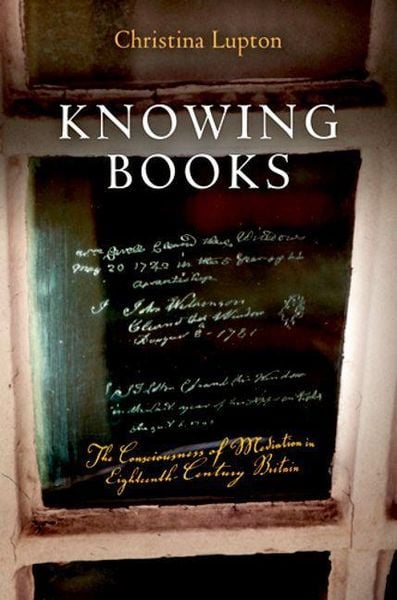
Knowing Books The Consciousness of Mediation in Eighteenth-Century Britain
75,89 €
inkl. gesetzl. MwSt.Beschreibung
Produktdetails
Format
ePUB
Kopierschutz
Nein
Family Sharing
Nein
Text-to-Speech
Ja
Erscheinungsdatum
29.11.2011
Verlag
University of Pennsylvania Press, Inc.Seitenzahl
200 (Printausgabe)
Sprache
Englisch
EAN
9780812205213
The eighteenth century has long been associated with realism and objective description, modes of representation that deemphasize writing. But in the middle decades of the century, Christina Lupton observes, authors described with surprising candor the material and economic facets of their own texts' production. In Knowing Books Lupton examines a variety of eighteenth-century sources, including sermons, graffiti, philosophical texts, and magazines, which illustrate the range and character of mid-century experiments with words announcing their status as physical objects. Books that "know" their own presence on the page and in the reader's hand become, in Lupton's account, tantalizing objects whose entertainment value competes with that of realist narrative.
Knowing Books introduces these mid-eighteenth-century works as part of a long history of self-conscious texts being greeted as fashionable objects. Poststructuralist and Marxist approaches to literature celebrate the consciousness of writing and economic production as belonging to revolutionary understandings of the world, but authors of the period under Lupton's gaze expose the facts of mediation without being revolutionary. On the contrary, their explication of economic and material processes shores up their claim to material autonomy and economic success. Lupton uses media theory and close reading to suggest the desire of eighteenth-century readers to attribute sentience to technologies and objects that entertain them.
Rather than a historical study of print technology, Knowing Books offers a humanist interpretation of the will to cede agency to media. This horizon of theoretical engagement makes Knowing Books at once an account of the least studied decades of the eighteenth century and a work of relevance for those interested in new attitudes toward media in the twenty-first.
Noch keine Bewertungen vorhanden
Verfassen Sie die erste Bewertung zu diesem Artikel
Helfen Sie anderen Kundinnen und Kunden durch Ihre Meinung.
Kurze Frage zu unserer Seite
Vielen Dank für Ihr Feedback
Wir nutzen Ihr Feedback, um unsere Produktseiten zu verbessern. Bitte haben Sie Verständnis, dass wir Ihnen keine Rückmeldung geben können. Falls Sie Kontakt mit uns aufnehmen möchten, können Sie sich aber gerne an unseren Kund*innenservice wenden.
zum Kundenservice