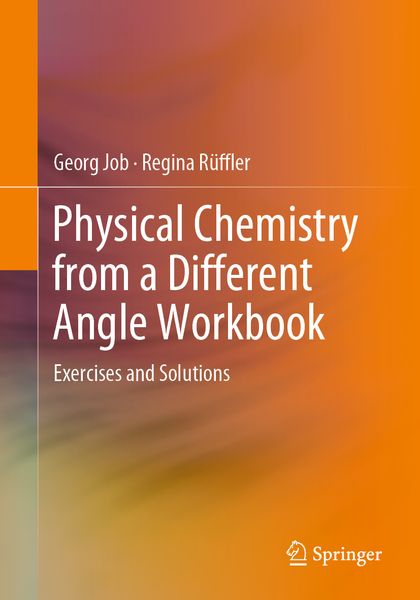

• Produktbild: Physical Chemistry from a Different Angle Workbook
  • Produktbild: Physical Chemistry from a Different Angle Workbook
- 11%

Physical Chemistry from a Different Angle Workbook Exercises and Solutions

11% sparen

62,99 € UVP 71,49 €

inkl. gesetzl. MwSt., Versandkostenfrei


Beschreibung

Produktdetails

Einband

Taschenbuch

Erscheinungsdatum

14.08.2019

Abbildungen

X, 3 illus., 2 illus. in color., farbige Illustrationen, schwarz-weiss Illustrationen

Verlag

Springer

Seitenzahl

291

Maße (L/B/H)

24/16,8/1,7 cm

Gewicht

514 g

Auflage

1st ed. 2019

Sprache

Englisch

ISBN

978-3-030-28490-9

Beschreibung

Produktdetails

Einband

Taschenbuch

Erscheinungsdatum

14.08.2019

Abbildungen

X, 3 illus., 2 illus. in color., farbige Illustrationen, schwarz-weiss Illustrationen

Verlag

Springer

Seitenzahl

291

Maße (L/B/H)

24/16,8/1,7 cm

Gewicht

514 g

Auflage

1st ed. 2019

Sprache

Englisch

ISBN

978-3-030-28490-9

Herstelleradresse

Springer-Verlag KG
Sachsenplatz 4-6
1201 Wien
AT

Email: GPSR Kontakt

Noch keine Bewertungen vorhanden

Verfassen Sie die erste Bewertung zu diesem Artikel

Helfen Sie anderen Kundinnen und Kunden durch Ihre Meinung.

Kundinnen und Kunden meinen

Bewertungen (0)

  • Produktbild: Physical Chemistry from a Different Angle Workbook
  • Produktbild: Physical Chemistry from a Different Angle Workbook
  • 1 Exercises1.1 Introduction and First Basic Concepts1.2 Energy 1.3 Entropy and Temperature  1.4 Chemical Potential                                      1.5 Influence of Temperature and Pressure on Transformations                1.6 Mass Action and Concentration Dependence of Chemical Potential           1.7 Consequences of Mass Action: Acid-Base Reactions                    1.8 Side Effects of Transformations of Substances                       1.9 Coupling                                            1.10 Molecular-Kinetic View of Dilute Gases                          1.11 Substances With Higher Density                                1.12 Spreading of Substances                                     1.13 Homogeneous and Heterogeneous Mixtures                         1.14 Binary Systems                                        1.15 Interfacial Phenomena                                      1.16 Basic Principles of Kinetics                                   1.17 Composite Reactions                                       1.18 Theory of Rate of Reaction                                 1.19 Catalysis                                            1.20 Transport Phenomena                                      1.21 Electrolyte Solutions                                       1.22 Electrode Reactions and Galvani Potential Differences                  1.23 Redox Potentials and Galvanic Cells          

    2 Solutions2.1 Introduction and First Basic Concepts                            2.2 Energy                                               2.3 Entropy and Temperature                                  2.4 Chemical Potential                                      2.5 Influence of Temperature and Pressure on Transformations                2.6 Mass Action and Concentration Dependence of Chemical Potential          2.7 Consequences of Mass Action: Acid-Base Reactions                    2.8 Side Effects of Transformations of Substances                      2.9 Coupling                                            2.10 Molecular-Kinetic View of Dilute Gases                          2.11 Substances With Higher Density                                2.12 Spreading of Substances 2.13 Homogeneous and Heterogeneous Mixtures 2.14 Binary Systems 2.15 Interfacial Phenomena 2.16 Basic Principles of Kinetics 2.17 Composite Reactions 2.18 Theory of Rate of Reaction 2.19 Catalysis 2.20 Transport Phenomena 2.21 Electrolyte Solutions 2.22 Electrode Reactions and Galvani Potential Differences 2.23 Redox Potentials and Galvanic Cells