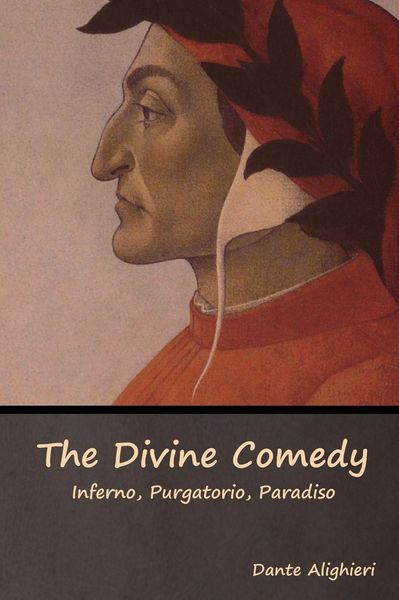
The Divine Comedy Inferno, Purgatorio, Paradiso
-
- Hardcover ausgewählt
- Taschenbuch
- eBook
- Hörbuch
- Leder
-
Sprache:Englisch
-
Verlag:Bibliotech Pr
- Bibliotech Pr 36,99 € ausgewählt
- Engage Classics 39,99 €
- Quarto Publishing Group 19,99 €
- Union Square & Co. 27,99 €
- Flame Tree 25,99 €
- Northwestern University Press 31,99 €
- University Presses 27,99 €
- W. W. Norton & Company 26,99 €
- Alba & Tromm 26,99 €
- Creative Media Partners, LLC 31,99 €
- Angelico Press 34,99 €
- Simon & Brown 38,99 €
- Everyman s Library PRH USA 31,99 €
- Indoeuropeanpublishing.Com 37,99 €
36,99 €
inkl. gesetzl. MwSt.,
Beschreibung
Produktdetails
Einband
Gebundene Ausgabe
Erscheinungsdatum
29.06.2019
Verlag
Bibliotech PrSeitenzahl
302
Maße (L/B/H)
26/18,3/2,1 cm
Gewicht
767 g
Sprache
Englisch
ISBN
978-1-61895-564-7
Durante di Alighiero degli Alighieri, commonly known by his pen name Dante Alighieri or simply as Dante (1265 – 1321), was an Italian poet during the Late Middle Ages. His Divine Comedy, originally called Comedìa (modern Italian: Commedia) and later christened Divina by Giovanni Boccaccio, is widely considered the most important poem of the Middle Ages and the greatest literary work in the Italian language. In the late Middle Ages, most poetry was written in Latin, making it accessible only to the most educated readers. In De vulgari eloquentia (On Eloquence in the Vernacular), however, Dante defended the use of the vernacular in literature. He would even write in the Tuscan dialect for works such as The New Life (1295) and the Divine Comedy; this highly unorthodox choice set a precedent that important later Italian writers such as Petrarch and Boccaccio would follow. Dante was instrumental in establishing the literature of Italy, and his depictions of Hell, Purgatory and Heaven provided inspiration for the larger body of Western art. He is cited as an influence on John Milton, Geoffrey Chaucer and Alfred Tennyson, among many others. In addition, the first use of the interlocking three-line rhyme scheme, or the terza rima, is attributed to him. In Italy, he is often referred to as il Sommo Poeta ("the Supreme Poet") and il Poeta; he, Petrarch, and Boccaccio are also called "the three fountains" or "the three crowns".
Noch keine Bewertungen vorhanden
Verfassen Sie die erste Bewertung zu diesem Artikel
Helfen Sie anderen Kundinnen und Kunden durch Ihre Meinung.
Kurze Frage zu unserer Seite
Vielen Dank für Ihr Feedback
Wir nutzen Ihr Feedback, um unsere Produktseiten zu verbessern. Bitte haben Sie Verständnis, dass wir Ihnen keine Rückmeldung geben können. Falls Sie Kontakt mit uns aufnehmen möchten, können Sie sich aber gerne an unseren Kund*innenservice wenden.
zum Kundenservice