KI-Beratung Beta

Gutscheinbedingungen

**Gültig bis 18.11.2026 auf englischsprachige Klassiker (klassiker-32728) online auf thalia.at und in der Thalia App. Einzelne Artikel können ausgeschlossen sein. Ausgenommen sind preisgebundene Artikel & eBooks. Pro Einkauf einmal einlösbar. Click & Collect nur bei Onlinevorabzahlung möglich. Keine Barauszahlung. Nicht kombinierbar mit anderen Aktionen und Gutscheinen. Gutschein wird auf max. 500€ Bestellwert angerechnet. Nicht gültig für Geschenkkarten, Versandkosten und Services.

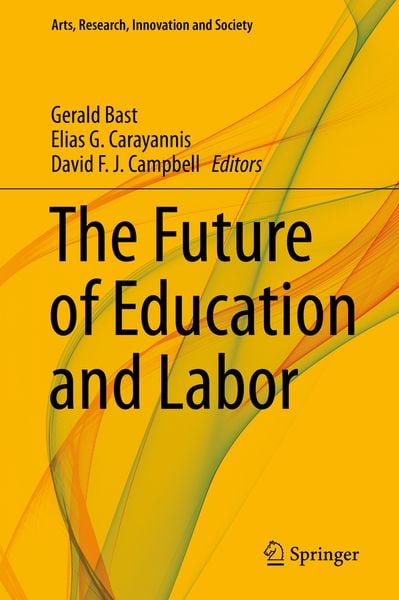
  • Produktbild: The Future of Education and Labor
  • Produktbild: The Future of Education and Labor

The Future of Education and Labor

139,99 €

inkl. gesetzl. MwSt., Versandkostenfrei


Beschreibung

This book explores the ways in which education impacts labor markets. Specifically, the contributions in this book indicate that the future of labor is creative, socially aware and inter-disciplinary while identifying the changes and innovations needed in our educational systems to meet this demand....

Beschreibung

This book explores the ways in which education impacts labor markets. Specifically, the contributions in this book indicate that the future of labor is creative, socially aware and inter-disciplinary while identifying the changes and innovations needed in our educational systems to meet this demand.

Due to an increasing automatization (robotic manufacturing), the character of labor and work in general will change dramatically in the near future. This will be the case not only in the western countries, but also in the larger emerging economies in Asia, for example China and India. While societal environments, economy and the character of labor are increasingly in a process of dramatic changes, the educational systems and the leading principles of research about labor and employment are not changing adequately. Cross-disciplinary (inter-disciplinary and trans-disciplinary) thinking and learning is not the main focus of our educational systems. Consequently, the systems of academic research follow and apply disciplinary or even sub-disciplinary strategies, avoiding cross-disciplinary research approaches, and not supporting inter-disciplinary academic career models. This book introduces such strategic models to better prepare the next generation of workers for the new knowledge economy, and the future of democratic societies.

Portrait


Gerald Bast
is president of the University of Applied Arts Vienna, Austria since 2000. As university president Gerald Bast initiated various new programs and departments focusing on cross-disciplinarity and the interrelation between arts, science and society. He published in the fields of university law, university management as well as educational and cultural policy and lectures globally on the role of art, creativity, innovation and higher education.

Elias G. Carayannis
 is Full Professor of Science, Technology, Innovation and Entrepreneurship, as well as co-Founder and co-Director of the Global and Entrepreneurial Finance Research Institute (GEFRI) and Director of Research on Science, Technology, Innovation and Entrepreneurship, European Union Research Center (EURC), at the School of Business of the George Washington University in Washington, DC.

David F. J. Campbell 
is Associate Professor (Privat-Dozent) in Political Science at theUniversity of Vienna; a Project Manager and Researcher at the Center for Educational Management and Higher Education Development, Department for Continuing Education Research and Educational Technologies, at Danube University Krems; a Quality Enhancement Expert and Quality Researcher at the University of Applied Arts in Vienna; and a Research Fellow (Senior Scientist) at the Institute of Science Communication and Higher Education Research (WIHO), Faculty for Interdisciplinary Studies (iff), Alpen-Adria-University of Klagenfurt.

Produktdetails

Einband

Gebundene Ausgabe

Erscheinungsdatum

19.12.2019

Abbildungen

X, 259 p. 47 illus., 30 illus. in color.

Herausgeber Gerald Bast + weitere

Produktdetails

Einband

Gebundene Ausgabe

Erscheinungsdatum

19.12.2019

Abbildungen

X, 259 p. 47 illus., 30 illus. in color.

Herausgeber
Verlag Springer
Seitenzahl

259

Maße (L/B/H)

24,1/16/2,1 cm

Gewicht

524 g

Auflage

1st ed. 2019

Sprache

Englisch

ISBN

978-3-030-26067-5

Herstelleradresse

Springer-Verlag GmbH
Europaplatz 3
69115 Heidelberg
DE

Email: ProductSafety@springernature.com

Noch keine Bewertungen vorhanden

Verfassen Sie die erste Bewertung zu diesem Artikel

Helfen Sie anderen Kundinnen und Kunden durch Ihre Meinung.

Kundinnen und Kunden meinen

Bewertungen (0)

  • Produktbild: The Future of Education and Labor
  • Produktbild: The Future of Education and Labor

  • Chapter 1: Introduction to The Future of Education and Labor.- Chapter 2: The Future of Education and Labor.- Part One: The Future of Education and Labor, The Economy Does Matter, The How and Why.- Chapter 3: An OECD Learning Framework 2030.- Chapter 4: The Consequences of Industry 4.0 for the Labour Market and Education. Scenario calculations in line with the BIBB-IAB qualifications and occupational field projections.- Chapter 5: The Knowledge Capital of the Network Firm: Socialization versus Business Appropriation of Scientific Work.- Chapter 6: The Co-Evolution of Labor and Creativity: A Way from the “Old” to the “New” Economy.- Chapter 7: Collaborative Creativity and Creative Collaboration as Future Work Paradigms: A Philosophical Conception and Real-Practices. A Case Study of the Practical Case of the Banff Centre.- Chapter 8: The Trends and Prospectives of Professional Economic Education in Russia.- Chapter 9: From Universal “Higher Education for All” to Differentiated “Skills for All” – The Shifting Rationale of The OECD Regarding Education and Labor.- Part Two: The Future of Education and Labor, The Arts Do Matter, The How and Why.- Chapter 10: Artists as Translators in Societal Turns.- Chapter 11: Forward Design. Creative Technologies in Art Education.- Chapter 12: Becoming Worldwide. Transdisciplinary Ways of Collaborations in Philosophy and the Arts––A Case Study.- Chapter 13: Querkraft – Cross-Force – Art as Education. Transversal Practices versus Economic Rationalization.- Chapter 14: Conclusion: The Future of The Future of Education and Labor.- Index.