
Children in Greek Tragedy Pathos and Potential
161,99 €
inkl. gesetzl. MwSt.,
Beschreibung
Produktdetails
Einband
Gebundene Ausgabe
Erscheinungsdatum
20.03.2020
Verlag
Oxford AcademicSeitenzahl
338
Maße (L/B/H)
22,2/14,5/2,2 cm
Gewicht
524 g
Sprache
Englisch
ISBN
978-0-19-882607-1
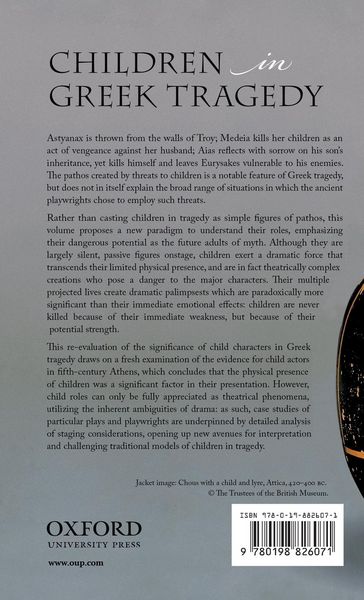
Astyanax is thrown from the walls of Troy; Medeia kills her children as an act of vengeance against her husband; Aias reflects with sorrow on his son's inheritance, yet kills himself and leaves Eurysakes vulnerable to his enemies. The pathos created by threats to children is a notable feature of Greek tragedy, but does not in itself explain the broad range of situations in which the ancient playwrights chose to employ such threats. Rather than casting children in tragedy as simple figures of pathos, this volume proposes a new paradigm to understand their roles, emphasizing their dangerous potential as the future adults of myth. Although they are largely silent, passive figures on stage, children exert a dramatic force that transcends their limited physical presence, and are in fact theatrically complex creations who pose a danger to the major characters. Their multiple projected lives create dramatic palimpsests which are paradoxically more significant than their immediate emotional effects: children are never killed because of their immediate weakness, but because of their potential strength. This re-evaluation of the significance of child characters in Greek tragedy draws on a fresh examination of the evidence for child actors in fifth-century Athens, which concludes that the physical presence of children was a significant factor in their presentation. However, child roles can only be fully appreciated as theatrical phenomena, utilizing the inherent ambiguities of drama: as such, case studies of particular plays and playwrights are underpinned by detailed analysis of staging considerations, opening up new avenues for interpretation and challenging traditional models of children in tragedy.
Noch keine Bewertungen vorhanden
Verfassen Sie die erste Bewertung zu diesem Artikel
Helfen Sie anderen Kundinnen und Kunden durch Ihre Meinung.
Kurze Frage zu unserer Seite
Vielen Dank für Ihr Feedback
Wir nutzen Ihr Feedback, um unsere Produktseiten zu verbessern. Bitte haben Sie Verständnis, dass wir Ihnen keine Rückmeldung geben können. Falls Sie Kontakt mit uns aufnehmen möchten, können Sie sich aber gerne an unseren Kund*innenservice wenden.
zum Kundenservice