KI-Beratung Beta

Gutscheinbedingungen

**Gültig am 25.11.2026 auf fremdsprachige Bücher online auf thalia.at und in der Thalia App. Einzelne Artikel können ausgeschlossen sein. Ausgenommen sind preisgebundene Artikel & eBooks. Pro Einkauf einmal einlösbar. Click & Collect nur bei Onlinevorabzahlung möglich. Keine Barauszahlung. Nicht kombinierbar mit anderen Aktionen und Gutscheinen. Gutschein wird auf max. 500€ Bestellwert angerechnet. Nicht gültig für Geschenkkarten, Versandkosten und Services.

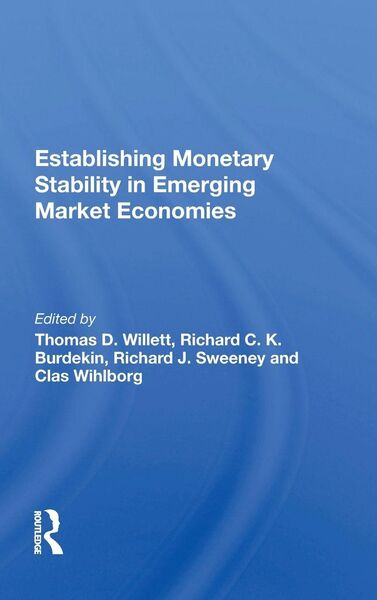
Produktbild: Establishing Monetary Stability in Emerging Market Economies

Establishing Monetary Stability in Emerging Market Economies

284,99 €

inkl. gesetzl. MwSt., Versandkostenfrei


Beschreibung

There has been fierce debate about the optimal sequencing of economic reforms in emerging market economies. Many economists argue that for market-oriented systems to operate effectively, a reasonable degree of monetary stability is necessary. Rampant inflation, a common challenge for emerging economies,...

Beschreibung

There has been fierce debate about the optimal sequencing of economic reforms in emerging market economies. Many economists argue that for market-oriented systems to operate effectively, a reasonable degree of monetary stability is necessary. Rampant inflation, a common challenge for emerging economies, greatly reduces the chances that market-oriented reforms will be successful. In this comprehensive volume, a group of policy-oriented economists from North America, Europe, and the former Soviet Union explore the causes of monetary instability in reforming economies and evaluate alternative institutional mechanisms designed to reduce inflationary pressures. Considering the latest theoretical and empirical research-as well as the experiences of former Communist countries, including Russia and the erstwhile Soviet republics-the contributors view inflation as a political issue and make a case for the creation of strong political institutions. They argue that although government actions that stimulate inflation tend to have low costs or even benefits in the sort run, they impose heavy costs on the economy in the longer term. Consequently, there is a strong need to develop institutional mechanisms to help ensure that decision makers place appropriate emphasis on the long-run consequences of policy actions.

Produktdetails

Einband

Gebundene Ausgabe

Erscheinungsdatum

07.06.2019

Herausgeber Thomas D. Willett
Verlag Taylor and Francis

Produktdetails

Einband

Gebundene Ausgabe

Erscheinungsdatum

07.06.2019

Herausgeber Thomas D. Willett
Verlag Taylor and Francis
Seitenzahl

280

Maße (L/B/H)

22,9/15,2/1,8 cm

Gewicht

544 g

Sprache

Englisch

ISBN

978-0-367-01700-2

Herstelleradresse

Libri GmbH
Europaallee 1
36244 Bad Hersfeld
DE

Email: gpsr@libri.de

Noch keine Bewertungen vorhanden

Verfassen Sie die erste Bewertung zu diesem Artikel

Helfen Sie anderen Kundinnen und Kunden durch Ihre Meinung.

Kundinnen und Kunden meinen

Bewertungen (0)

Die Leseprobe wird geladen.
  • Produktbild: Establishing Monetary Stability in Emerging Market Economies
  • Introduction: The Political Economy of Establishing Monetary Stability -- Aspects of the Political Economy of Inflation -- The High Costs of Monetary Instability -- Budget Deficits and Inflation: The Importance of Budget Controls for Monetary Stability -- Inflation and Optimal Seigniorage in the CIS and Eastern Europe -- The Politics of Inflation: An Empirical Assessment of the Emerging Market Economies -- Institutional Mechanisms for Promoting Economic Stability -- Guidelines for Constructing Monetary Constitutions -- Designing Central Bank Arrangements to Promote Monetary Stability -- Central Banking in Economies in Transition -- Alternative Approaches to Monetary Reform in the Formerly Communist Countries: A Parallel Strategy -- Case Studies -- The Russian Central Bank and the Conduct of Monetary Policy -- Impediments to the Macroeconomic Stabilization of Russia -- The Collapse of the Ruble Zone, 1991-93 -- The Latvian Monetary Reform -- Fiscal and Monetary Policies in the Transition: Searching for the Credit Crunch