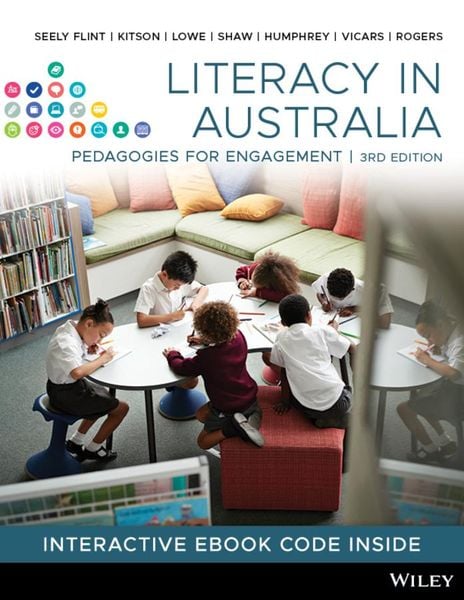
Produktbild: Literacy in Australia: Pedagogies for Engagement, 3rd Edition

Literacy in Australia: Pedagogies for Engagement, 3rd Edition

82,99 €

inkl. gesetzl. MwSt., Versandkostenfrei


Produktdetails

Einband

Taschenbuch

Erscheinungsdatum

30.09.2019

Verlag

Wiley

Seitenzahl

464

Maße (L/B/H)

27,7/21,6/1,5 cm

Gewicht

930 g

Auflage

3rd edition

Sprache

Englisch

ISBN

978-0-7303-6924-0

Produktdetails

Einband

Taschenbuch

Erscheinungsdatum

30.09.2019

Verlag

Wiley

Seitenzahl

464

Maße (L/B/H)

27,7/21,6/1,5 cm

Gewicht

930 g

Auflage

3rd edition

Sprache

Englisch

ISBN

978-0-7303-6924-0

Herstelleradresse

Libri GmbH
Europaallee 1
36244 Bad Hersfeld
DE

Email: gpsr@libri.de

Noch keine Bewertungen vorhanden

Verfassen Sie die erste Bewertung zu diesem Artikel

Helfen Sie anderen Kundinnen und Kunden durch Ihre Meinung.

Kundinnen und Kunden meinen

Bewertungen (0)

Weitere Artikel finden Sie in

  • Produktbild: Literacy in Australia: Pedagogies for Engagement, 3rd Edition
  • About the adapting authors viii

    Chapter 1 Examining literacy in the twenty-first century 1

    1.1 Mind the gap: literacy practices in school and outside of school 5

    1.2 Perspectives on what it means to be literate 7

    1.3 Models of schooling that affect literacy development 8

    Learning as skill building: industrial model 9

    Investigating a question: inquiry model 12

    Problematising the status quo: critical model 14

    1.4 Six guiding principles for teaching reading and writing in the twenty-first century 16

    Principle 1: literacy practices are socially and culturally constructed 16

    Principle 2: literacy practices are purposeful 17

    Principle 3: literacy practices contain ideologies and values 18

    Principle 4: literacy practices are learned through inquiry 19

    Principle 5: literacy practices invite readers and writers to use their background knowledge and cultural understandings to make sense of texts 20

    Principle 6: literacy practices expand to include everyday texts and multimodal texts 22

    1.5 The Australian Curriculum 24

    1.6 Creating a vision for effective literacy instruction 25

    Chapter 2 Talking to learn in and out of the classroom 31

    2.1 Spoken language development 33

    Learning to talk 33

    Pointing, imitating and pretending: the origins of literacy 34

    Meaning, language and learning 35

    From home to school 36

    From everyday knowledge to educational knowledge 36

    Learning language, learning through language, learning about language 37

    Conditions for language learning 37

    2.2 Spoken language use and language variation 38

    Language variation in response to cultural and social contexts 40

    Variations in spoken language 40

    English language variation and language standard 41

    Language variation as a resource for learning 47

    2.3 Language and literacy in the curriculum: implications for teaching literacy 50

    2.4 Learning language 52

    Learning through language 55

    2.5 Learning about language 56

    A language for talking about language: metalanguage 57

    Knowledge about sounds and graphic symbols 58

    Knowledge about grammar, words and punctuation 61

    Meaning 62

    Chapter 3 Getting to know students: Developing culturally relevant practices for reading and writing 68

    3.1 Examining cultural diversity in classroom settings 70

    Recognising differences in literacy learning within the classroom 71

    Learning about home and community practices 72

    3.2 Teaching from a culturally relevant perspective 75

    3.3 Supporting linguistically diverse learners in reading and writing 76

    Connecting students' background knowledge and personal experiences to literacy events 77

    Creating opportunities for students to meaningfully and authentically apply oral language skills 78

    Encouraging students' primary language and/or code switching during literacy events 79

    Contextualising instruction of language through authentic literature 79

    Documenting students' home and community literacy practices 80

    Establishing culturally relevant interaction patterns in literacy events 82

    3.4 Using early assessment to know your students 85

    3.5 Kid-watching 86

    3.6 Attitudes and interest in reading and writing 89

    Attitude questionnaires and surveys 89

    Interviews 90

    Chapter 4 Theories of literacy development 95

    4.1 What does theory have to do with curriculum building? 98

    Uncovering your beliefs about teaching and instruction 99

    4.2 Four classroom portraits and four theories of literacy development 99

    Ms Robyn Teal's classroom: learning to read means focusing on skills 100

    Bottom-up theory of literacy development 102

    Ms Cheryl Battle's classroom: learning to read means understanding the meaning of words 104

    Mr Thomas Ruby's classroom: learning to read means learning how to respond to a text 109

    Ms Pauline Fuller's classroom: learning to read means critically examining the text 114

    4.3 Reading models for the twenty-first century classroom 119

    Chapter 5 Literacy programs and approaches 124

    5.1 Approaches to literacy education 126

    Basic skills: grammar conventions, decoding and drills 127

    Whole language: authentic texts and meaning making 129

    Focus on social practice: situated literacies 130

    Text-based literacy and multiliteracy approaches 130

    The current situation in Australia 131

    5.2 Classroom approaches to literacy programs 133

    Developing or adapting a program 133

    Theme and concept-based units 134

    Literature-based units 135

    5.3 Resourcing your classroom literacy program 137

    5.4 Scaffolding for literacy 139

    The gradual release of responsibility model 140

    The teaching learning cycle 140

    Reading to learn 141

    5.5 Reading and writing procedures within a scaffolding cycle 141

    Establishing a shared context 141

    Scaffolding for reading and viewing 142

    Modelling language and strategies for reading 143

    Scaffolding for composition 147

    5.6 Structure of literacy instruction 152

    Commercial literacy programs 153

    5.7 Creating a literacy-rich environment 154

    Spaces and places in the classroom to support literacy development 154

    Chapter 6 Entering into the literacy landscape: Emergent readers and writers 162

    6.1 Historical beginnings of emergent literacy 164

    Reading readiness 165

    Emergent literacy 167

    6.2 Oral language learning: what it means for emergent reading and writing practices 170

    Conditions for developing oral language skills 171

    Conditions to support young English language learners (ELLs) in preschool settings 172

    Dimensions of emergent literacy 173

    Concepts of texts 175

    Concepts of words 177

    Concepts of letters and sounds 178

    Assessing the dimensions of emergent literacy 180

    6.3 Emergent writing 181

    Inventing and refining written language forms 182

    Emergent spelling 183

    Emergent writing and meaning making 187

    6.4 Literacy and technology in early literacy settings 188

    Concepts of screen 188

    Reading on devices 188

    6.5 Literacy events and practices: promoting emergent reading and writing 190

    Make use of environmental print 190

    Writing centres 191

    Reading aloud 192

    Reading aloud as a cultural practice 193

    Sociodramatic play settings 194

    Language experience approach stories (LEA) and the digital language experience approach (D-LEA) 195

    Chapter 7 Beginning readers and writers 203

    7.1 Guiding principles to promote beginning reading and writing 205

    7.2 Exploring beginning reading through the four-resource model 210

    Code breaking to exemplify how words work 211

    Becoming a text participant 221

    Understanding how texts are used 225

    Text analyst - thinking critically about texts 226

    7.3 Literacy blocks for beginning readers 227

    Creating a routine for primary level literacy blocks 228

    Teacher-led inquiries 229

    Reading and responding 230

    7.4 Connections to national achievement standards 243

    Chapter 8 Intermediate and accomplished readers and writers 250

    8.1 Needs and characteristics of students in middle to upper primary 252

    8.2 Guiding principles for intermediate and accomplished readers and writers 253

    8.3 What do we teach intermediate and accomplished readers and writers? 256

    8.4 Key understandings about multimodal and digital texts 259

    8.5 How do we teach intermediate and accomplished readers and writers? 261

    Selecting texts for intermediate and accomplished readers 262

    Reading and writing conferences 263

    8.6 The four-resource model for intermediate and accomplished readers and writers 264

    Code breaking for intermediate and accomplished readers 265

    Text participant practices with intermediate and accomplished readers 272

    Text use with intermediate and accomplished readers and writers 282

    Developing critical practices with intermediate and accomplished readers 284

    Chapter 9 Effective assessment practices for reading and writing 293

    9.1 Formative and summative assessments 295

    9.2 Tests and assessments in schools 296

    National Assessment Program - Literacy and Numeracy (NAPLAN) 296

    Purposes for assessments 299

    Literacy assessments reveal ideologies about learning and literacy 301

    9.3 The cycle of reflection-assessment-instruction 302

    9.4 Traditional and authentic assessment practices 304

    Who is interested in assessment? High stakes for parents, teachers and schools 304

    Authentic assessment practices 305

    Types of authentic assessment practices 306

    9.5 Gathering information to use in assessing readers' and writers' growth in literacy development 316

    Portfolio systems 317

    9.6 Assessment practices align with code breaking, text meaning, text use and critical practices 318

    Code-breaking assessment 319

    Text participant assessments 322

    Text use assessments 325

    Critical practices assessments 325

    Chapter 10 Literature in the classroom 329

    10.1 What is literature? 331

    The picturebook 332

    Graphic novels and manga 334

    E-literature 336

    Film and television 337

    10.2 Literature and context 338

    Historical, cultural and social contexts 338

    10.3 Responding to literature 340

    Reader-response theory 341

    Take a stance: a reader's purpose and attitude 342

    10.4 Goals for literature discussions 345

    Response and interpretive authority 346

    Teacher-led discussions 347

    Teacher-led, student-centred discussions 347

    Student-led discussions 348

    10.5 Examining literature for its features and language 350

    Key features of literary texts 351

    The language of literary texts 352

    10.6 Creating literary texts 355

    Author craft 356

    Poetry 357

    Innovation on a text 357

    Digital storytelling 358

    Chapter 11 ICTs and reading to learn in the content areas 365

    11.1 Reading to learn: the literacy demands in content areas 367

    Literacy demands in humanities and social sciences 371

    Literacy demands in science 372

    Literacy demands in mathematics 373

    11.2 Technology and literacy 374

    11.3 Integrating ICTs and literacy in the content areas 377

    ICT capability across the content areas 380

    11.4 Using inquiry-based learning 382

    Key principles of inquiry-based learning 383

    The teacher's role in inquiry-based learning 384

    Selecting an inquiry topic 385

    Planning for inquiry in the classroom 386

    11.5 Using texts to develop knowledge and literacy in the content areas 389

    Reading and writing to learn in the content areas 389

    Using resources to develop knowledge and understanding in the content areas 390

    11.6 Teaching strategies for reading and writing in the content areas 396

    Read informative texts aloud 397

    Provide time to read in content areas 398

    Scaffolding creating and communicating with ICTs 398

    11.7 Developing literate practices in the content areas: the four-resource model 399

    Code-breaking practices 399

    Text participant practices 402

    Chapter 12 Working with struggling readers and writers 411

    12.1 Factors that contribute to struggling reading and writing 413

    Cognitive processing 414

    Motivation and engagement 414

    Teachers' and parents' beliefs and attitudes 419

    12.2 Identifying struggling readers and writers during literacy events 420

    12.3 Instructional practices for struggling readers and writers 421

    Echo reading 422

    Shared reading 423

    Neurological impress method (NIM) 423

    Interest and background 423

    Read-alouds to extend comprehension and pave the way forward for readers' choices 424

    Voluntary free reading time 425

    Buddy reading 426

    Reading all day across all curriculum areas 427

    Scaffolding 428

    Comprehension monitoring strategies 429

    12.4 Supporting struggling readers through parent education 431

    Creating partnerships with parents and carers 433

    12.5 Teaching all children to lead literate lives in the twenty-first century 435

    Index 443