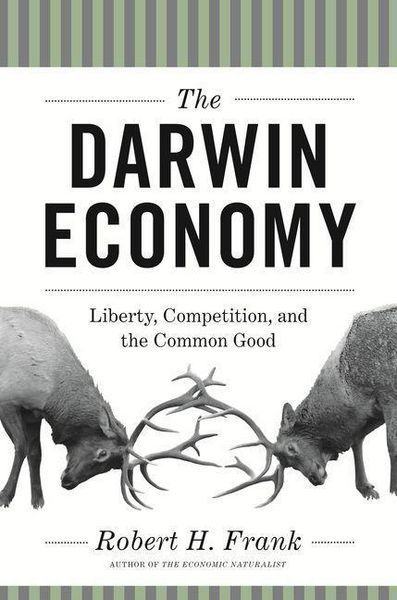
Darwin Economy Liberty, Competition, and the Common Good
-
- Taschenbuch
- eBook ausgewählt
-
Form:Einzelkauf Download
-
Sprache:Englisch
-
eBook Format:PDF
- PDF 18,69 € ausgewählt
- ePUB 28,80 €
18,69 €
inkl. gesetzl. MwSt.Beschreibung
Produktdetails
Format
Kopierschutz
Ja
Family Sharing
Ja
Text-to-Speech
Ja
Erscheinungsdatum
16.09.2012
Verlag
Princeton University PressSeitenzahl
272 (Printausgabe)
Dateigröße
438 KB
Sprache
Englisch
EAN
9781400844982
What Charles Darwin can teach us about building a fairer society
Who was the greater economist-Adam Smith or Charles Darwin? The question seems absurd. Darwin, after all, was a naturalist, not an economist. But Robert Frank, New York Times economics columnist and best-selling author of The Economic Naturalist, predicts that within the next century Darwin will unseat Smith as the intellectual founder of economics. The reason, Frank argues, is that Darwin's understanding of competition describes economic reality far more accurately than Smith's. And the consequences of this fact are profound. Indeed, the failure to recognize that we live in Darwin's world rather than Smith's is putting us all at risk by preventing us from seeing that competition alone will not solve our problems.
Smith's theory of the invisible hand, which says that competition channels self-interest for the common good, is probably the most widely cited argument today in favor of unbridled competition-and against regulation, taxation, and even government itself. But what if Smith's idea was almost an exception to the general rule of competition? That's what Frank argues, resting his case on Darwin's insight that individual and group interests often diverge sharply. Far from creating a perfect world, economic competition often leads to "arms races," encouraging behaviors that not only cause enormous harm to the group but also provide no lasting advantages for individuals, since any gains tend to be relative and mutually offsetting.
The good news is that we have the ability to tame the Darwin economy. The best solution is not to prohibit harmful behaviors but to tax them. By doing so, we could make the economic pie larger, eliminate government debt, and provide better public services, all without requiring painful sacrifices from anyone. That's a bold claim, Frank concedes, but it follows directly from logic and evidence that most people already accept.
In a new afterword, Frank further explores how the themes of inequality and competition are driving today's public debate on how much government we need.
Noch keine Bewertungen vorhanden
Verfassen Sie die erste Bewertung zu diesem Artikel
Helfen Sie anderen Kundinnen und Kunden durch Ihre Meinung.
Kurze Frage zu unserer Seite
Vielen Dank für Ihr Feedback
Wir nutzen Ihr Feedback, um unsere Produktseiten zu verbessern. Bitte haben Sie Verständnis, dass wir Ihnen keine Rückmeldung geben können. Falls Sie Kontakt mit uns aufnehmen möchten, können Sie sich aber gerne an unseren Kund*innenservice wenden.
zum Kundenservice