KI-Beratung Beta

Gutscheinbedingungen

**Gültig bis 18.11.2026 auf englischsprachige Klassiker (klassiker-32728) online auf thalia.at und in der Thalia App. Einzelne Artikel können ausgeschlossen sein. Ausgenommen sind preisgebundene Artikel & eBooks. Pro Einkauf einmal einlösbar. Click & Collect nur bei Onlinevorabzahlung möglich. Keine Barauszahlung. Nicht kombinierbar mit anderen Aktionen und Gutscheinen. Gutschein wird auf max. 500€ Bestellwert angerechnet. Nicht gültig für Geschenkkarten, Versandkosten und Services.

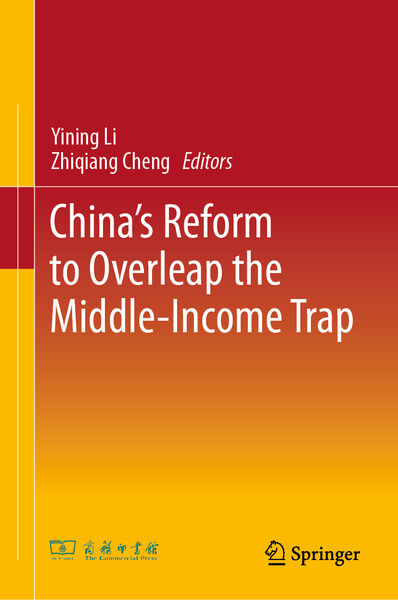
Produktbild: China’s Reform to Overleap the Middle-Income Trap
- 11%

China’s Reform to Overleap the Middle-Income Trap

11% sparen

96,99 € UVP 109,99 €

inkl. gesetzl. MwSt., Versandkostenfrei


Beschreibung

This book addresses how China could avoid the middle-income trap. Professor Li Yining proposed the framework and wrote the first article. Under Li’s guidance, other articles were written by researchers at the Guanghua School of Management, Peking University. It is well known that China's reform has been...

Beschreibung

This book addresses how China could avoid the middle-income trap. Professor Li Yining proposed the framework and wrote the first article. Under Li’s guidance, other articles were written by researchers at the Guanghua School of Management, Peking University. It is well known that China's reform has been highly successful, but there are still many unsolved institutional problems. The book’s authors suggest that the middle-income trap is composed of three traps. Firstly, there is the “development system trap”. Secondly,  the “social crisis trap ” and finally, the “technology trap”. In order to avoid these traps, it is important for China to intensify its economic reform, to lessen the gap between the rich and poor, and to enhance innovations in technology as well as the capital market.This book uses both theoretical and case studies to discuss agricultural modernization, new urbanization, the urban-rural gap, income growth, community management, pastoral areas of medicine and the newly-industrializing economy, etc.

Portrait


Li Yining, born in Yizheng of Jiangsu Province, is a professor of Peking University. He is also the director of Social Science Department and honorary president of Guanghua School of Management, Peking University. 
Cheng Zhiqiang, born in Chunhua of Shanxi Province, is a Ph.D. of Economics. He is also a part-time professor of Guanghua School of Management, Peking University and the director of China Postdoctoral Science Foundation.

Produktdetails

Einband

Gebundene Ausgabe

Erscheinungsdatum

24.07.2019

Abbildungen

XXI, 270 p. 28 illus., 5 illus. in color.

Herausgeber Yining Li + weitere

Produktdetails

Einband

Gebundene Ausgabe

Erscheinungsdatum

24.07.2019

Abbildungen

XXI, 270 p. 28 illus., 5 illus. in color.

Herausgeber
Verlag Springer Singapore
Seitenzahl

270

Maße (L/B/H)

24,1/16/2,2 cm

Gewicht

554 g

Auflage

1. Auflage

Sprache

Englisch

ISBN

978-981-13-9220-7

Herstelleradresse

Springer-Verlag KG
Sachsenplatz 4-6
1201 Wien
AT

Email: ProductSafety@springernature.com

Noch keine Bewertungen vorhanden

Verfassen Sie die erste Bewertung zu diesem Artikel

Helfen Sie anderen Kundinnen und Kunden durch Ihre Meinung.

Kundinnen und Kunden meinen

Bewertungen (0)

  • Produktbild: China’s Reform to Overleap the Middle-Income Trap

  • Chapter1 An Analysis of the Factors affecting New-Generation Peasant Workers’ Decision-making of Vocational Training Participation —A Micro Perspective.- Chapter2 A Theoretical and Empirical Study on over-leaping the Middle Income Trap.- Chapter3 Middle Income Trap and the Innovation of China’s Rural Land Financial Institutions.- Chapter4 A Study on the Income Disparity of Aged Population and Social Security Institutions.- Chapter5 Reform Forest Property Institution to Overleap the Middle Income Trap.- Chapter6 Overleaping the Middle Income Trap and the Innovation of Rural Production-Operation-Management System.- Chapter7 A Study on The Significance of Small and Medium Enterprises Development for China to Overleap the Middle Income Trap.- Chapter8 Bank Credit Financing Predicament for Small and Micro Enterprises —Reasons and Inspirations.- Chapter9 Overleaping the Middle Income Trap and Social Governance Reform —From the Perspective of Authoritarian Government Transformation.- Chapter10 Narrowing the Income Gap between Urban and Rural Residents —A Case Study of Beijing.- Chapter11 Building a Long-term Income Growth Mechanism for Peasants’ to Overleap the Middle Income Trap —A Case Study of Suizhou, Hubei Province.- Chapter12 Statistical Monitoring Indicator System on Building a Well-off Society and Overleaping the Middle Income Trap —A Case Study of a Resource-based City in Western China.- Chapter13 Survey Research on Community Management Innovation and Overleaping the Middle Income Trap —A Case Study of Xi’an District, Mudanjiang City, Heilongjiang Province.- Chapter14 The Practices of Overleaping the Middle Income Trap via New Industrialization —A Case Study of Dazu District in Chongqing.- Chapter15 The Practices of over-leaping the Middle Income Trap in the Primary-level Health Care in Pastoral Areas —A Case Study of Chifeng City in Inner Mongolia.- Chapter16 New Urbanization and Overleaping the Middle Income Trap —A Case Study of Henan Province.- Chapter17 Agricultural Modernization and Overleaping the Middle Income Trap —A Case Study of Japan.