Gutscheinbedingungen

**Gültig bis 17.08.2026 auf Schreibwaren & Office-Artikel online auf thalia.at, in der Thalia App und in teilnehmenden Thalia Buchhandlungen in Österreich mit Schulsortiment. In den Buchhandlungen nur gültig auf lagernde Ware. Einzelne Artikel können ausgeschlossen sein. Ausgenommen sind preisgebundene Artikel. Pro Einkauf einmal einlösbar. Nur gültig gegen Vorlage oder im Onlineshop hinterlegter Bonuscard. Infos zur Einlösung in der Buchhandlung sind auf der Bonuscard-Vorteilspreisseite zu finden. Click & Collect nur bei Onlinevorabzahlung möglich. Keine Einlösung bei Scan & Go-Bezahlung. Keine Barauszahlung. Nicht kombinierbar mit anderen Aktionen und Gutscheinen. Gutschein wird auf max. 500€ Bestellwert angerechnet. Nicht gültig für Geschenkkarten, Versandkosten und Services.

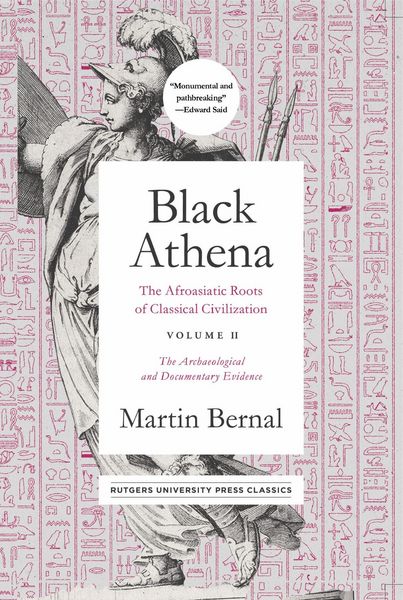
Produktbild: Black Athena

Black Athena The Afroasiatic Roots of Classical Civilization Volume II: The Archaeological and Documentary Evidence Volume 2

47,99 €

inkl. gesetzl. MwSt., Versandkostenfrei


Beschreibung

Produktdetails

Einband

Taschenbuch

Erscheinungsdatum

14.02.2020

Verlag

Rutgers University Press

Seitenzahl

938

Maße (L/B/H)

20,4/13,1/5,4 cm

Gewicht

938 g

Sprache

Englisch

ISBN

978-1-978804-27-2

Beschreibung

Rezension

"Martin Bernal's Black Athena is nothing short of a monumental achievement in scholarship that re-oriented and transformed serious study of ancient civilizations. It remains a soaring accomplishment of classical erudition of the Afroasiatic foundation of Greek history." - Molefi Kete Asante (author of The History of Africa, Professor, Department of Africology, Temple University) "In a spectacular undertaking, Martin Bernal sets out to... restore the credibility of what he calls the Ancient Model of the beginnings of Greek civilizations... Bernal makes an exotic interloper in Classical studies. He comes to them with two outstanding gifts: a remarkable flair for the sociology - perhaps one should say politics - of knowledge, and a formidable linguistic proficiency... The story told by Bernal, with many fascinating twists and turns and quite a few entertaining digressions, is... a critical inquiry into a large part of the European imagination... a retrospect of ingenious and often sardonic erudition." - Perry Anderson (The Guardian) "An astonishing work, breathtakingly bold in conception and passionately written... salutary, exciting, and, in its historiographical aspects, convincing." - G. W. Bowersock (Journal of Interdisciplinary History) "A work which has much to offer the lay reader, and its multi-disciplinary sweep is refreshing: it is an important contribution to historiography and the sociology of knowledge, written with elegance, wit, and self-awareness... a thrilling journey... his account is as gripping a tale of scholarly detection and discovery as one could hope to find." - Margaret Drabble (The Observer) "Bernal's material is fascinating, his mind is sharp, and his analyses convince." - Richard Jenkyns (Times Higher Educational Supplement) "A formidable work of intellectual history, one that demonstrates that the politics of knowledge is never far from national politics." (Christian Science Monitor) "His book should be welcome to both classicists and ancient historians, most of whom will, now at least, be inclined to agree with him." - R. A. McNeal (Franklin and Marshall College) "Bernal's work and the stir it has occasioned have caused ancient historians and archaeologists to undertake a major reexamination of methods and motives." - Robert L. Pounder (American Historical Review) "Colossal.... Bernal aims to revise current understanding of Ancient Middle Eastern history by taking seriously the ancient Greeks' legends that portrayed much in their civilization as originating in the Middle East, especially Egypt." (New York Times Book Review) "Demands to be taken seriously... Every page that Bernal writes is educating and enthralling. To agree with all his thesis may be a sign of naivety, but not to have spent time in his company is a sign of nothing at all." (Times Literary Supplement) "A serious work that deals in a serious way with many of the principal issues of Aegean history in the second millennium B.C., and one can ask little more of any historical work." - Stanley M. Burstein, California State University (Classic Philology) "[Bernal's] multifaceted assault on academic complacency is an important contribution to the development of a more open, historical, and culturally oriented post-processual archaeology." (Current Anthropology) "A breathtaking panoply of archaeological artifacts, texts, and myths." (Toronto Star) "Bernal's enterprise - his attack on the Aryan model and his promotion of a new paradigm - will profoundly mark the next century's perception of the origins of Greek civilization and the role of Ancient Egypt." (Transition) "Challenges the racism implicit in the recent 'cultural literacy' movement." (Socialist Review) "A monumental and path-breaking work." - Edward Said "[Martin Bernal] has forced scholars to reexamine the roots of Western civilization." (Newsweek) "Martin Bernal has managed to make the subject of Ancient Greece both popular and controversial." (Baltimore Sun) "Black Athena is a powerfully written and brilliantly researched book that relentlessly unveils the historical and cultural African origins of Western civilization. Still a must read for all those in search of truth."
- Ama Mazama (Professor of Africology and African American Studies, Temple University) "Bernal has ample justification for calling into question many widely accepted hypotheses.... He shows that Egypt and its culture were misrepresented or simply ignored by European writers." - Mary Lefkowitz (Newsweek)

Produktdetails

Einband

Taschenbuch

Erscheinungsdatum

14.02.2020

Verlag

Rutgers University Press

Seitenzahl

938

Maße (L/B/H)

20,4/13,1/5,4 cm

Gewicht

938 g

Sprache

Englisch

ISBN

978-1-978804-27-2

Herstelleradresse

Libri GmbH
Europaallee 1
36244 Bad Hersfeld
DE

Email: GPSR Kontakt

Noch keine Bewertungen vorhanden

Verfassen Sie die erste Bewertung zu diesem Artikel

Helfen Sie anderen Kundinnen und Kunden durch Ihre Meinung.

Kundinnen und Kunden meinen

Bewertungen (0)

Die Leseprobe wird geladen.
  • Produktbild: Black Athena
  • \Preface and Acknowledgements                                                                                  
    Transcription and Phonetics                                                                                         
    Chronological Tables                                                                                                    
    Introduction                                                                                                                  
    Intrinsic reasons for preferring the Revised Ancient Model to the Aryan one            
    Some theoretical considerations                                                                                   
    A summary of the argument                                                                                         
    Chapter I Crete before the palaces, 7000–2100 bc                                                       
    The ‘diffusionist’ and ‘isolationist’ debate                                                                  
    Crete before the 21st century bc                                                                                   
    Cretan religion in the Early Bronze Age                                                                      
    Conclusion                                                                                                                    
    Chapter II Egypt’s influence on Boiotia and the
    peloponnese in the 3rd millennium, I
    The cultic, mythical and legendary evidence                                                               
    Semel¿ and Alkm¿n¿                                                                                                    
    Athena and Athens in Boiotia: The cults of Athena
    It¿nia and Athena Alalkomena                                                                                     
    N¿it, the controller of water                                                                                         
    The battles between N¿it and Seth, Athena and Poseidon                                           
    Poseidon / Seth                                                                                                             
    N¿it / Athena and Nephthys / Erinys                                                                            
    Herakles                                                                                                                        
    Conclusion                                                                                                                    
    Chapter III Egypt’s influence on Boiotia and the
    peloponnese in the 3rd millennium, II
    The archaeological evidence                                                                                        
    Spartan archaeology: the tomb of Alkm¿n¿                                                                 
    The tomb of Amphion and Z¿thos                                                                               
    The draining of the Kopais                                                                                           
    Granaries                                                                                                                       
    Irrigation and settlement in the Argolid                                                                       
    Drainage and irrigation in Arkadia                                                                               
    Parallels between Boiotian and Arkadian place names                                                
    Social and political structures in Early Helladic Greece                                              
    Other archaeological traces of Old Kingdom Egypt in
    the Aegean                                                                                                                    
    The end of Early Bronze Age ‘high’ civilization                                                          
    Conclusion                                                                                                                    
    Chapter IV The Old Palace Period in Crete and the
    Egyptian Middle Kingdom, 2100 to 1730 bc                                                               
    Early Minoan III – the Prepalatial Period                                                                    
    Lead and spirals                                                                                                            
    The Cretan palaces                                                                                                        
    Crètan writing systems                                                                                                 
    Cultic symbols in Early Palatial Crete                                                                         
    Possible Anatolian origins of the bull cult                                                                   
    Thunder and sex: Min, Pan and Bwäzä                                                                         
    Min and Minos                                                                                                              
    The case against Egyptian influence                                                                            
    Mont and Rhadamanthys                                                                                              
    The survival of the bull cult — Cretan conservatism                                                   
    Conclusion                                                                                                                    
    Chapter V Ses¿stris, I
    The archaeological and documentary evidence for the
    Greek accounts of his conquest                                                                                    
    The discovery of the Mit Rahina inscription                                                                
    The significance of the inscription as evidence for an
    Egyptian empire in Asia during the Middle Kingdom                                                 
    Senwosre and Ses¿stris                                                                                                 
    The real and the fantastic in the Ses¿stris stories                                          
    Middle Kingdom Egypt’s military capability                                                               
    The background                                                                                                            
    Archaeological evidence for the campaigns                                                                 
    Was Ses¿stris the destroyer?                                                                                        
    Ses¿stris in Thrace and Scythia?                                                                                  
    Ses¿stris in Colchis?                                                                                                     
    The evidence for Ses¿stris’ ‘conquests’ from the Mit Rahina inscription                   
    Conclusion                                                                                                                    
    Chapter VI Ses¿stris, II
    The cultic, mythical and legendary evidence                                                               
    The Egyptian tradition                                                                                                  
    The traditions of the Levant and Anatolia
    Thrace and Scythia
    Colchis: an Egyptian colony?
    Mesopotamia and Iran
    The Greek legends of Memn¿n and his conquests of Anatolia                                    
    The case for an Egyptian conquest of Troy c. 1900 bc                                                
    Ses¿stris / Senwosre and Amenem¿’s conquests:
    a summary of the evidence                                                                                           
    Chapter VII The Thera eruption: from the Aegean to China                                       
    The controversy over dating                                                                                         
    The eruption re-dated                                                                                                   
    The implications of the re-dating                                                                                 
    Thera and Kalliste                                                                                                         
    Volcanic allusions in the Exodus story                                                                        
    Membliaros and the pall of darkness                                                                            
    The myth of Atlantis                                                                                                     
    The Hekla eruption in Iceland                                                                                      
    China: the historiographical impact                                                                              
    The world-wide impact of the Thera eruption                                                              
    Conclusion                                                                                                                    
    Chapter VIII The Hyksos                                                                                             
    The chronology of the 13th Dynasty: chaos in Egypt                                                  
    The chronology of the 15th Dynasty: the beginnings of Hyksos rule                          
    The Hyksos capital at Tell el Daba’a
    The 400-year stela and the Temple of Seth
    A chronological summary
    Who were the Hyksos?
    Different views on the origin and the arrival of the Hyksos
    The Hyksos as a multinational corporation
    Horses and chariots: Hurrians and Aryans
    Hurrians and Hyksos
    Hyksos material culture                                                                                                
    The Hyksos and the biblical captivity or sojourn in Egypt                                          
    Conclusion                                                                                                                    
    Chapter IX Crete, Thera and the birth of Mycenaean
    culture in the i8th and 17th centuries bc
    A Hyksos invasion?
    The Cretan new palaces
    The weapons of Crete in MMIII
    The flying gallop, the sphinx and the griffin
    Was there a Hyksos invasion of Crete c. 1730 bc?
    The Hyksos in Thera?
    The origins of Mycenaean civilization
    The Aryanist Model of invasion                                                                                   
    Between Aryan and Ancient: Frank Stubbings
    Conclusion: a revision of the Ancient Model
    Chapter X Egyptian, Mesopotamian and Levantine contacts with the Aegean
    The documentary evidence
    Egyptian place names referring to the Aegean
    The etymology of Danaan
    Documentary evidence for Egyptian relations with the Aegean in the Late Bronze Age
    Accuracy and hybridism in Egyptian inscriptions and tomb paintings
    Why did Cretan princes bring tribute to Egypt?                                                          
    Dating the Mycenaean domination of Crete                                                                 
    Crete and Mycenaean missions to Egypt                                                                     
    The statue base of Amen¿phis III
    Contacts between Egypt and the Aegean in the late 18th and 19th Dynasties
    A summary of the evidence from Egyptian documents and paintings
    Mesopotamian and Ugaritic documents
    Aegean documents
    Conclusion
    Chapter XI Egyptian and Levantine contacts with the Aegean, 1550–1250 bc
    The archaeological evidence
    Late Mycenaean Greece
    The relative isolation of the Aegean 1550–1470 bc
    Egyptian expansion from c. 1520 to 1420
    Pelops and the Achaians: evidence from Anatolia
    Pelops ‘the crown prince’?
    The Achaians and the Danaans
    Archaeological traces of the Achaians
    Mycenaeans and Hittites
    Ugarit and Cyprus
    Mycenaean expansion and the conquests of Tuthm¿sis III
    The merchants of the Mediterranean in the Late Bronze Age?
    The Kä shipwreck: the sailors
    The Egyptian Thebes and Mycenae, 1420–1370 bc
    The foundation deposit plaques
    The vocabulary of trade
    The decline of Egyptian influence on the Aegean 1370–1220 bc
    Phi and Psi figurines and smiting gods
    Canaanite jars
    Ivory
    Conclusion
    Chapter XII The heroic end to the heroic age
    The fall of Thebes, Troy and Mycenae 1250–1150 bc
    Cylinder seals
    The Boiotian Thebes and the Phoenicians’ arrival
    Ancient chronographies
    Kadmos and the alphabet
    Kadmos and Danaos: Hyksos rulers
    Problems in the writing of Linear B
    The treasure of the Kadmeion                                                                                      
    The Kassite connection                                                                                                 
    The destruction of Thebes                                                                                             
    A brief survey of Trojan history                                                                                   
    The date of the Trojan War                                                                                           
    Thebes and Troy                                                                                                           
    The collapse of Mycenaean civilization                                                                       
    Conclusion                                                                                                                    
    Conclusion                                                                                                                    
    Maps and Charts                                                                                                           
    Notes                                                                                                                             
    Glossary                                                                                                                        
    Bibliography                                                                                                                 
    Index