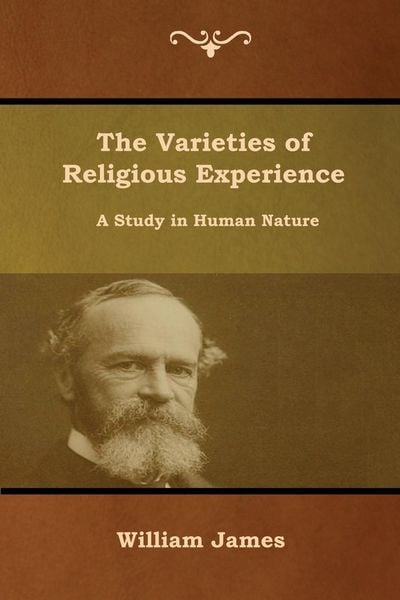
The Varieties of Religious Experience A Study in Human Nature
-
- Hardcover
- Taschenbuch ausgewählt
- eBook
-
Sprache:Englisch
-
Verlag:Indoeuropeanpublishing.Com
- Taylor & Francis 26,99 €
- Wilder Publications 24,99 €
- Editorium 24,99 €
- Tredition 23,60 €
- Oxford University Press 15,99 €
- Sharp Ink 17,20 €
- Bibliotech Pr 28,99 €
- Arc Manor 29,99 €
- Touchstone 17,99 €
- Natal Publishing, Llc 19,99 €
- Random House N.Y. 16,99 €
- Martino Fine Books 27,99 €
- Digireads.com 21,99 €
- Penguin Books 16,99 €
- Simon & Brown 28,99 €
- Grapevine 27,99 €
- Megalodon Entertainment LLC. 29,99 €
- Random House Publishing Group 22,99 €
- Laine Educational Media LLC 23,99 €
- Indoeuropeanpublishing.Com 29,99 € ausgewählt
29,99 €
inkl. gesetzl. MwSt.,
- Kostenlose Lieferung ab 30 € Einkaufswert
- Versandkostenfrei für Bonuscard-Kund*innen
Beschreibung
Produktdetails
Einband
Taschenbuch
Erscheinungsdatum
08.05.2019
Verlag
Indoeuropeanpublishing.ComSeitenzahl
362
Maße (L/B/H)
22,9/15,2/2,1 cm
Gewicht
587 g
Sprache
Englisch
ISBN
978-1-64439-164-8
William James (January 11, 1842 – August 27, 1910) was an American philosopher and psychologist, and the first educator to offer a psychology course in the United States. James was a leading thinker of the late nineteenth century, one of the most influential U.S. philosophers, and has been labelled the "Father of American psychology". Along with Charles Sanders Peirce, James established the philosophical school known as pragmatism, and is also cited as one of the founders of functional psychology. A Review of General Psychology analysis, published in 2002, ranked James as the 14th most eminent psychologist of the 20th century. A survey published in American Psychologist in 1991 ranked James's reputation in second place, after Wilhelm Wundt, who is widely regarded as the founder of experimental psychology. James also developed the philosophical perspective known as radical empiricism. James' work has influenced intellectuals such as Émile Durkheim, W. E. B. Du Bois, Edmund Husserl, Bertrand Russell, Ludwig Wittgenstein, Hilary Putnam, and Richard Rorty, and has even influenced former US President Jimmy Carter. Born into a wealthy family, James was the son of the Swedenborgian theologian Henry James Sr. and the brother of both the prominent novelist Henry James and the diarist Alice James. James trained as a physician and taught anatomy at Harvard, but never practiced medicine. Instead he pursued his interests in psychology and then philosophy. James wrote widely on many topics, including epistemology, education, metaphysics, psychology, religion, and mysticism. Among his most influential books are The Principles of Psychology, a groundbreaking text in the field of psychology; Essays in Radical Empiricism, an important text in philosophy; and The Varieties of Religious Experience, an investigation of different forms of religious experience, including theories on mind-cure. "The Varieties of Religious Experience" comprises James’ edited Gifford Lectures on natural theology, which were delivered at the University of Edinburgh in Scotland in 1901 and 1902. The lectures concerned the nature of religion and the neglect of science in the academic study of religion. Soon after its publication, Varieties entered the Western canon of psychology and philosophy and has remained in print for over a century. James later developed his philosophy of pragmatism.
Noch keine Bewertungen vorhanden
Verfassen Sie die erste Bewertung zu diesem Artikel
Helfen Sie anderen Kundinnen und Kunden durch Ihre Meinung.
Kurze Frage zu unserer Seite
Vielen Dank für Ihr Feedback
Wir nutzen Ihr Feedback, um unsere Produktseiten zu verbessern. Bitte haben Sie Verständnis, dass wir Ihnen keine Rückmeldung geben können. Falls Sie Kontakt mit uns aufnehmen möchten, können Sie sich aber gerne an unseren Kund*innenservice wenden.
zum Kundenservice