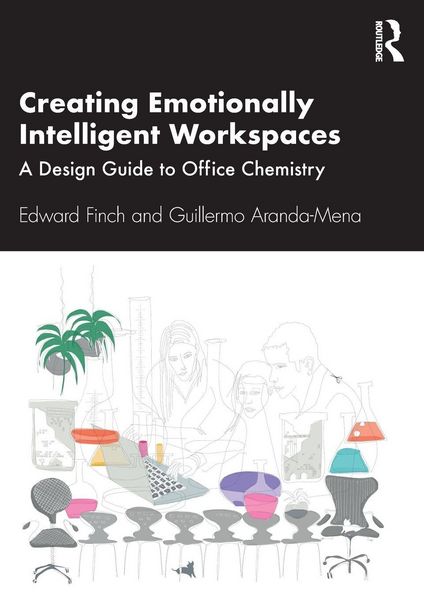
Creating Emotionally Intelligent Workspaces A Design Guide to Office Chemistry
-
- Taschenbuch ausgewählt
- eBook
-
Sprache:Englisch
73,99 €
inkl. gesetzl. MwSt.,
Beschreibung
Produktdetails
Einband
Taschenbuch
Erscheinungsdatum
16.09.2019
Abbildungen
26 SW-Abb., 6 SW-Fotos, 20 SW-Zeichn., 2 Tabellen
Verlag
Taylor & FrancisSeitenzahl
120
Maße (L/B/H)
24,6/17,4/0,7 cm
Gewicht
229 g
Sprache
Englisch
ISBN
978-1-138-60247-2
Emotions in the workplace have until recently been seen simply as a distraction. We often think of work as rational, logical and non-emotional. But organisations are waking up to the key role of emotions and affect at work. Emotions influence how we make decisions, how we relate with one another and how we make sense of our surroundings.
Whilst organisations are slowly embracing the pivotal role of emotions, designers and managers of workplaces have been struggling to keep up. New insights from hard sciences such as neuropsychology are presenting a radically different interpretation of emotions. Yet workplace designers and facilities managers still rely on measuring non-specific states such as satisfaction and stress.
In this book we attempt to capture modern-day interpretations of emotion, looking at emotion in terms of transactions and processes rather than simple cause and effect. We entertain the idea of an 'emotionally intelligent building' as an alternative to the much-hyped intelligent building. The assertion is that we should create environments that are emotionally intelligent. Rather than focusing on the aptitudes or shortcomings of individuals at work, we should place closer attention on the office environment. It's not that we are emotionally disabled - it's the environment that disables us! The ability of you and me to interpret, control and express emotions may not simply be a result of our own make-up. A radically different outlook considers how our workspace and workplace debilitates or enables our emotional understanding.
In the modern workplace there are many innovations that can undermine our emotional intelligence, such poorly implemented hot-desking or lean environments. Contrariwise there are key innovations such as Activity Based Working (ABW) that have the potential to enhance our emotional state. Through a series of unique case studies from around the world, we investigate key concepts that can be used by designers and facilities managers alike. No longer should designers be asked to incorporate emotional elements as intangible un-costed 'add-ons'. This book provides a shot in the arm for workplace design professionals, pointing to a new way of thinking based on the emotional intelligence of the workplace.
Noch keine Bewertungen vorhanden
Verfassen Sie die erste Bewertung zu diesem Artikel
Helfen Sie anderen Kundinnen und Kunden durch Ihre Meinung.
Kurze Frage zu unserer Seite
Vielen Dank für Ihr Feedback
Wir nutzen Ihr Feedback, um unsere Produktseiten zu verbessern. Bitte haben Sie Verständnis, dass wir Ihnen keine Rückmeldung geben können. Falls Sie Kontakt mit uns aufnehmen möchten, können Sie sich aber gerne an unseren Kund*innenservice wenden.
zum Kundenservice