Beschreibung
Produktdetails
Einband
Taschenbuch
Erscheinungsdatum
02.03.2021
Verlag
Pearson AcademicSeitenzahl
650
Maße (L/B/H)
23,2/18,6/3,1 cm
Gewicht
1118 g
Auflage
1. Auflage
Sprache
Englisch
ISBN
978-1-61729-535-5
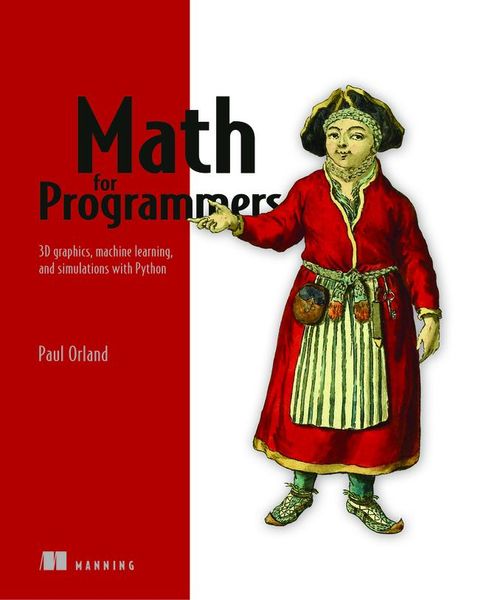
Explore important mathematical concepts through hands-on coding.
Purchase of the print book includes a free eBook in PDF, Kindle, and ePub formats from Manning Publications.
To score a job in data science, machine learning, computer graphics, and cryptography, you need to bring strong math skills to the party. Math for Programmers teaches the math you need for these hot careers, concentrating on what you need to know as a developer. Filled with lots of helpful graphics and more than 200 exercises and mini-projects, this book unlocks the door to interesting–and lucrative!–careers in some of today’s hottest programming fields.
About the technology
Skip the mathematical jargon: This one-of-a-kind book uses Python to teach the math you need to build games, simulations, 3D graphics, and machine learning algorithms. Discover how algebra and calculus come alive when you see them in code!
About the book
In Math for Programmers you’ll explore important mathematical concepts through hands-on coding. Filled with graphics and more than 300 exercises and mini-projects, this book unlocks the door to interesting–and lucrative!–careers in some of today’s hottest fields. As you tackle the basics of linear algebra, calculus, and machine learning, you’ll master the key Python libraries used to turn them into real-world software applications.
What's inside
Vector geometry for computer graphics
Matrices and linear transformations
Core concepts from calculus
Simulation and optimization
Image and audio processing
Machine learning algorithms for regression and classification
About the reader
For programmers with basic skills in algebra.
About the author
Paul Orland is a programmer, software entrepreneur, and math enthusiast. He is co-founder of Tachyus, a start-up building predictive analytics software for the energy industry.
Table of Contents
1 Learning math with code
PART I - VECTORS AND GRAPHICS
2 Drawing with 2D vectors
3 Ascending to the 3D world
4 Transforming vectors and graphics
5 Computing transformations with matrices
6 Generalizing to higher dimensions
7 Solving systems of linear equations
PART 2 - CALCULUS AND PHYSICAL SIMULATION
8 Understanding rates of change
9 Simulating moving objects
10 Working with symbolic expressions
11 Simulating force fields
12 Optimizing a physical system
13 Analyzing sound waves with a Fourier series
PART 3 - MACHINE LEARNING APPLICATIONS
14 Fitting functions to data
15 Classifying data with logistic regression
16 Training neural networks
Noch keine Bewertungen vorhanden
Verfassen Sie die erste Bewertung zu diesem Artikel
Helfen Sie anderen Kundinnen und Kunden durch Ihre Meinung.
Kurze Frage zu unserer Seite
Vielen Dank für Ihr Feedback
Wir nutzen Ihr Feedback, um unsere Produktseiten zu verbessern. Bitte haben Sie Verständnis, dass wir Ihnen keine Rückmeldung geben können. Falls Sie Kontakt mit uns aufnehmen möchten, können Sie sich aber gerne an unseren Kund*innenservice wenden.
zum Kundenservice