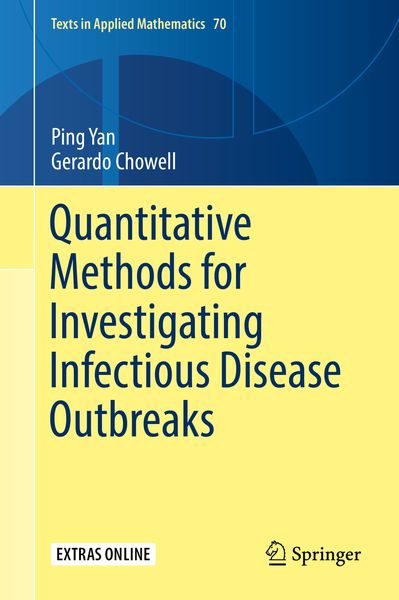
Quantitative Methods for Investigating Infectious Disease Outbreaks
-
- Hardcover ausgewählt
- Taschenbuch
- eBook
-
Sprache:Englisch
68,99 €
UVP
76,99 €
inkl. gesetzl. MwSt.,
Beschreibung
Produktdetails
Einband
Gebundene Ausgabe
Erscheinungsdatum
30.08.2019
Abbildungen
XIII, 354 p. 104 illus., 93 illus. in color.
Verlag
SpringerSeitenzahl
354
Maße (L/B/H)
24,1/16/2,6 cm
Gewicht
717 g
Auflage
1st ed. 2019
Sprache
Englisch
ISBN
978-3-030-21922-2
This book provides a systematic treatment of the mathematical underpinnings of work in the theory of outbreak dynamics and their control, covering balanced perspectives between theory and practice including new material on contemporary topics in the field of infectious disease modelling. Specifically, it presents a unified mathematical framework linked to the distribution theory of non-negative random variables; the many examples used in the text, are introduced and discussed in light of theoretical perspectives.
The book is organized into 9 chapters: The first motivates the presentation of the material on subsequent chapters; Chapter 2-3 provides a review of basic concepts of probability and statistical models for the distributions of continuous lifetime data and the distributions of random counts and counting processes, which are linked to phenomenological models. Chapters 4 focuses on dynamic behaviors of a disease outbreak during the initial phase while Chapters 5-6 broadly cover compartment models to investigate the consequences of epidemics as the outbreak moves beyond the initial phase. Chapter 7 provides a transition between mostly theoretical topics in earlier chapters and Chapters 8 and 9 where the focus is on the data generating processes and statistical issues of fitting models to data as well as specific mathematical epidemic modeling applications, respectively.
This book is aimed at a wide audience ranging from graduate students to established scientists from quantitatively-oriented fields of epidemiology, mathematics and statistics. The numerous examples and illustrations make understanding of the mathematics of disease transmission and control accessible. Furthermore, the examples and exercises, make the book suitable for motivated students in applied mathematics, either through a lecture course, or through self-study. This text could be used in graduate schools or special summer schools covering research problems in mathematical biology.
Noch keine Bewertungen vorhanden
Verfassen Sie die erste Bewertung zu diesem Artikel
Helfen Sie anderen Kundinnen und Kunden durch Ihre Meinung.
Kurze Frage zu unserer Seite
Vielen Dank für Ihr Feedback
Wir nutzen Ihr Feedback, um unsere Produktseiten zu verbessern. Bitte haben Sie Verständnis, dass wir Ihnen keine Rückmeldung geben können. Falls Sie Kontakt mit uns aufnehmen möchten, können Sie sich aber gerne an unseren Kund*innenservice wenden.
zum Kundenservice