Gutscheinbedingungen

**Gültig bis 17.08.2026 auf Schreibwaren & Office-Artikel online auf thalia.at, in der Thalia App und in teilnehmenden Thalia Buchhandlungen in Österreich mit Schulsortiment. In den Buchhandlungen nur gültig auf lagernde Ware. Einzelne Artikel können ausgeschlossen sein. Ausgenommen sind preisgebundene Artikel. Pro Einkauf einmal einlösbar. Nur gültig gegen Vorlage oder im Onlineshop hinterlegter Bonuscard. Infos zur Einlösung in der Buchhandlung sind auf der Bonuscard-Vorteilspreisseite zu finden. Click & Collect nur bei Onlinevorabzahlung möglich. Keine Einlösung bei Scan & Go-Bezahlung. Keine Barauszahlung. Nicht kombinierbar mit anderen Aktionen und Gutscheinen. Gutschein wird auf max. 500€ Bestellwert angerechnet. Nicht gültig für Geschenkkarten, Versandkosten und Services.

  • Produktbild: Edible Insects in Sustainable Food Systems
  • Produktbild: Edible Insects in Sustainable Food Systems

Edible Insects in Sustainable Food Systems

327,99 €

inkl. gesetzl. MwSt., Versandkostenfrei


Beschreibung

Produktdetails

Einband

Taschenbuch

Erscheinungsdatum

02.02.2019

Abbildungen

XVII, 80 illus., 64 illus. in color., schwarz-weiss Illustrationen, farbige Illustrationen

Herausgeber

Afton Halloran + weitere

Verlag

Springer

Seitenzahl

479

Maße (L/B/H)

23,5/15,5/2,7 cm

Gewicht

759 g

Auflage

Softcover reprint of the original 1st ed. 2018

Sprache

Englisch

ISBN

978-3-030-08900-9

Beschreibung

Rezension

“This book is a valuable and timely addition to the previous books on the topic of insects as food and feed, and is interesting for the professionals in the field of food and feed science, students, human and animal nutritionists and entrepreneurs.” (S. Smetana, Journal of Insects as Food and Feed, September 21, 2018)

Portrait

Dr. Afton Halloran completed her PhD on cricket farming in Thailand and Kenya in August 2017 under the GREEiNSECT research project at the University of Copenhagen. She formally worked for the Insects as Food and Feed Programme at the Food and Agriculture Organization of the United Nations, where she co-authored Edible insects: future prospects for food and feed security. 

Roberto Flore is the Head of Research and Development at the Nordic Food Lab, University of Copenhagen. Roberto is one of the authors of On eating insects: essays, stories and recipes, a Phaidon Press publication. He is also one of the protaganists in the 2016 documentary BUGS. 

Paul Vantomme is a retired Senior Forestry Officer at the Food and Agriculture Organization of the United Nations (FAO). Paul is responsible for initaiting the Insects for Food and Feed Programme at the FAO. He is also a co-author on the publication, Edible insects: future prospects for food and feed security. 

Dr. Nanna Roos is an Associate Professor in Human Nutrition at the Department of Nutrition, Exercise and Sports, University of Copenhagen. She has extensive experience in research and research capacity in the linkages between human nutrition and insects. She is the principal investigator of the GREEiNSECT research project.

Produktdetails

Einband

Taschenbuch

Erscheinungsdatum

02.02.2019

Abbildungen

XVII, 80 illus., 64 illus. in color., schwarz-weiss Illustrationen, farbige Illustrationen

Herausgeber

Verlag

Springer

Seitenzahl

479

Maße (L/B/H)

23,5/15,5/2,7 cm

Gewicht

759 g

Auflage

Softcover reprint of the original 1st ed. 2018

Sprache

Englisch

ISBN

978-3-030-08900-9

Herstelleradresse

Springer Nature c/o IBS
Benzstrasse 21
48619 Heek
DE

Email: Tanja.Keller@springer.com

Noch keine Bewertungen vorhanden

Verfassen Sie die erste Bewertung zu diesem Artikel

Helfen Sie anderen Kundinnen und Kunden durch Ihre Meinung.

Kundinnen und Kunden meinen

Bewertungen (0)

  • Produktbild: Edible Insects in Sustainable Food Systems
  • Produktbild: Edible Insects in Sustainable Food Systems
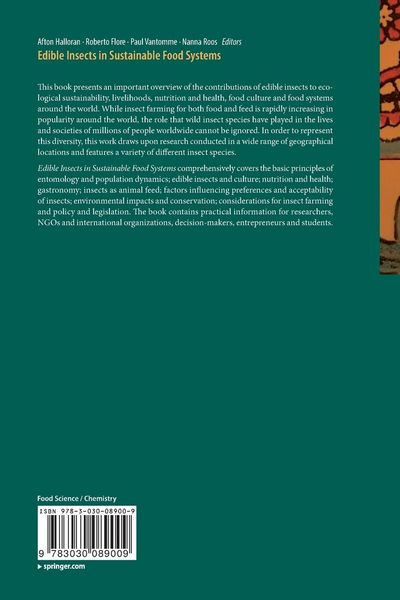
  • Part I: Introduction to insects.-  Insects: key biological features.-  Part II: Culture.-  Insect consumption in the Arctic.- An ethnographic account of the role of edible insects in the Adi tribe of Arunachal Pradesh, North-East India.- Edible Insects And Their Uses In North America; Past, Present and Future.-  Part III: Nutrition and health.-  Insects and human nutrition.- The role of edible insects in diets and nutrition in East Africa.- Edible insects in a food safety perspective.-  Part IV: Gastronomy.-  A new world of ingredients: aspiring chefs’ opinions on insects in gastronomy.- Su Casu Marzu: Per una Genealogia Gastronomica.- Edible Insects Uses in South Korean Gastronomy: “Korean Edible Insect Laboratory” Case Study.-  Part V: Environmental impacts, conservation and future challenges.-  Comparing environmental impacts from insects for feed and food as an alternative to animal production.- Conservationof edible insects in Sub-Saharan Africa.- Sustainable proteins? Values related to insects in food systems.- Marketing Insects: Superfood or Solution-food?.-  Part VI: Insects as animal feed.-  Small-scale fly larvae production for animal feed.- Insects as raw materials in compound feed for aquaculture.- Mealworm larvae production systems - Management scenarios.- Importance of insects for use as animal feed in low-income countries.- Sustainable Mealworm Production for Feed and Food.-  Part VII: Consumer preferences and acceptability.-  What governs selection and acceptance of edible insect species?.- Insects, the next European foodie craze?.- Kenyan consumers' experience of using edible insects as food and their preferences for selected insect-based food products.- Consumer acceptance of insects as food: integrating psychological and socio-cultural perspectives.- Customer Acceptance, Barriers, and Preferences in the U.S.- Means-end chain approach explains motivations to consume insect-based foods: The case of cricket-scones in Kenya.-  Part VIII: Legislation and policy on the use of insects as food and feed.-  PROteINSECT - Insects as a sustainable source of protein.- Insects in Thailand: National Leadership and Regional development, from standards to regulations through association.- The Effects of Regulation, Legislation and Policy on Consumption of Edible Insects in the Global South.- Legislation for the use of insects as food and feed in the South African context.- Current status of the insect producing industry in Europe.