Gutscheinbedingungen

**Gültig bis 15.06.2026 auf Spiele & Spielzeug online auf thalia.at, in der Thalia App ab einem Mindestbestellwert von 30€ und in allen Thalia Buchhandlungen in Österreich. In den Buchhandlungen nur gültig auf lagernde Ware. Einzelne Artikel können ausgeschlossen sein. Ausgenommen sind preisgebundene Artikel sowie online auf thalia.at und in der Thalia App einzelne Artikel von tonies®. Pro Einkauf einmal einlösbar. Nur gültig gegen Vorlage oder im Onlineshop hinterlegter Bonuscard. Infos zur Einlösung in der Buchhandlung sind auf der Bonuscard-Vorteilspreisseite zu finden. Click & Collect nur bei Onlinevorabzahlung möglich. Keine Einlösung bei Scan & Go-Bezahlung. Keine Barauszahlung. Nicht kombinierbar mit anderen Aktionen und Gutscheinen. Gutschein wird auf max. 500€ Bestellwert angerechnet. Nicht gültig für Geschenkkarten, Versandkosten und Services.

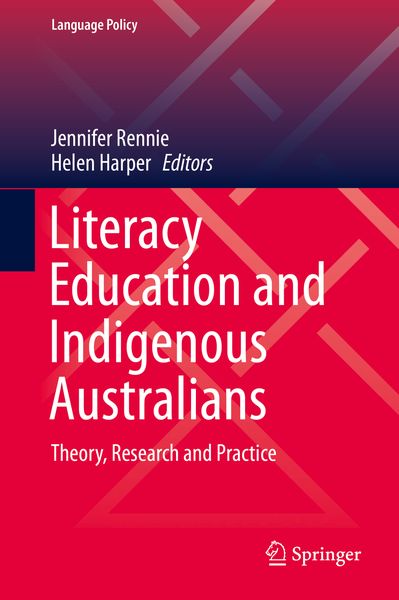
Produktbild: Literacy Education and Indigenous Australians
Band 19 - 11%

Literacy Education and Indigenous Australians Theory, Research and Practice

Aus der Reihe Language Policy
11% sparen

96,99 € UVP 109,99 €

inkl. gesetzl. MwSt., Versandkostenfrei


Beschreibung

Produktdetails

Einband

Gebundene Ausgabe

Erscheinungsdatum

11.11.2019

Abbildungen

XI, 20 illus., schwarz-weiss Illustrationen

Herausgeber

Jennifer Rennie + weitere

Verlag

Springer Singapore

Seitenzahl

332

Maße (L/B/H)

24,1/16/2,5 cm

Gewicht

682 g

Auflage

1st ed. 2019

Sprache

Englisch

ISBN

978-981-13-8628-2

Beschreibung

Portrait

Dr Jennifer Rennie is a Senior Lecturer in Literacy Education at the Faculty of Education, Monash University. Prior to working in higher education, she worked as a primary and high school teacher. Her chief research interests are Indigenous literacies, students who are marginalised from mainstream schooling, and reading pedagogies for disengaged adolescent readers. She has maintained a long-standing affiliation with the Australian Literacy Educators Association, and was the recipient of the ALEA medal for outstanding service to the association and the profession in 2015. She recently took office as Vice President of ALEA. In addition, she has been Managing Editor of the Australian Journal of Language and Literacy since 2009. 

Dr Helen Harper has worked as a researcher and lecturer in language and literacy education, as a linguist in remote Indigenous communities, and as a teacher of English as an Additional Language. Currently she is a Senior Lecturer at the School of Education, University of New England (UNE), where she teaches English language and literacy education. Helen’s research interests include pedagogies for educationally marginalised students, pedagogies of literacy, and classroom interactions. Before taking up her post at the UNE in 2018, Helen spent more than two decades in the Northern Territory, where she worked as a researcher and educator.

Produktdetails

Einband

Gebundene Ausgabe

Erscheinungsdatum

11.11.2019

Abbildungen

XI, 20 illus., schwarz-weiss Illustrationen

Herausgeber

Verlag

Springer Singapore

Seitenzahl

332

Maße (L/B/H)

24,1/16/2,5 cm

Gewicht

682 g

Auflage

1st ed. 2019

Sprache

Englisch

ISBN

978-981-13-8628-2

Herstelleradresse

Springer-Verlag KG
Sachsenplatz 4-6
1201 Wien
AT

Email: ProductSafety@springernature.com

Kundinnen und Kunden meinen

0 Bewertungen

Informationen zu Bewertungen

Zur Abgabe einer Bewertung ist eine Anmeldung im Konto notwendig. Die Authentizität der Bewertungen wird von uns nicht überprüft. Wir behalten uns vor, Bewertungstexte, die unseren Richtlinien widersprechen, entsprechend zu kürzen oder zu löschen.

Die Bewertungen sind nach Format, Anzahl Sterne und Datum sortiert.

Verfassen Sie die erste Bewertung zu diesem Artikel

Helfen Sie anderen Kund*innen durch Ihre Meinung

Kundinnen und Kunden meinen

0 Bewertungen filtern

Weitere Artikel finden Sie in

  • Produktbild: Literacy Education and Indigenous Australians
  • 1 introduction.- Section 1 Examining the lOcal: Theory and practice.- 2 The Evidence of Literacy Learning Through Contemporary Kunibídji Knowledge Systems.- 3 The Evidence of Literacy Learning Through Contemporary Kunibídji Knowledge Systems.- 4 Durithunga Boul: A pattern of respectful relationships, reciprocity and socially just literacy education in one urban school.- 5 Family story time.- 6 Confessions from a reading program:  building connections, competence and confidence.- 7 Talking and writing to develop mathematical meanings in a remote Indigenous context.- 8 Indigenous doctoral literacy in the Humanities and Social Sciences.- 9 Preparing pre-service teachers to teach literacy in remote spaces.- Section 2 Examining the systemic: Theory and practice.- 10 A long unfinished struggle: literacy education and Indigenous cultural and language rights.- 11 Embedding evidence based practice into a remote Indigenous early learning and parenting program: A systematic approach.- 12 Early Literacy: strengthening outcomes through processes of collaboration and engagement.- 13 “Just teach our kids to read”: Efficacy of intensive reading interventions for both younger and older low-progress readers in schools serving mainly remote Indigenous communities.- 14 A Case Study of Controversy: the Cape York Aboriginal Australian Academy.- 15 Good theory, good systems: An instance of accelerated literacy pedagogy implementation.- 16 ‘A strong belief in the possibility of a better life’. The pedagogy of contingency and the ethic of solidarity in the Yes, I Can! Aboriginal Adult Literacy Campaign.- 17 Afterword: Being literate in ‘Australian’: The future can.