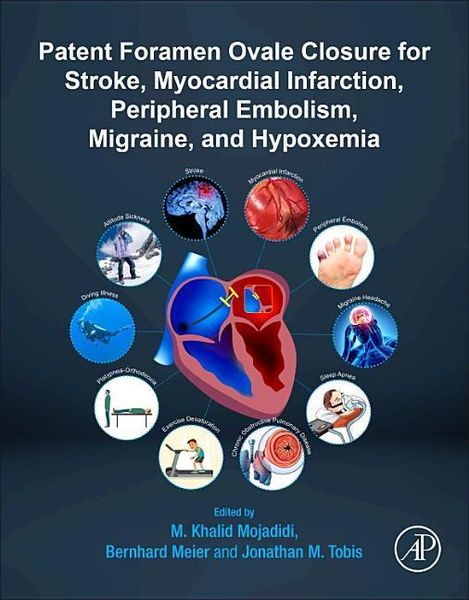
Produktbild: Patent Foramen Ovale Closure for Stroke, Myocardial Infarction, Peripheral Embolism, Migraine, and Hypoxemia

Patent Foramen Ovale Closure for Stroke, Myocardial Infarction, Peripheral Embolism, Migraine, and Hypoxemia

176,99 €

inkl. gesetzl. MwSt., Versandkostenfrei


Beschreibung

Produktdetails

Einband

Taschenbuch

Erscheinungsdatum

24.08.2019

Herausgeber

M. Khalid Mojadidi + weitere

Verlag

Elsevier

Seitenzahl

254

Maße (L/B/H)

27,4/21,6/1,3 cm

Gewicht

703 g

Sprache

Englisch

ISBN

978-0-12-816966-7

Beschreibung

Portrait

Dr. M. Khalid Mojadidi is an Invasive Cardiologist and Assistant Professor of Medicine at Virginia Commonwealth University. His clinical concentration includes invasive and noninvasive cardiology, echocardiography, and nuclear cardiology. His research interests include PFO and related clinical pathologies. Since early in his career, he has published extensively on different aspects of percutaneous PFO closure for numerous medical conditions.

Bernhard Meier has served from 1992 to his retirement in 2015 as full Professor of Cardiology and Chairman of the Department of Cardiology at the Swiss Cardiovascular Center Bern of the University of Bern, Switzerland. Since 2016, he served as a Senior Consultant. He has personally performed thousands of coronary angioplasties, starting with assisting on the world’s first case in 1977, and other catheter-based cardiac procedures. He implanted the world’s first dedicated PFO occluder in 1997.

Dr. Jonathan M. Tobis is the Director of Interventional Cardiology Research at UCLA and Clinical Professor of Medicine in Cardiology at the University of California, Los Angeles. He performed the world’s first digital left ventricular and coronary angiograms and contributed to the advancements of intravascular ultrasound early in his career. His recent work is devoted to understanding the role of PFO closure in relation to several medical conditions including stroke and migraine. He was voted one of the 10 Most Highly Regarded Heart Doctors in the United States.

Produktdetails

Einband

Taschenbuch

Erscheinungsdatum

24.08.2019

Herausgeber

Verlag

Elsevier

Seitenzahl

254

Maße (L/B/H)

27,4/21,6/1,3 cm

Gewicht

703 g

Sprache

Englisch

ISBN

978-0-12-816966-7

Herstelleradresse

Libri GmbH
Europaallee 1
36244 Bad Hersfeld
DE

Email: gpsr@libri.de

Noch keine Bewertungen vorhanden

Verfassen Sie die erste Bewertung zu diesem Artikel

Helfen Sie anderen Kundinnen und Kunden durch Ihre Meinung.

Kundinnen und Kunden meinen

Bewertungen (0)

Die Leseprobe wird geladen.
  • Produktbild: Patent Foramen Ovale Closure for Stroke, Myocardial Infarction, Peripheral Embolism, Migraine, and Hypoxemia
  • I. INTRODUCTION
    1. Embryology, Anatomy, and Physiology: Anatomical Variations, Lipomatous Hypertrophy, Atrial Septal Aneurysm, Eustachian Valve, Chiari Network, Combination With Other Atrial Septal Defects

    II. DIAGNOSIS AND IMAGING ASSESSMENT OF PFO
    2. Echocardiography, Transcranial Doppler, and Oximetry for Imaging and Quantification of PFO-Mediated Shunts
    3. Angiography, Transthoracic, Transesophageal, and Intracardiac Echocardiography: Periprocedural Assessment and Guidance During PFO Closure

    III. STROKE AND PFO
    4. Definition of Cryptogenic Stroke, the Risk of Paradoxical Embolism RoPE Score, and Assessment of Embolic Stroke of Undetermined Source
    5. Observational Studies of PFO Closure for Stroke
    6. Early Randomized Trials of PFO Closure for Stroke (CLOSURE I, PC, RESPECT)
    7. Newer Randomized Trials on PFO Closure for Stroke (CLOSE, REDUCE, and DEFENSE-PFO)

    IV. NON-CEREBRAL PARADOXICAL EMBOLISM AND PFO
    8. Myocardial Infarction and PFO
    9. Peripheral Embolism and PFO

    V. MIGRAINE AND PFO
    10. Migraine Headache: Clinical Association With PFO and Observational Studies
    11. Randomized Clinical Trials of PFO Closure for Migraine Headache (MIST, PRIMA, PREMIUM)

    VI. OTHER CONDITIONS AND PFO
    12. Hypoxemia and PFO
    13. Less Recognized Conditions Associated with PFO: Decompression Illness, Carcinoid Heart Disease, Coronary Spasm

    VII. SAFETY, TECHNICAL ASPECTS TO PFO CLOSURE, AND FUTURE OUTLOOK
    14. Percutaneous PFO Closure: History, Devices, Techniques, Safety, and Informed Consent
    15. How I Do It: ICE-guided Technique for Percutaneous PFO Closure
    16. How I Do It: Fluoroscopy-guided Technique for Percutaneous PFO Closure
    17. PFO Closure: History, Final thoughts and Future outlook
    18. The Full Spectrum of PFO: Are We Seeing Just the Tip of the Iceberg?
    19. Frequent Questions: PFO Closure With the Amplatzer or Gore Cardioform Devices