KI-Beratung Beta

  • Produktbild: Cyber Influence and Cognitive Threats
  • Produktbild: Cyber Influence and Cognitive Threats

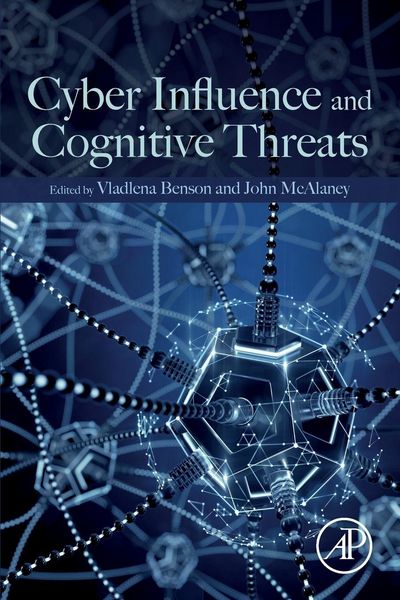
Cyber Influence and Cognitive Threats

135,99 €

inkl. gesetzl. MwSt., Versandkostenfrei


Beschreibung

Produktdetails

Einband

Taschenbuch

Erscheinungsdatum

27.09.2019

Herausgeber

Vladlena Benson + weitere

Verlag

Elsevier Science & Technology

Seitenzahl

238

Maße (L/B/H)

22,9/15,2/1,3 cm

Gewicht

325 g

Sprache

Englisch

ISBN

978-0-12-819204-7

Beschreibung

Portrait

Professor Vladlena Benson, leads the Cybersecurity and Innovation Partnership and the IS Research group of academics working in the areas of cyber security risk management, information and supply chain security. Professor Benson is a Founding member of the Neustar International Security Council - an industry leading forum of trust, integrity and confidentiality focused on defending against cyber threats. Vladlena has served on the Board of Directors of ISACA London and Central UK over the last three years. She has published over 100 journal papers, books, edited volumes and other publications. Vladlena's research encompasses areas of innovation actions across cybersecurity risk management, financial and VFA technologies. Her research at Aston has been supported by grants from the European Commission, GCRF, Ministry of Science and Technology (Taiwan), UK Strategic Priorities and the British Council. Having been recognized as a Women in IT Editor's Choice Award in 2017, Professor Benson continues her work in creating an inclusive space in cyber security careers.John McAlaney is a Chartered Psychologist, Chartered Scientist and Associate Professor of Psychology at Bournemouth University. He completed his undergraduate degree at the University of Stirling, his MSc at the University of Strathclyde and then his PhD at the University of West of Scotland in 2007. Dr. McAlaney's PhD was on the topic of social psychology and substance use, looking particularly at misperceptions of peer norms. Following this he worked on an AERC funded post-doc position at London School of Hygiene and Tropical Medicine before moving onto a lecturing post at the University of Bradford in 2008. He joined the Department of Psychology at Bournemouth University in 2014. Since joining Bournemouth he has collaborated extensively with colleagues in the Department of Computing and Informatics to explore psychological factors of cyber security, including participation in hacking and hacktivism, group dynamics in cyber security actors and decision making processes in relation to phishing emails and other mediums. As part of this work he collaborates extensively with government, military and commercial organisations. In 2018 he led the authorship of the British Psychological Society's briefing paper on the role of psychology in informing cybersecurity practices.

Produktdetails

Einband

Taschenbuch

Erscheinungsdatum

27.09.2019

Herausgeber

Verlag

Elsevier Science & Technology

Seitenzahl

238

Maße (L/B/H)

22,9/15,2/1,3 cm

Gewicht

325 g

Sprache

Englisch

ISBN

978-0-12-819204-7

EU-Ansprechpartner

Elsevier B.V.
Radarweg 29
1043 NX Amsterdam
NL
productsafety@elsevier.com

Herstelleradresse

Elsevier Science & Technology
London Wall 125
EC2Y 5AS London
GB
tradeorders@elsevier.com

Noch keine Bewertungen vorhanden

Verfassen Sie die erste Bewertung zu diesem Artikel

Helfen Sie anderen Kundinnen und Kunden durch Ihre Meinung.

Kundinnen und Kunden meinen

Bewertungen (0)

Die Leseprobe wird geladen.
  • Produktbild: Cyber Influence and Cognitive Threats
  • Produktbild: Cyber Influence and Cognitive Threats
  • 1. Cybersecurity as a social phenomenon

    John McAlaney and Vladlena Benson

    2. Towards an integrated socio-technical approach for designing adaptive privacy aware services in cloud computing

    Angeliki Kitsiou, Eleni Tzortzaki, Christos Kalloniatis, and Stefanos Gritzalis

    3. Challenges of using machine learning algorithsm for cybersecurity: a study of threat-classification models applied to social media communication data

    Andrei Queiroz Lima and Brian Keegan

    4. 'Nothing up my sleeve': information warfare and the magical mindset

    K. Scott

    5. Digital hoarding behaviours: implications for cybersecurity

    Nick Neave, Kerry McKellar, Elizabeth Sillence, and Pam Briggs

    6. A review of security awareness approaches: towards achieving communal awareness

    Azma Alina Ali Zani, Azah Anir Norman, and Norjihan Abdu Ghani

    7. Understanding users' information security awareness and intentions: a full nomology of protection motivation theory

    Farkhondeh Hassandoust and Angsana A. Techatassanasoontorn

    8. Social big data and its integrity: the effect of trust and personality traits on organic reach of facebook content

    Vladlena Benson and Tom Buchanan

    9. The impact of sentiment on content post popularity through emoji and text on social platforms

    Wei-Lun Chang and Hsiao-Chiao Tseng

    10. Risk and social influence in sustainable smart home technologies: a persuasive systems design model

    Nataliya Shevchuk, Harri Oinas-Kukkonen, and Vladlena Benson