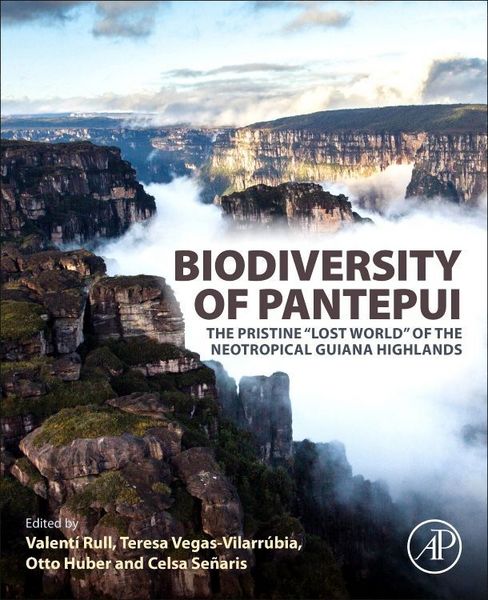
Produktbild: Biodiversity of Pantepui

Biodiversity of Pantepui The Pristine Lost World of the Neotropical Guiana Highlands

99,99 €

inkl. gesetzl. MwSt., Versandkostenfrei


Beschreibung

Produktdetails

Einband

Taschenbuch

Erscheinungsdatum

13.06.2019

Herausgeber

Valentí Rull + weitere

Verlag

Elsevier Science & Technology

Seitenzahl

470

Maße (L/B/H)

23,4/19,1/2,5 cm

Gewicht

953 g

Sprache

Englisch

ISBN

978-0-12-815591-2

Beschreibung

Portrait

Valentí Rull is a biologist with a PhD in paleoecology (1990). He is a Tenured Scientist of the Spanish Council for Scientific Research (CSIC) at the Institute of Earth Sciences Jaume Almera, Barcelona. He uses paleocological evidence to study the type and characteristics of biotic responses to environmental shifts, the natural and anthropogenic drivers of ecological change and the role of tectonics and environmental change on the origin of biodiversity. He also works on the contribution of paleoecology to biodiversity conservation. Dr. Rull has conducted his research on several temperate (Pyrenees, Azores Islands), tropical (Andes, Orinoco delta, Maracaibo basin, Gran Sabana, Pantepui) and subtropical (Easter Island) regions.Teresa Vegas-Vilarrúbia obtained her PhD at the Venezuelan Institute of Scientific Research (1989). She worked as Consultant assessing environmental impacts of the Venezuelan oil industry, and as Environmental Researcher and Education Manager of the National Parks System of Venezuela. Since 2002 she has served as faculty member at the University of Barcelona (Spain). Her main research lines are: Biotic responses to rapid climate changes, high-resolution Paleolimnology since the Lateglacial, long-term variations of lake hypoxia/anoxia and effects of global change on aquatic ecosystems. She teaches courses on Epicontinental Waters, Biogeochemistry and Paleoecology at the master level.Otto Huber, born Germany, 24.11.1944, resident in Merano (Italy). MSc in Biological Sciences, University of Rome (Italy) in 1971; Ph.D in Plant Ecology, University of Innsbruck (Austria) in 1976. Lived and worked in Venezuela 1973-2002, and part-time 2003-2010. Main research activities: plant ecology in savanna ecosystems of the Central Venezuelan Llanos; phenology of montane cloud forests of northern Venezuela; flora and vegetation of 56 different tepui summits of Pantepui, Venezuelan Guayana Shield. Professor for Plant Ecology at Universidad Simón Bolívar, Caracas (1999-2002); Director of Research (1994-98) and Research Associate (2002-10) of the Botanical Institute in Caracas.Celsa Señaris received her Ph.D. degree from the University of Santiago de Compostela in 2001. From 1991-2003 she was the Curator of the Herpetology collection of the La Salle Natural History Museum in Caracas, and she served as Director until 2012. Currently she is a Researcher in the Ecology and Genetics Laboratory at Instituto Venezolano de Investigaciones Científicas. Her research focuses on the Guianan herpetofauna, studying the systematic and biogeography of the amphibians and reptiles in that region. Also, she has been a Professor in the Universidad Central de Venezuela. She is the Venezuelan Chair of the Amphibian Specialist Group-IUCN.

Produktdetails

Einband

Taschenbuch

Erscheinungsdatum

13.06.2019

Herausgeber

Verlag

Elsevier Science & Technology

Seitenzahl

470

Maße (L/B/H)

23,4/19,1/2,5 cm

Gewicht

953 g

Sprache

Englisch

ISBN

978-0-12-815591-2

EU-Ansprechpartner

Elsevier B.V.
Radarweg 29
1043 NX Amsterdam
NL
productsafety@elsevier.com

Herstelleradresse

Elsevier Science & Technology
London Wall 125
EC2Y 5AS London
GB
tradeorders@elsevier.com

Noch keine Bewertungen vorhanden

Verfassen Sie die erste Bewertung zu diesem Artikel

Helfen Sie anderen Kundinnen und Kunden durch Ihre Meinung.

Kundinnen und Kunden meinen

Bewertungen (0)

Weitere Artikel finden Sie in

  • Produktbild: Biodiversity of Pantepui
  • 1. Physiographical and environmental diversity
    2. Holocene climatic and ecological history
    3. Protista: cyanobacteria, green algae, diatoms
    4. Bryophyta
    5. Vascular plant diversity and phytogeography
    6. Elevational plant diversity patterns
    7. Plant phylogeography and evolution
    8. Vegetation and ecosystems
    9. Invertebrates: insects, scorpions, crabs, snails, vertebrate parasites
    10. Amphibians and reptiles
    11. Birds
    12. Mammals
    13. Threats and conservation status
    14. Potential effects of global warming