Gutscheinbedingungen

**Gültig nur für Bestellungen an die Wunsch-Poststation bis 10.06.2026 auf Spielzeug, Schreibwaren, Filme, Geschenke & Trends, Musik, tolino eReader & Zubehör, Hörbücher und Hörbuch-Downloads (außer Abo), nicht preisgebundene Bücher und Kalender online auf thalia.at und in der Thalia App. Einzelne Artikel können ausgeschlossen sein. Aufgrund der Buchpreisbindung sind deutschsprachige Bücher und eBooks ausgenommen. Zusätzlich ausgenommen sind preisgebundene Artikel, Abos & Flatrates, eBooks, Games, Geschenkkarten/-boxen, Shelfies, Software, Zeitschriften sowie einzelne Artikel von tonies®. Pro Einkauf einmal einlösbar. Kein Click & Collect möglich. Keine Barauszahlung. Nicht kombinierbar mit anderen Aktionen und Gutscheinen. Gutschein wird auf max. 500€ Bestellwert angerechnet. Nicht gültig für Versandkosten und Services.

  • Produktbild: Philosophy of Science
  • Produktbild: Philosophy of Science
Band 9

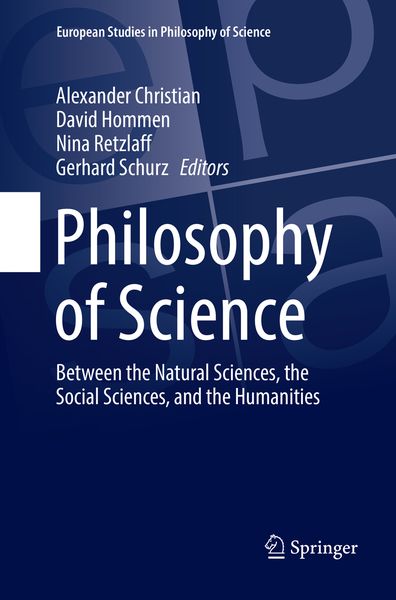
Philosophy of Science Between the Natural Sciences, the Social Sciences, and the Humanities

153,99 €

inkl. gesetzl. MwSt., Versandkostenfrei


Beschreibung

Produktdetails

Einband

Taschenbuch

Erscheinungsdatum

25.01.2019

Abbildungen

XXI, 17 illus., 4 illus. in color., farbige Illustrationen, schwarz-weiss Illustrationen

Herausgeber

Alexander Christian + weitere

Verlag

Springer

Seitenzahl

274

Maße (L/B/H)

23,5/15,5/1,7 cm

Gewicht

452 g

Auflage

Softcover reprint of the original 1st ed. 2018

Sprache

Englisch

ISBN

978-3-030-10229-6

Beschreibung

Portrait

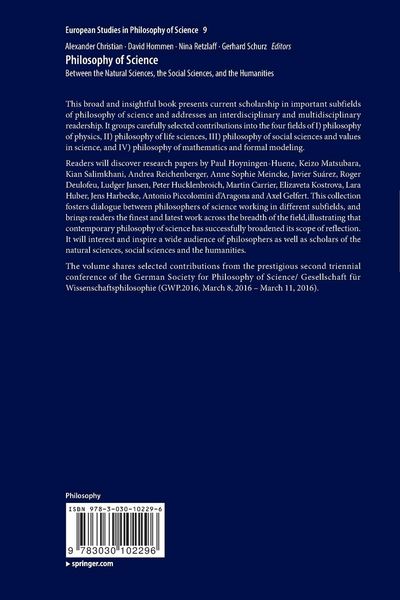
Alexander Christian is a research fellow at the Düsseldorf center for Logic and Philosophy of Science (DCLPS) at the Heinrich Heine University Düsseldorf. His main research areas are general philosophy of science and ethics of science, with a particular focus on bias, questionable research practices and scientific misconduct in medical research. He published about the demarcation problem (“Wissenschaft und Pseudowissenschaft”, Peter Lang, 2013), values in science and the suppression of empirical evidence.


David Hommen is currently Post-Doctoral research fellow in the DFG Collaborative Research Centre “The Structure of Representations in Language, Cognition, and Science” at Heinrich Heine University Düsseldorf. His main research areas are philosophy of mind, the theory of concepts, causal theory and the metaphysics of absences. He is co-author of “Negative Kausalität” (de Gruyter 2012, with Dieter Birnbacher) and author of “Mentale Verursachung, innere Erfahrung und handelnde Personen” (mentis 2013).


Nina Retzlaff is a research fellow at the Düsseldorf center for Logic and Philosophy of Science (DCLPS) at the Heinrich Heine University Düsseldorf. Her main research interests lie in philosophy of science, causality and metaphysics. In the context of her PhD thesis, she is investigating causality with regard to quantum mechanics. 


Gerhard Schurz holds the Chair for Theoretical Philosophy at the Heinrich Heine University Düsseldorf and is the Director of the Düsseldorf Center for Logic and Philosophy of Science (DCLPS). His research areas include general and special philosophy of science, logic, epistemology, generalized evolution theory, artificial intelligence and metaethics. He published more than 200 papers. Among other books, he published “The Is-Ought Problem“, Dordrecht: Kluwer (1997), “Einführung in die Wissenschaftstheorie“, Darmstadt: Wissenschaftliche Buchgesellschaft (2006, 4. Aufl.2014), “Evolution in Natur und Kultur“, Heidelberg: Spektrum Akademischer Verlag (2011), “Philosophy of Science: A Unified Approach“, New York: Routledge (2013) and “Wahrscheinlichkeitstheorie“, Berlin: DeGruyter (2015).

Produktdetails

Einband

Taschenbuch

Erscheinungsdatum

25.01.2019

Abbildungen

XXI, 17 illus., 4 illus. in color., farbige Illustrationen, schwarz-weiss Illustrationen

Herausgeber

Verlag

Springer

Seitenzahl

274

Maße (L/B/H)

23,5/15,5/1,7 cm

Gewicht

452 g

Auflage

Softcover reprint of the original 1st ed. 2018

Sprache

Englisch

ISBN

978-3-030-10229-6

Herstelleradresse

Springer-Verlag KG
Sachsenplatz 4-6
1201 Wien
AT

Email: ProductSafety@springernature.com

Kundinnen und Kunden meinen

0 Bewertungen

Informationen zu Bewertungen

Zur Abgabe einer Bewertung ist eine Anmeldung im Konto notwendig. Die Authentizität der Bewertungen wird von uns nicht überprüft. Wir behalten uns vor, Bewertungstexte, die unseren Richtlinien widersprechen, entsprechend zu kürzen oder zu löschen.

Die Bewertungen sind nach Format, Anzahl Sterne und Datum sortiert.

Verfassen Sie die erste Bewertung zu diesem Artikel

Helfen Sie anderen Kund*innen durch Ihre Meinung

Kundinnen und Kunden meinen

0 Bewertungen filtern

  • Produktbild: Philosophy of Science
  • Produktbild: Philosophy of Science
  • Introduction (Alexander Christian, David Hommen, Nina Retzlaff and Gerhard Schurz).- Part I: Philosophy of physics.- Chapter 1: Quantum Gravity: An Ideology of Unification? (Kian Salimkhani).- Chapter 2: On Predictions and Explanations in Multiverse Scenarios (Keizo Matsubara).- Chapter 3: The Role of the Concept of Causation in Physics (Enno Fischer).- Chapter 4: Causality in General Relativity. “Partial Determination” Revisited (Andrea Reichenberger).- Part II. Philosophy of life sciences.- Chapter 5: The Philosophical Concept of Agency between Systems Biology and Artificial Intelligence (Anne Sophie Meincke).- Chapter 6. Functions, Malfunctioning, and Negative Causation (Ludger Jansen).- Chapter 7. The Quantitative Problem for Theories of Function and Dysfunction (Thomas Schramme).- Chapter 8. On the Explanatory Character of the Serial Endosymbiotic Theory of the Origin of Eukaryotic Cells (Javier Suárez and Roger Deulofeu).- Part III. Philosophy of social sciences & values inscience.- Chapter 9. Agnotological Challenges: How to Capture the Production of Ignorance (Martin Carrier).- Chapter 10. The “Invisible Hand” as a Natural Law (Judith Würgler).- Chapter 11. Micro Economics Between the Natural Sciences and the Humanities (Karsten Klint Jensen).- Chapter 12. The Role of “Ought” in Value Theory: Philosophical and Sociological Perspectives (Elizaveta Kostrova).- Chapter 13. From Stability to Validity: How Standards Serve Epistemic Ends (Lara Huber).- Part IV. Philosophy of mathematics & formal modeling.- Chapter 14. A Theory of Constitutive Inference for the Regularity Account of Mechanistic Constitution (Jens Harbecke). Chapter 15. Recognition Procedures and Dag Prawitz’s Theory of Grounds (Antonio Piccolomini d’Aragona).- Chapter 16. Exploratory Modes of Scientific Inquiry: From Experimentation to Modeling (Axel Gelfert).