KI-Beratung Beta

Gutscheinbedingungen

**Gültig am 15.10.2026 auf Spielzeug, Schreibwaren, Filme, Geschenke & Trends, Musik, tolino eReader & Zubehör, Hörbücher und Hörbuch-Downloads, nicht preisgebundene Bücher und Kalender in der Thalia App. Einzelne Artikel können ausgeschlossen sein. Aufgrund der Buchpreisbindung sind deutschsprachige Bücher und eBooks ausgenommen. Zusätzlich ausgenommen sind Abos & Flatrates, Games, Geschenkkarten/-boxen, Shelfies, Software, Zeitschriften sowie einzelne Artikel von tonies®. Pro Einkauf einmal einlösbar. Click & Collect nur bei Onlinevorabzahlung möglich. Keine Barauszahlung. Nicht kombinierbar mit anderen Aktionen und Gutscheinen. Gutschein wird auf max. 500€ Bestellwert angerechnet. Nicht gültig für Versandkosten und Services.

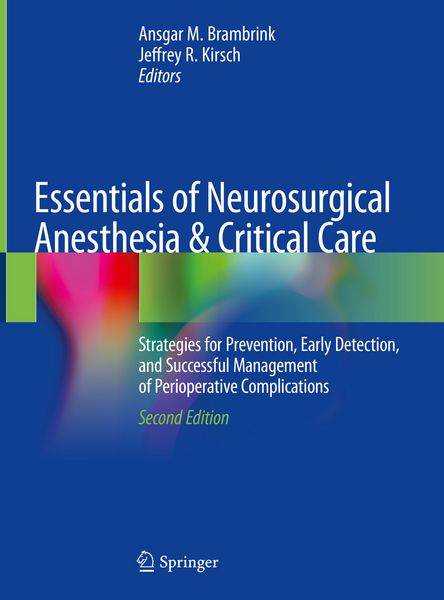
Produktbild: Essentials of Neurosurgical Anesthesia & Critical Care

Essentials of Neurosurgical Anesthesia & Critical Care Strategies for Prevention, Early Detection, and Successful Management of Perioperative Complications

108,99 €

inkl. gesetzl. MwSt., Versandkostenfrei


Beschreibung

Produktdetails

Einband

Gebundene Ausgabe

Erscheinungsdatum

11.10.2019

Abbildungen

XXX, 671 p. 92 illus., 37 illus. in color.

Herausgeber

Ansgar M. Brambrink + weitere

Verlag

Springer

Seitenzahl

671

Maße (L/B/H)

28,5/21,5/4,1 cm

Gewicht

2064 g

Auflage

Second Edition 2020

Sprache

Englisch

ISBN

978-3-030-17408-8

Beschreibung

Portrait


Ansgar M. Brambrink, MD, PhD

E.M. Papper Professor and Chair

Department of Anesthesiology

College of Physicians & Surgeons

Columbia University Medical Center / NewYork Presbyterian Hospital

New York, NY 10032, USA

Jeffrey R. Kirsch, MD


Professor, Chair-Emeritus


Department of Anesthesiology and Perioperative Medicine 


Oregon Health & Science University


Portland, OR 97239


Produktdetails

Einband

Gebundene Ausgabe

Erscheinungsdatum

11.10.2019

Abbildungen

XXX, 671 p. 92 illus., 37 illus. in color.

Herausgeber

Verlag

Springer

Seitenzahl

671

Maße (L/B/H)

28,5/21,5/4,1 cm

Gewicht

2064 g

Auflage

Second Edition 2020

Sprache

Englisch

ISBN

978-3-030-17408-8

Herstelleradresse

Springer-Verlag GmbH
Europaplatz 3
69115 Heidelberg
DE

Email: ProductSafety@springernature.com

Noch keine Bewertungen vorhanden

Verfassen Sie die erste Bewertung zu diesem Artikel

Helfen Sie anderen Kundinnen und Kunden durch Ihre Meinung.

Kundinnen und Kunden meinen

Bewertungen (0)

  • Produktbild: Essentials of Neurosurgical Anesthesia & Critical Care

  • Section I. Basics of Neuroanesthesia Care.- 1 - The Adult Central Nervous System: Anatomy and Physiology.- 2 - Neuroendocrine Physiology: Fundamentals and Common Syndromes.- 3 - Cerebral Edema: Pathophysiology and Principles of Management.- 4 - Management of Fluids, Electrolytes and Blood Products in Neurosurgical Patients.- 5 - Key Monitoring in Neuroanesthesia: Principles, Techniques and Indications.- 6 - Assessing the Anesthetized State with the Electroencephalogram.- Section II. Preoperative Concerns of the Neuroanesthesiologist.- 7 - Cardiovascular Risk and Instability: Evaluation, Management and Triage.- 8 - Risk Assessment and Treatment of Critical Carotid Stenosis: Suggestions for Perioperative Management.- 9 - Aneurysmal Subarachnoid Hemorrhage: Risk Assessment and Perioperative Complications.- 10 - Traumatic Brain Injury: Risk Assessment and Perioperative Management.- 11 - Rare Neurologic Disorders and Neuromuscular Diseases: Risk Assessment and Perioperative Management.-12 - Perioperative Pharmacotherapy in Neurosurgery: Risk Assessment and Planning.- 13. Specific Considerations Regarding Consent and Communication with Patients and Family Prior to Neurosurgery.- 14. Neurotoxicity of General Anesthetics.- 15. Postoperative Neurocognitive Disorders in the Geriatric Patient.- 16: The Chronic Pain Patient Scheduled For Neurosurgery.- 17 - Anesthesia for Patients Scheduled for Intraoperative Electrophysiological Monitoring.- 18 - Factors Influencing Outcome in Neurosurgical Anesthesia.- 19 - A Comparison of Inhaled Anesthesia and Total Intravenous Anesthesia with Target-Controlled Infusion for Neuroanesthesia.- Section III. Fundamentals of Adult Neurosurgery / Neuroanesthesia.- 20. Preparing for Anesthesia in Neurosurgical Patients.- 21 - Basics of Neurosurgical Techniques and Procedures.- 22 - Positioning the Patient for Neurosurgical Operations.- 23 - The Intraoperative Team: Getting the Most out of Collaborative Care in the Operating Room.- 24 - Next Level Communication.- Section IV. Critical Situations During Anesthesia for Brain Surgery in Adults.- 25: The “Tight Brain”: Cerebral Herniation Syndrome.- 26: Cerebral Ischemia: Options for Perioperative Neuroprotection.- 27 : Massive Hemorrhage During Craniotomy: Emergency Management.- 28: Challenges During Anesthesia for Awake Craniotomy.- 29:  Perioperative Challenges During Stereotactic Neurosurgery and Deep Brain Stimulator Placement.- 30: Perioperative Challenges During Posterior Fossa Surgery.- 31: Perioperative Challenges During Surgical Evacuation of Subdural and Epidural Hematomas.- 32: Perioperative Challenges During Cerebrovascular Surgery.- 33: Perioperative Challenges During Pituitary Surgery.- 34: Perioperative Challenges During Craniotomy for Space-Occupying Brain Lesions.- Section V. Critical Situations During Anesthesia for Spinal Surgery in Adults.- 35: Perioperative Challenges in Patients With Unstable Spine.- 36: Airway Crisis Associated with Cervical Spine Surgery.- 37: Spinal Cord Injury During Spinal Surgery.- 38: Blood Loss During Spinal Surgery.- 39 - Coagulopathy in Spinal Surgery.- 40 - Postoperative Visual Loss Following Spinal Surgery.- Section VI. Critical Situations During Anesthesia for Other Procedures in Adult Neurosurgery.- 41: Perioperative Challenges During Diagnostic and Perioperative Magnetic Resonance Imaging (MRI).- 42: Perioperative Challenges During Electro Convulsive Therapy (ECT) .- 43: Perioperative Challenges During Carotid Artery Revascularization.- VII. Specific Perioperative Concerns in Adult Neuroanesthesia.- 44: Venous Air Embolism During Neurosurgery.- 45 - Arterial Hypotension, Hypertension.- 46 - Hyperthermia and Hypothermia During Neurosurgical Procedures.- 47: Challenges Associated with Perioperative Monitoring During Neurosurgery.- 48: Unintended Wake-up During Neurosurgery.- 49: Cardiac Arrest/Code.- 50: Arousal from Anesthesia: Failure to Emerge.- 51: Communication Challenges During the Perioperative Period.- Section VIII. Fundamentals of Pediatric Neurosurgery and Neuroanesthesia.- 52: Anatomy and Physiology of the Central Nervous System in Children.- 53: Pediatric Anesthetic Care Requirements.- 54: The Pediatric Airway in Neurosurgery.- 55: Specific Aspects of Positioning, Fluids, Glucose Control and Temperature Management.- Section IX. Critical Situations During Anesthesia for Pediatric Neurosurgery.- 56:Challenges During Surgery for Hydrochephalus.- 57: Challenges During Surgery for Traumatic Brain Injury in Children and Adults.- 58: Challenges During Surgery for Meningomyelocele and Encephalomyelocele.- 59: Challenges During Cranial Decompression.- 60: Challenges During Surgery for Craniosynostosis and Craniofacial Surgery.- 61: Challenges During Tumor Surgery in Children and Infants.- 62: Challenges During Surgery for Vascular Anomalies in Pediatrics.- 63: Challenges During Epilepsy Surgery in Pediatric Patients.- 64: Challenges During Pediatric Endoscopic Neurosurgery.- 65: Challenges During Diagnostic and Perioperative Imaging in Children with Brain Pathology.- Section X. Postoperative Concerns in Pediatric Neuroanesthesia.- 66: Emergence from Anesthesia Following Pediatric Neurosurgery.- 67: Postanesthesia Care Unit Risks Following Pediatric Neurosurgery.- 68: Intensive Care Risks of Pediatric Neurosurgery.- Section XI. Fundamentals of Interventional Neuroradiology.- 69: Radiation Safety in Interventional Neuroradiology.- 70: Understanding Basic Techniques and Procedures in Interventional Neuroradiology.- 71: Basics of Image Interpretation in Interventional Neuroradiology.- Section XII. Specific Concerns Regarding Anesthesia for Interventional Neuroradiology.- 72: Procedural Challenges in Interventional Neuroradiology.- 73 - Anesthesiological Challenges During Neuroradiological Interventions.- 74 - Specific Challenges during Neuroradiologic Interventions in Pediatric Patients.- Section XIII. Challenges During Postoperative Anesthesia Care After Neurosurgery.- 75 - Surgical Emergencies After Neurosurgery.- 76 - Postoperative Respiratory Complications .- 77 - Neurologic Emergencies After Neurosurgery.- 78 - Hemodynamic Complications After Neurosurgery.- 79 - Endocrinologic Emergencies After Neurosurgery.- 80 - Postoperative Paralysis, Skin Lesions and Corneal Abrasions After Neurosurgery.- 81 - Postoperative Pain Management in Patients After Neurosurgical Operations .- 82 - Management of Postoperative Nausea and Vomiting After Neurosurgery.- 83 - The Intrahospital Transport of Neurosurgical Patients.- 84 - Acute Post-op Brain Edema: Treatment Strategies.- Section XIV. Challenges in Neurocritical Care of Neurosurgical Patients.- 85 - Altered Mental Status in Neurosurgical Critical Care.- 86 - Cerebrovascular Vasospasm, Normal Pressure Breakthrough Edema, Posterior Reversible Encephalopathy Syndrome (PRES) in Neurosurgical Critical Care.- 87 - Sedation, Analgesia, and Neuromuscular Blockade in Neurosurgical Critical Care.- 88 - Airway andPulmonary Management in Neurosurgical Critical Care.- 89 - Myocardial and Vascular Management in Neurosurgical Critical Care.- 90 - Nutrition and Glucose.- 91 - Fluid and Electrolyte Management in Neurosurgical Critical Care.- 92 - Temperature Management in Neurosurgical Critical Care.- 93 - Coagulation Management in Neurosurgical Critical Care .- 94 - Gastrointestinal Hemorrhage in Neurosurgical Critical .- 95 - Intracranial Monitors in Neurosurgical Critical Care .- 96 - Central Nervous System Infection in Neurosurgical Critical Care.- 97 - Antiepileptic Drug Therapy in Neurosurgical Critical Care.- 98 - Withdrawal of Mechanical Ventilation in Neurosurgical Critical Care.- 99 - Brain Death in Neurosurgical Critical Care.- 100 - Organ Donation.- 101 - Interaction with Family and Friends in Neurosurgical Critical Care.