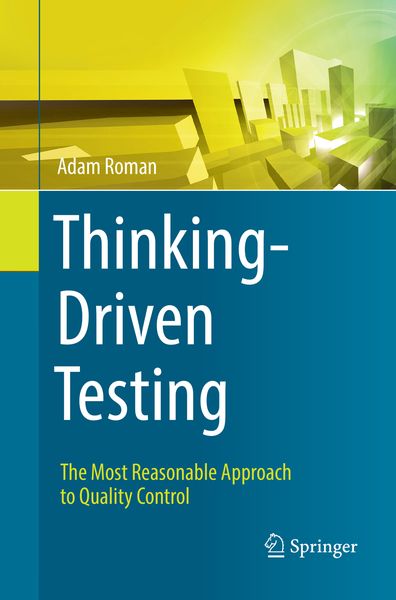
Thinking-Driven Testing The Most Reasonable Approach to Quality Control
-
- Hardcover
- Taschenbuch ausgewählt
- eBook
-
Sprache:Englisch
49,99 €
inkl. gesetzl. MwSt.,
Beschreibung
Produktdetails
Einband
Taschenbuch
Erscheinungsdatum
04.01.2019
Abbildungen
XXV, 305 p. 84 illus., 7 illus. in color.
Verlag
SpringerSeitenzahl
305
Maße (L/B/H)
23,5/15,5/1,9 cm
Gewicht
505 g
Auflage
Softcover reprint of the original 1st edition 2018
Sprache
Englisch
ISBN
978-3-030-10331-6
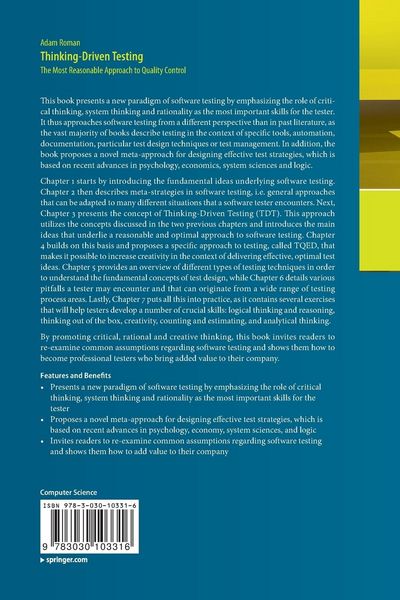
This book presents a new paradigm of software testing by emphasizing the role of critical thinking, system thinking and rationality as the most important skills for the tester. It thus approaches software testing from a different perspective than in past literature, as the vast majority of books describe testing in the context of specific tools, automation, documentation, particular test design techniques or test management. In addition, the book proposes a novel meta-approach for designing effective test strategies, which is based on recent advances in psychology, economics, system sciences and logic.
Chapter 1 starts by introducing the fundamental ideas underlying software testing. Chapter 2 then describes meta-strategies in software testing, i.e. general approaches that can be adapted to many different situations that a software tester encounters. Next, Chapter 3 presents the concept of Thinking-Driven Testing (TDT). This approach utilizes the conceptsdiscussed in the two previous chapters and introduces the main ideas that underlie a reasonable and optimal approach to software testing. Chapter 4 builds on this basis and proposes a specific approach to testing, called TQED, that makes it possible to increase creativity in the context of delivering effective, optimal test ideas. Chapter 5 provides an overview of different types of testing techniques in order to understand the fundamental concepts of test design, while Chapter 6 details various pitfalls a tester may encounter and that can originate from a wide range of testing process areas. Lastly, Chapter 7 puts all this into practice, as it contains several exercises that will help testers develop a number of crucial skills: logical thinking and reasoning, thinking out of the box, creativity, counting and estimating, and analytical thinking.
By promoting critical, rational and creative thinking, this book invites readers to re-examine common assumptions regarding software testing and shows them how to become professional testers who bring added value to their company.
Noch keine Bewertungen vorhanden
Verfassen Sie die erste Bewertung zu diesem Artikel
Helfen Sie anderen Kundinnen und Kunden durch Ihre Meinung.
Kurze Frage zu unserer Seite
Vielen Dank für Ihr Feedback
Wir nutzen Ihr Feedback, um unsere Produktseiten zu verbessern. Bitte haben Sie Verständnis, dass wir Ihnen keine Rückmeldung geben können. Falls Sie Kontakt mit uns aufnehmen möchten, können Sie sich aber gerne an unseren Kund*innenservice wenden.
zum Kundenservice