
Principles and Structures of FPGAs
-
- Hardcover
- Taschenbuch ausgewählt
- eBook
-
Sprache:Englisch
189,99 €
UVP
219,99 €
inkl. gesetzl. MwSt.,
Beschreibung
Produktdetails
Einband
Taschenbuch
Erscheinungsdatum
11.02.2019
Herausgeber
Hideharu AmanoVerlag
Springer SingaporeSeitenzahl
231
Maße (L/B/H)
23,5/15,5/1,4 cm
Gewicht
379 g
Auflage
Softcover reprint of the original 1st ed. 2018
Sprache
Englisch
ISBN
978-981-13-4510-4
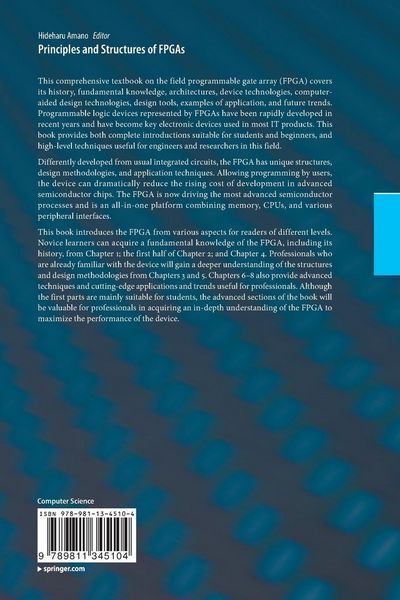
This comprehensive textbook on the field programmable gate array (FPGA) covers its history, fundamental knowledge, architectures, device technologies, computer-aided design technologies, design tools, examples of application, and future trends. Programmable logic devices represented by FPGAs have been rapidly developed in recent years and have become key electronic devices used in most IT products. This book provides both complete introductions suitable for students and beginners, and high-level techniques useful for engineers and researchers in this field.
Differently developed from usual integrated circuits, the FPGA has unique structures, design methodologies, and application techniques. Allowing programming by users, the device can dramatically reduce the rising cost of development in advanced semiconductor chips. The FPGA is now driving the most advanced semiconductor processes and is an all-in-one platform combining memory, CPUs, and various peripheral interfaces.
This book introduces the FPGA from various aspects for readers of different levels. Novice learners can acquire a fundamental knowledge of the FPGA, including its history, from Chapter 1; the first half of Chapter 2; and Chapter 4. Professionals who are already familiar with the device will gain a deeper understanding of the structures and design methodologies from Chapters 3 and 5. Chapters 6–8 also provide advanced techniques and cutting-edge applications and trends useful for professionals. Although the first parts are mainly suitable for students, the advanced sections of the book will be valuable for professionals in acquiring an in-depth understanding of the FPGA to maximize the performance of the device.
Noch keine Bewertungen vorhanden
Verfassen Sie die erste Bewertung zu diesem Artikel
Helfen Sie anderen Kundinnen und Kunden durch Ihre Meinung.
Kurze Frage zu unserer Seite
Vielen Dank für Ihr Feedback
Wir nutzen Ihr Feedback, um unsere Produktseiten zu verbessern. Bitte haben Sie Verständnis, dass wir Ihnen keine Rückmeldung geben können. Falls Sie Kontakt mit uns aufnehmen möchten, können Sie sich aber gerne an unseren Kund*innenservice wenden.
zum Kundenservice