KI-Beratung Beta

  • Produktbild: The Visionary Realism of German Economics
  • Produktbild: The Visionary Realism of German Economics

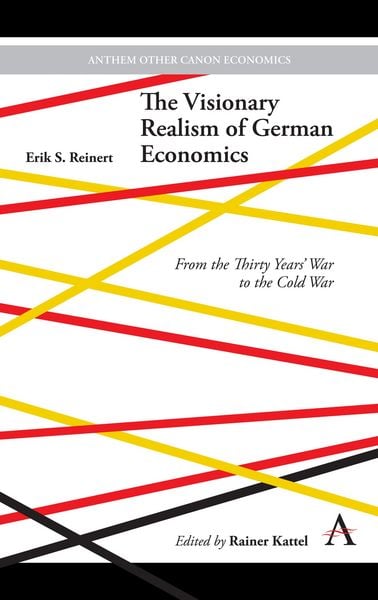
The Visionary Realism of German Economics From the Thirty Years' War to the Cold War

181,99 €

inkl. gesetzl. MwSt., Versandkostenfrei


Beschreibung

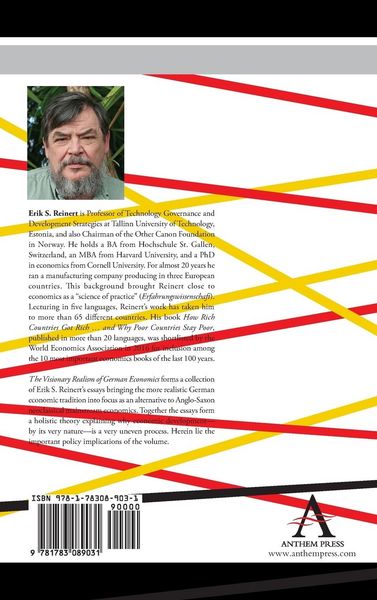
'The Visionary Realism of German Economics' forms a collection of Erik S. Reinert's essays bringing the more realistic German economic tradition into focus as an alternative to Anglo-Saxon neoclassical mainstream economics.

Beschreibung

'The Visionary Realism of German Economics' forms a collection of Erik S. Reinert's essays bringing the more realistic German economic tradition into focus as an alternative to Anglo-Saxon neoclassical mainstream economics.

Produktdetails

Einband

Gebundene Ausgabe

Erscheinungsdatum

15.02.2019

Herausgeber Rainer Kattel
Verlag Ingram Publishers Services

Produktdetails

Einband

Gebundene Ausgabe

Erscheinungsdatum

15.02.2019

Herausgeber Rainer Kattel
Verlag Ingram Publishers Services
Seitenzahl

606

Maße (L/B/H)

23,5/15,7/4 cm

Gewicht

1075 g

Sprache

Englisch

ISBN

978-1-78308-903-1

Herstelleradresse

Libri GmbH
Europaallee 1
36244 Bad Hersfeld
DE

Email: gpsr@libri.de

Noch keine Bewertungen vorhanden

Verfassen Sie die erste Bewertung zu diesem Artikel

Helfen Sie anderen Kundinnen und Kunden durch Ihre Meinung.

Kundinnen und Kunden meinen

Bewertungen (0)

Die Leseprobe wird geladen.
  • Produktbild: The Visionary Realism of German Economics
  • Produktbild: The Visionary Realism of German Economics
  • Introduction; Chapter 1 German Economics as Development Economics: From the Thirty Years' War to World War II; Chapter 2 The Role of the State in Economic Growth; Chapter 3 A Brief Introduction to Veit Ludwig von Seckendorff (1626- 1692); Chapter 4 Exploring the Genesis of Economic Innovations: The Religious Gestalt- Switch and the Duty to Invent as Preconditions for Economic Growth (with Arno Daastøl); Chapter 5 Johann Heinrich Gottlob von Justi (1717- 1771): The Life and Times of an Economist Adventurer; Chapter 6 Jacob Bielfeld's "On the Decline of States" (1760) and Its Relevance for Today; Chapter 7 Raw Materials in the History of Economic Policy; or, Why List (the Protectionist) and Cobden (the Free Trader) Both Agreed on Free Trade in Corn; Chapter 8 Compensation Mechanisms and Targeted Economic Growth: Lessons from the History of Economic Policy; Chapter 9 Karl Bücher and the Geographical Dimensions of Techno- Economic Change: Production- Based Economic Theory and the Stages of Economic Development; Chapter 10 Austrian Economics and the Other Canon: The Austrians between the Activistic- Idealistic and the Passivistic- Materialistic Traditions of Economics; Chapter 11 Nietzsche and the German Historical School of Economics (with Sophus A. Reinert); Chapter 12 Creative Destruction in Economics: Nietzsche, Sombart, Schumpeter (with Hugo Reinert); Chapter 13 Schumpeter in the Context of Two Canons of Economic Thought; Chapter 14 The Role of Technology in the Creation of Rich and Poor Nations: Underdevelopment in a Schumpeterian System; Chapter 15 Towards an Austro-German Theory of Uneven Economic Development? A Plea for Theorising by Inclusion; Chapter 16 The Qualitative Shift in European Integration: Towards Permanent Wage Pressures and a 'Latin- Americanization' of Europe? (with Rainer Kattel); Chapter 17 Primitivization of the EU Periphery: The Loss of Relevant Knowledge; Chapter 18 Mechanisms of Financial Crises in Growth and Collapse: Hammurabi, Schumpeter, Perez, and Minsky; Chapter 19 Full Circle: Economics from Scholasticism through Innovation and Back into Mathematical Scholasticism: Reflections on a 1769 Price Essay: "Why Is It That Economics So Far Has Gained So Few Advantages from Physics and Mathematics?"; Chapter 20 Werner Sombart (1863-1941) and the Swan Song of German Economics; Index.