Gutscheinbedingungen

**Gültig von 22.06.2026 ab 19 Uhr bis 23.06.2026 24 Uhr auf Spielzeug, Schreibwaren, Filme, Geschenke & Trends, Musik, tolino eReader & Zubehör, Hörbücher und Hörbuch-Downloads (außer Abo), nicht preisgebundene Bücher und Kalender online auf thalia.at und in der Thalia App. Einzelne Artikel können ausgeschlossen sein. Aufgrund der Buchpreisbindung sind deutschsprachige Bücher und eBooks ausgenommen. Zusätzlich ausgenommen sind preisgebundene Artikel, Abos & Flatrates, eBooks, Games, Geschenkkarten/-boxen, Shelfies, Software, Zeitschriften sowie einzelne Artikel von tonies®. Pro Einkauf einmal einlösbar. Click & Collect nur bei Onlinevorabzahlung möglich. Keine Barauszahlung. Nicht kombinierbar mit anderen Aktionen und Gutscheinen. Gutschein wird auf max. 500€ Bestellwert angerechnet. Nicht gültig für Versandkosten und Services.

  • Produktbild: Logistical Asia
  • Produktbild: Logistical Asia
- 19%

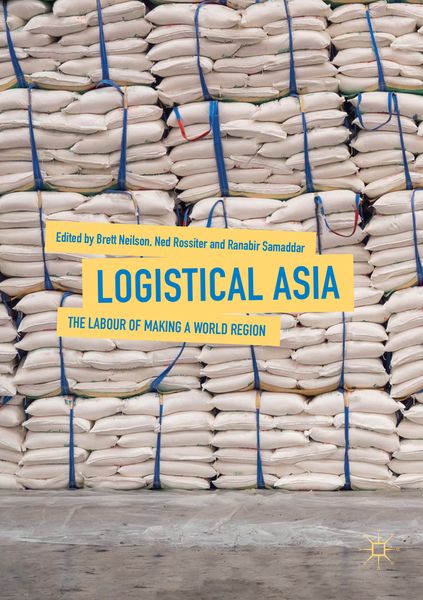
Logistical Asia The Labour of Making a World Region

19% sparen

105,99 € UVP 131,99 €

inkl. gesetzl. MwSt., Versandkostenfrei


Beschreibung

Produktdetails

Einband

Taschenbuch

Erscheinungsdatum

30.01.2019

Abbildungen

XIII, 6 illus., schwarz-weiss Illustrationen

Herausgeber

Brett Neilson + weitere

Verlag

Springer Singapore

Seitenzahl

300

Maße (L/B/H)

21/14,8/1,8 cm

Gewicht

411 g

Auflage

Softcover reprint of the original 1st ed. 2018

Sprache

Englisch

ISBN

978-981-13-4126-7

Beschreibung

Portrait

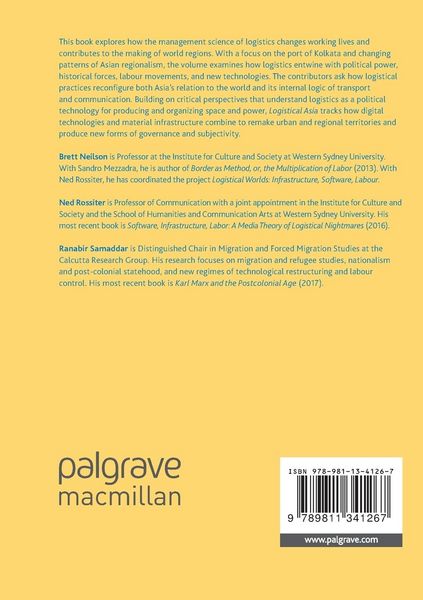
Brett Neilson is Professor at the Institute for Culture and Society at Western Sydney University. With Sandro Mezzadra, he is author of Border as Method, or, the Multiplication of Labor (2013). With Ned Rossiter, he has coordinated the project Logistical Worlds: Infrastructure, Software, Labour.

Ned Rossiter is Professor of Communication with a joint appointment in the Institute for Culture and Society and the School of Humanities and Communication Arts at Western Sydney University. His most recent book is Infrastructure, Software, Labor: A Media Theory of Logistical Nightmares (2016).

Ranabir Samaddar is Distinguished Chair in Migration and Forced Migration Studies at the Calcutta Research Group. His research focuses on migration and refugee studies, nationalism and post-colonial statehood, and new regimes of technological restructuring and labour control. His most recent book is Karl Marx and the Postcolonial Age (2017).

Produktdetails

Einband

Taschenbuch

Erscheinungsdatum

30.01.2019

Abbildungen

XIII, 6 illus., schwarz-weiss Illustrationen

Herausgeber

Verlag

Springer Singapore

Seitenzahl

300

Maße (L/B/H)

21/14,8/1,8 cm

Gewicht

411 g

Auflage

Softcover reprint of the original 1st ed. 2018

Sprache

Englisch

ISBN

978-981-13-4126-7

Herstelleradresse

Springer-Verlag GmbH
Tiergartenstr. 17
69121 Heidelberg
DE

Email: ProductSafety@springernature.com

Kundinnen und Kunden meinen

0 Bewertungen

Informationen zu Bewertungen

Zur Abgabe einer Bewertung ist eine Anmeldung im Konto notwendig. Die Authentizität der Bewertungen wird von uns nicht überprüft. Wir behalten uns vor, Bewertungstexte, die unseren Richtlinien widersprechen, entsprechend zu kürzen oder zu löschen.

Die Bewertungen sind nach Format, Anzahl Sterne und Datum sortiert.

Verfassen Sie die erste Bewertung zu diesem Artikel

Helfen Sie anderen Kund*innen durch Ihre Meinung

Kundinnen und Kunden meinen

0 Bewertungen filtern

  • Produktbild: Logistical Asia
  • Produktbild: Logistical Asia
  • 1. Making Logistical Worlds.- Part I Port as Infrastructure of Postcolonial Capitalism.- 2. The Port of Calcutta in the Imperial Network of South and South-East Asia, 1870s-1950s.- 3. Spatialization of Calculability, Financialization of Space: A Study of the Kolkata Port.- 4. Ports and Crime.- 5. Haldia: Logistics and Its Other(s).- 6. Kolkata Port: Challenges of Geopolitics and Globalization.- Part II Logistics of Asia-Led Globalization.- 7. The Importance of Being Siliguri: Border Effect and the ‘Untimely’ City in North Bengal.- 8. Piraeus Port as a Machinic Assemblage: Labour, Precarity and Struggles.- 9. Asia’s Era of Infrastructure and the Politics of Corridors: Decoding the Language of Logistical Governance.- 10. Logistics of the Accident: E-waste Management in Hong Kong.- 11. Geopolitics of the Belt and Road: Space, State, and Capital in China and Pakistan.- 12. Becoming Immaterial Labour: The Case of Macau’s Internet Users.- 13. Follow the Software: Reflections on the Logistical Worlds Project.