Gutscheinbedingungen

**Gültig von 22.06.2026 ab 19 Uhr bis 23.06.2026 24 Uhr auf Spielzeug, Schreibwaren, Filme, Geschenke & Trends, Musik, tolino eReader & Zubehör, Hörbücher und Hörbuch-Downloads (außer Abo), nicht preisgebundene Bücher und Kalender online auf thalia.at und in der Thalia App. Einzelne Artikel können ausgeschlossen sein. Aufgrund der Buchpreisbindung sind deutschsprachige Bücher und eBooks ausgenommen. Zusätzlich ausgenommen sind preisgebundene Artikel, Abos & Flatrates, eBooks, Games, Geschenkkarten/-boxen, Shelfies, Software, Zeitschriften sowie einzelne Artikel von tonies®. Pro Einkauf einmal einlösbar. Click & Collect nur bei Onlinevorabzahlung möglich. Keine Barauszahlung. Nicht kombinierbar mit anderen Aktionen und Gutscheinen. Gutschein wird auf max. 500€ Bestellwert angerechnet. Nicht gültig für Versandkosten und Services.

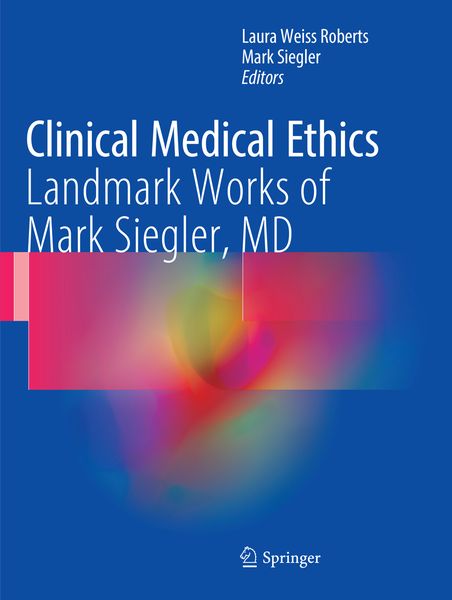
  • Produktbild: Clinical Medical Ethics
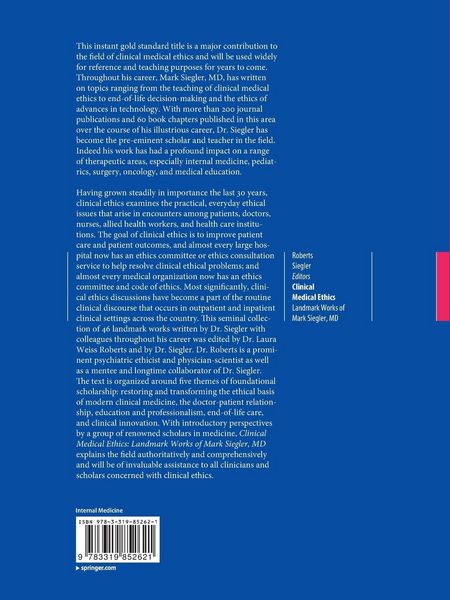
  • Produktbild: Clinical Medical Ethics
- 12%

Clinical Medical Ethics Landmark Works of Mark Siegler, MD

12% sparen

88,99 € UVP 101,20 €

inkl. gesetzl. MwSt., Versandkostenfrei


Beschreibung

Produktdetails

Einband

Taschenbuch

Erscheinungsdatum

12.09.2018

Abbildungen

XVII, 17 illus., 8 illus. in color., farbige Illustrationen, schwarz-weiss Illustrationen

Herausgeber

Laura Weiss Roberts + weitere

Verlag

Springer

Seitenzahl

419

Maße (L/B/H)

27,9/21/2,4 cm

Gewicht

1065 g

Auflage

Softcover reprint of the original 1st edition 2017

Sprache

Englisch

ISBN

978-3-319-85262-1

Beschreibung

Portrait

Laura Weiss Roberts, M.D., M.A. is Chairman and Katharine Dexter McCormick and Stanley McCormick Memorial Professor in the Department of Psychiatry and Behavioral Medicine at the Stanford University School of Medicine. She is an internationally recognized scholar and leader in bioethics, psychiatry, medicine, and medical education. Dr. Roberts has performed numerous empirical studies of contemporary ethics issues in medicine and health policy, societal implications for genetic innovation, the impact of medical student and physician health issues, and has been funded by the National Institutes of Health, the Department of Energy, the National Alliance of Schizophrenia and Depression, the Arnold P. Gold Foundation, and other private and public foundations. In 2003, Dr. Roberts was appointed the Editor-in-Chief for Academic Psychiatry a journal focused on innovative education, mentorships, and leadership in academic psychiatry.

Produktdetails

Einband

Taschenbuch

Erscheinungsdatum

12.09.2018

Abbildungen

XVII, 17 illus., 8 illus. in color., farbige Illustrationen, schwarz-weiss Illustrationen

Herausgeber

Verlag

Springer

Seitenzahl

419

Maße (L/B/H)

27,9/21/2,4 cm

Gewicht

1065 g

Auflage

Softcover reprint of the original 1st edition 2017

Sprache

Englisch

ISBN

978-3-319-85262-1

Herstelleradresse

Springer-Verlag KG
Sachsenplatz 4-6
1201 Wien
AT

Email: ProductSafety@springernature.com

Kundinnen und Kunden meinen

0 Bewertungen

Informationen zu Bewertungen

Zur Abgabe einer Bewertung ist eine Anmeldung im Konto notwendig. Die Authentizität der Bewertungen wird von uns nicht überprüft. Wir behalten uns vor, Bewertungstexte, die unseren Richtlinien widersprechen, entsprechend zu kürzen oder zu löschen.

Die Bewertungen sind nach Format, Anzahl Sterne und Datum sortiert.

Verfassen Sie die erste Bewertung zu diesem Artikel

Helfen Sie anderen Kund*innen durch Ihre Meinung

Kundinnen und Kunden meinen

0 Bewertungen filtern

  • Produktbild: Clinical Medical Ethics
  • Produktbild: Clinical Medical Ethics
  • Part I Restoring and Transforming the Ethical Basis of Modern Clinical Medicine.- 1. An Introduction from Laura Weiss Roberts, M.D., M.A..- 2. A Perspective from Mark Siegler, M.D..- 3. A Perspective from Daniel P. Sulmasy, M.D., Ph.D..- 4. A Perspective from Dana Levinson, M.P.H., Holly J. Humphrey, M.D., and Kenneth S. Polonsky, M.D..- 5. A Perspective from Jordan J. Cohen, M.D..- 6. A Perspective from Peter A. Singer, M.D..- Part II Landmark Works on Clinical Medical Ethics by Mark Siegler, M.D..- 7. Foundational Scholarship7.1 Clinical ethics and clinical medicine (1979).- 7.2 Decision-making strategy for clinical ethical problems in medicine (1982).- 7.3 An ethics consultation service in a teaching hospital. Utilization and evaluation (1988).- 7.4 Clinical medical ethics (1990).- 7.5 Ethics committees and consultants (1990).- 7.6 Future directions in clinical ethics (1991).- 7.7 Clinical ethics (1991).- 7.8 Clinical ethics in the practice of medicine (1996).- 7.9 Five major themes in bioethics (1997).- 7.10 The contributions of clinical ethics to patient care (1997).- 8. The Doctor-Patient Relationship.- 8.1 Searching for moral certainty in medicine: a proposal for a new model of the doctor-patient encounter  1981).- 8.2 Clinical intuition: a procedure for balancing the rights of patients and the responsibilities of physicians (1981).- 8.3 The doctor-patient encounter and its relationship to theories of health and disease (1981).- 8.4 The physician-patient accommodation: a central event in clinical medicine (1982).- 8.5 Confidentiality in medicine: a decrepit concept (1982).- 8.6 Medical consultations in the context of the physician-patient relationship (1982).- 8.7 Metaphors and models of doctor-patient relationships: their implications for autonomy (1984).- 8.8 The progression of medicine: from physician paternalism to patient autonomy to bureaucratic parsimony (1985).- 8.9 Learning from our patients: one participant’s impact on clinicaltrial research and informed consent (1997).- 8.10 The physician-surrogate relationship (2007).- 9. Education and Professionalism.- 9.1 A legacy of Osler: teaching clinical ethics at the bedside (1978).- 9.2 Basic curricular goals in medical ethics: the DeCamp conference on the teaching of medical ethics (1985).- 9.3 Fellowship training programs in clinical ethics (1988).- 9.4 Development of a teaching program in clinical medical ethics at the University of Chicago (1989).- 9.5 Internal medicine residents' preferences regarding medical ethics education (1989).- 9.6 Caring for medical students as patients (1990).- 9.7 Teaching clinical ethics (1990).- 9.8 Medical students as patients: a pilot study of their health care needs, practices, and concerns (1996).- 9.9 What and how psychiatry residents at ten training programs wish to learn about ethics (1996).- 9.10 Clinical ethics teaching in psychiatric supervision (1996).- 9.11 Training doctors for professionalism: some lessons from teaching clinical medical ethics (2002).- 10. End-of-Life Care.- 10.1 Pascal's wager and the hanging of crepe (1975).- 10.2 Critical illness: the limits of autonomy (1977).- 10.3 Brain death and live birth (1982).- 10.4 Against the emerging stream: should fluids and nutritional support be discontinued? (1985).- 10.5 Euthanasia: a critique (1990).- 10.6 Elective use of life-sustaining treatments in internal medicine (1991).- 10.7 Intimacy and caring: the legacy of Karen Ann Quinlan (1993).- 10.8 The rise and fall of the futility movement (2000).- 11. Clinical Innovation11.1 Ethical issues in growth hormone therapy (1989).- 11.2 Orthopedic surgeons' attitudes and practices concerning the treatment of patients with human immunosuppressive virus infection (1989).- 11.3 Ethics of liver transplantation with living donors (1989).- 11.4 Bone marrow transplantation for sickle cell disease; a study of parents’ decisions (1991).- 11.5 Ethical justification for living liver donation (1992).- 11.6 Transplantation of liver grafts from living donors into adults: too much, too soon (2001).- 11.7 Elective surgical patients as living organ donors: a clinical and ethical innovation (2009).- Appendix.