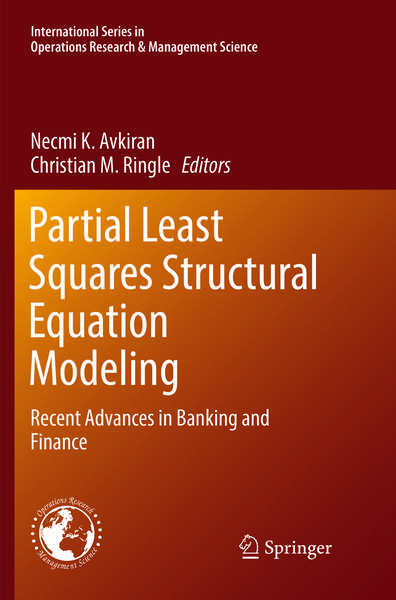
Partial Least Squares Structural Equation Modeling Recent Advances in Banking and Finance
-
- Hardcover
- Taschenbuch ausgewählt
- eBook
-
Sprache:Englisch
221,99 €
inkl. gesetzl. MwSt.,
Beschreibung
Produktdetails
Einband
Taschenbuch
Erscheinungsdatum
07.06.2019
Abbildungen
X, 239 p. 33 illus., 2 illus. in color.
Herausgeber
Necmi K. Avkiran + weitereVerlag
SpringerSeitenzahl
239
Maße (L/B/H)
23,5/15,5/1,4 cm
Gewicht
388 g
Auflage
Softcover reprint of the original 1st ed. 2018
Sprache
Englisch
ISBN
978-3-319-89095-1
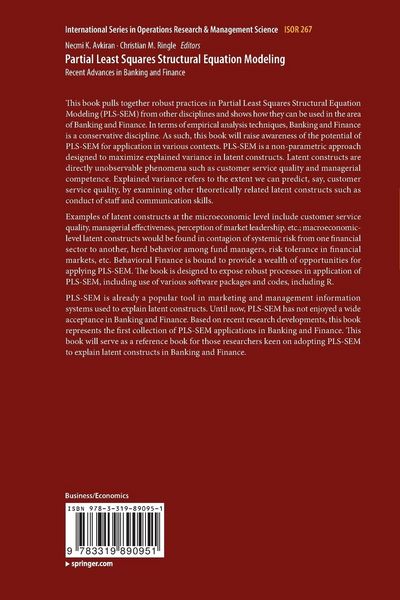
This book pulls together robust practices in Partial Least Squares Structural Equation Modeling (PLS-SEM) from other disciplines and shows how they can be used in the area of Banking and Finance. In terms of empirical analysis techniques, Banking and Finance is a conservative discipline. As such, this book will raise awareness of the potential of PLS-SEM for application in various contexts. PLS-SEM is a non-parametric approach designed to maximize explained variance in latent constructs. Latent constructs are directly unobservable phenomena such as customer service quality and managerial competence. Explained variance refers to the extent we can predict, say, customer service quality, by examining other theoretically related latent constructs such as conduct of staff and communication skills.
Examples of latent constructs at the microeconomic level include customer service quality, managerial effectiveness, perception of market leadership, etc.; macroeconomic-level latent constructs would be found in contagion of systemic risk from one financial sector to another, herd behavior among fund managers, risk tolerance in financial markets, etc. Behavioral Finance is bound to provide a wealth of opportunities for applying PLS-SEM. The book is designed to expose robust processes in application of PLS-SEM, including use of various software packages and codes, including R.
PLS-SEM is already a popular tool in marketing and management information systems used to explain latent constructs. Until now, PLS-SEM has not enjoyed a wide acceptance in Banking and Finance. Based on recent research developments, this book represents the first collection of PLS-SEM applications in Banking and Finance. This book will serve as a reference book for those researchers keen on adopting PLS-SEM to explain latent constructs in Banking and Finance.
Noch keine Bewertungen vorhanden
Verfassen Sie die erste Bewertung zu diesem Artikel
Helfen Sie anderen Kundinnen und Kunden durch Ihre Meinung.
Kurze Frage zu unserer Seite
Vielen Dank für Ihr Feedback
Wir nutzen Ihr Feedback, um unsere Produktseiten zu verbessern. Bitte haben Sie Verständnis, dass wir Ihnen keine Rückmeldung geben können. Falls Sie Kontakt mit uns aufnehmen möchten, können Sie sich aber gerne an unseren Kund*innenservice wenden.
zum Kundenservice