Gutscheinbedingungen

**Gültig bis 25.06.2026 auf fremdsprachige Bücher online auf thalia.at und in der Thalia App. Einzelne Artikel können ausgeschlossen sein. Ausgenommen sind preisgebundene Artikel & eBooks. Pro Einkauf einmal einlösbar. Click & Collect nur bei Onlinevorabzahlung möglich. Keine Barauszahlung. Nicht kombinierbar mit anderen Aktionen und Gutscheinen. Gutschein wird auf max. 500€ Bestellwert angerechnet. Nicht gültig für Geschenkkarten, Versandkosten und Services.

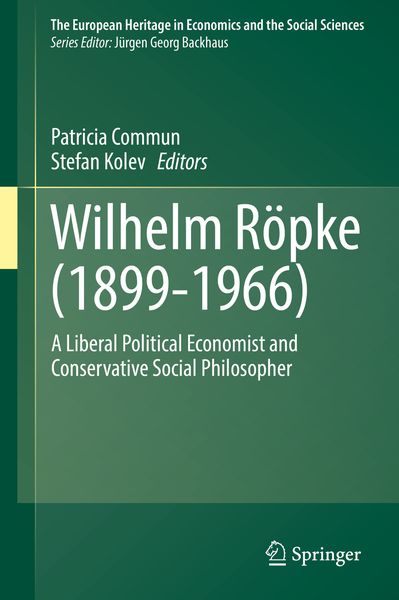
  • Produktbild: Wilhelm Röpke (1899–1966)
  • Produktbild: Wilhelm Röpke (1899–1966)
Band 20

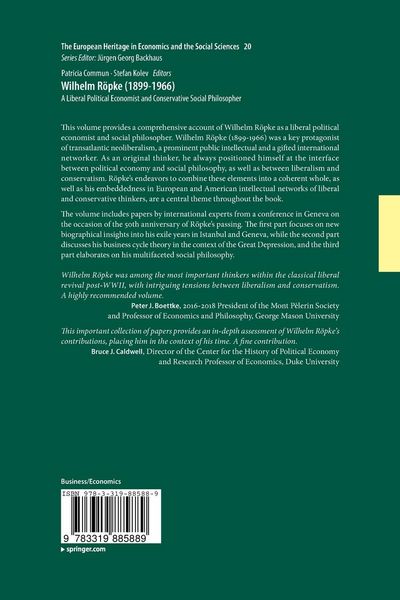
Wilhelm Röpke (1899–1966) A Liberal Political Economist and Conservative Social Philosopher

148,99 €

inkl. gesetzl. MwSt., Versandkostenfrei


Beschreibung

Produktdetails

Einband

Taschenbuch

Erscheinungsdatum

09.05.2019

Herausgeber

Patricia Commun + weitere

Verlag

Springer

Seitenzahl

272

Maße (L/B/H)

23,5/15,5/1,6 cm

Gewicht

435 g

Auflage

Softcover reprint of the original 1st ed. 2018

Sprache

Englisch

ISBN

978-3-319-88588-9

Beschreibung

Rezension

“It is to the credit of the editors and contributors to this collection of essays that they have produced a book that will surely spur further discussion of the thought and ongoing relevance of a sophisticated and synthetic twentieth-century public economist and social philosopher.” (Samuel Gregg, Journal of Markets & Morality, Vol. 22 (1), 2019)

“The … book brings a welcome and timely contribution to a better understanding of such a complex concept as (neo)liberalism … Röpke’s books remain a source of inspiration for us today, in our age of sophists, bankers, and calculators.” (Aurelian Craiutu, Society, Vol. 56, 2019)

Portrait

Patricia Commun  is a professor of German studies at the University of Cergy-Pontoise, France. Her fields of research are history of German economic thought, history of German liberalism and especially ordoliberalism. Patricia Commun’s last book (“Les Ordolibéraux. Histoire d'un libéralisme à l'allemande”, Les Belles Lettres, Paris 2016) covers the historical, political, and intellectual context of the refounding of German liberalism in the 1920s-1950s. Together with Stefan Kolev, she co-organized in April 2016 the International Wilhelm Röpke Conference in Geneva.

Stefan Kolev  is a professor of political economy at the University of Applied Sciences Zwickau, Germany, and the deputy director of the Wilhelm Röpke Institute in Erfurt, Germany. His fields of research are history of economic thought, Austrian economics, and constitutional political economy. Stefan Kolev’s last book (“Neoliberale Staatsverständnisse im Vergleich”, 2nd edition, De Gruyter Oldenbourg, Berlin/Boston 2017) analyzes comparatively the political economies of ordoliberals and Austrian economists of the 20th century, whereas his current projects address the 19th century origins of these ideas and their revitalization for the 21st century.

Produktdetails

Einband

Taschenbuch

Erscheinungsdatum

09.05.2019

Herausgeber

Verlag

Springer

Seitenzahl

272

Maße (L/B/H)

23,5/15,5/1,6 cm

Gewicht

435 g

Auflage

Softcover reprint of the original 1st ed. 2018

Sprache

Englisch

ISBN

978-3-319-88588-9

Herstelleradresse

Springer-Verlag GmbH
Tiergartenstr. 17
69121 Heidelberg
DE

Email: ProductSafety@springernature.com

Kundinnen und Kunden meinen

0 Bewertungen

Informationen zu Bewertungen

Zur Abgabe einer Bewertung ist eine Anmeldung im Konto notwendig. Die Authentizität der Bewertungen wird von uns nicht überprüft. Wir behalten uns vor, Bewertungstexte, die unseren Richtlinien widersprechen, entsprechend zu kürzen oder zu löschen.

Die Bewertungen sind nach Format, Anzahl Sterne und Datum sortiert.

Verfassen Sie die erste Bewertung zu diesem Artikel

Helfen Sie anderen Kund*innen durch Ihre Meinung

Kundinnen und Kunden meinen

0 Bewertungen filtern

  • Produktbild: Wilhelm Röpke (1899–1966)
  • Produktbild: Wilhelm Röpke (1899–1966)
  • I. Wilhelm Röpke as a Pragmatic Political Economist and Eclectic Social Philosopher: An Introduction.- II. Wilhelm Röpke: New Biographical Insights.- 1. Between Two Continents: Wilhelm Röpke’s Years in Istanbul.- 2. Wilhelm Röpke’s Utopia and Swiss Reality: From Neoliberalism to Neoconservatism.- 3. The Making of the “Third way”: Wilhelm Röpke, Luigi Einaudi, and the Identity of Neoliberalism.- 4. Paleo- and Neoliberals: Ludwig von Mises and the “Ordo Interventionists”.- III. Wilhelm Röpke as a Political Economist: Between Keynes and the Austrians.- 5. The Moral Foundations of Society and Technological Progress of the Economy in the Workof Wilhelm Röpke.- 6. Was Wilhelm Röpke Really a Proto-Keynesian?.- 7. Wilhelm Röpke’s Report on the Brauns Commission: Advocating a Pragmatic Business Cycle Policy.- 8. The Secondary Depression: An Integral Part of Wilhelm Röpke’s Business Cycle Theory.- IV. Wilhelm Röpke as a Social Philosopher: Between Conservatism and Liberalism.- IV. A) Wilhelm Röpke and Conservatism.- 9. From Basel to Brooklyn: Liberal Cultural Pessimism in Jacob Burckhardt, Wilhelm Röpke, and the American Neoconservatives.- 10. Wilhelm Röpke: Why He Was a Conservative.- 11. Wilhelm Röpke and American Conservatism.- 12. Cultural Pessimism and Liberal Regeneration? Wilhelm Röpke as an Ideological In-between in German Social Philosophy.- IV. B) Wilhelm Röpke and Liberalism.- 13. Wilhelm Röpke on Liberalism, Culture, and Economic Development.- 14. Scepticism about Markets and Optimism about Culture.- 15. Democracy, Liberalism, and Moral Order in Wilhelm Röpke: A Comparison with James M. Buchanan.- 16. The Relevance of Wilhelm Röpke in a Post-Totalitarian World.