Gutscheinbedingungen

**Gültig bis 12.08.2026 auf fremdsprachige Bücher online auf thalia.at und in der Thalia App. Einzelne Artikel können ausgeschlossen sein. Ausgenommen sind preisgebundene Artikel & eBooks. Pro Einkauf einmal einlösbar. Click & Collect nur bei Onlinevorabzahlung möglich. Keine Barauszahlung. Nicht kombinierbar mit anderen Aktionen und Gutscheinen. Gutschein wird auf max. 500€ Bestellwert angerechnet. Nicht gültig für Geschenkkarten, Versandkosten und Services.

  • Produktbild: Brief Cognitive Behavioural Therapy for Non-Underweight Patients
  • Produktbild: Brief Cognitive Behavioural Therapy for Non-Underweight Patients

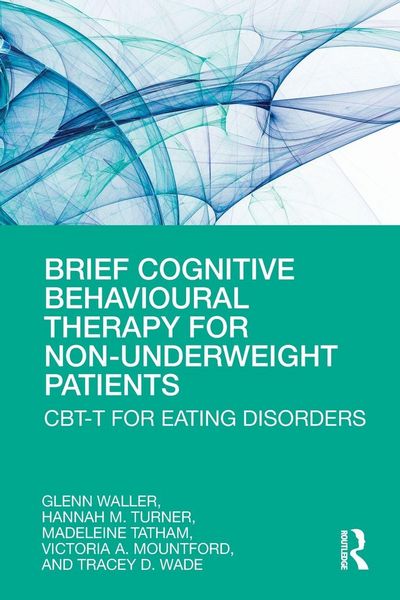
Brief Cognitive Behavioural Therapy for Non-Underweight Patients CBT-T for Eating Disorders

37,99 €

inkl. gesetzl. MwSt., Versandkostenfrei


Beschreibung

Produktdetails

Einband

Taschenbuch

Erscheinungsdatum

24.05.2019

Abbildungen

2 schwarzweisse Fotos, 10 schwarzweisse Zeichnungen, 20 Tabellen

Verlag

Taylor & Francis

Seitenzahl

234

Maße (L/B/H)

23,4/15,6/1,3 cm

Gewicht

360 g

Sprache

Englisch

ISBN

978-0-367-19229-7

Beschreibung

Rezension

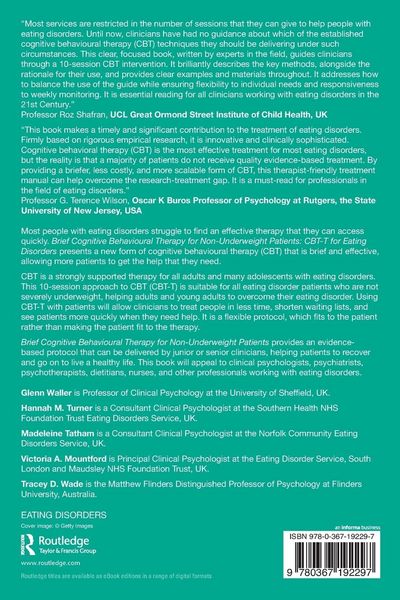
"Most services are restricted in the number of sessions that they can give to help people with eating disorders. Until now, clinicians have had no guidance about which of the established cognitive behavioural techniques (CBT) they should be delivering under such circumstances. This clear, focused book, written by experts in the field, guides clinicians through a ten session CBT intervention. It brilliantly describes the key methods, alongside the rationale for their use and provides clear examples and materials throughout. It addresses how to balance the use of the guide while ensuring flexibility to individual needs and responsiveness to weekly monitoring. It is essential reading for all clinicians working with eating disorders in the 21st Century." - Professor Roz Shafran, UCL Great Ormond Street Institute of Child Health

"This book makes a timely and significant contribution to the treatment of eating disorders. Firmly based on rigorous empirical research, it is innovative and clinically sophisticated. Cognitive behavioral therapy (CBT) is the most effective treatment for most eating disorders, but the reality is that a majority of patients do not receive quality evidence-based treatment. By providing a briefer, less costly, and more scalable form of CBT, this therapist-friendly treatment manual can help overcome the research-treatment gap. It is a must-read for professionals in the field of eating disorders." - Professor G. Terence Wilson, Oscar K Buros Professor of Psychology at Rutgers, the State University of New Jersey

Produktdetails

Einband

Taschenbuch

Erscheinungsdatum

24.05.2019

Abbildungen

2 schwarzweisse Fotos, 10 schwarzweisse Zeichnungen, 20 Tabellen

Verlag

Taylor & Francis

Seitenzahl

234

Maße (L/B/H)

23,4/15,6/1,3 cm

Gewicht

360 g

Sprache

Englisch

ISBN

978-0-367-19229-7

Herstelleradresse

Libri GmbH
Europaallee 1
36244 Bad Hersfeld
DE

Email: gpsr@libri.de

Noch keine Bewertungen vorhanden

Verfassen Sie die erste Bewertung zu diesem Artikel

Helfen Sie anderen Kundinnen und Kunden durch Ihre Meinung.

Kundinnen und Kunden meinen

Bewertungen (0)

Die Leseprobe wird geladen.
  • Produktbild: Brief Cognitive Behavioural Therapy for Non-Underweight Patients
  • Produktbild: Brief Cognitive Behavioural Therapy for Non-Underweight Patients
  • Foreword  Chapter 1. The background to CBT-T and its evidence base  Chapter 2. Principles of CBT-T, and how to apply them in routine practice  Chapter 3. The CBT-T protocol checklist, and how to employ it  Chapter 4. The critical first session  Chapter 5. Phase 1 - Exposure, nutrition, and repairing the 'broken' cognitive link  Chapter 6. Session 4 - Reviewing progress and deciding whether to continue  Chapter 7. Phase 2 - Addressing cognitions regarding food, eating, and weight, using behavioural experiments and cognitive restructuring  Chapter 8. Phase 3 - Working with emotional triggers and core beliefs  Chapter 9. Phase 4 - Working with body image  Chapter 10. Phase 5 - Relapse prevention  Chapter 11. Follow-up as an active part of therapy  Chapter 12. Patients' experiences of CBT-T, and the roles of clinicians and supervisors  References  Appendix 1 - CBT-T Protocol checklist  Appendix 2 - Basic diary sheet  Appendix 3 - ED-15 questionnaire and scoring key  Appendix 4 - Information sheet  for patients and their families and friends Appendix 5 - REAL food guide for CBT-T (Susan Hart & Caitlin McMaster)  Appendix 6 - Questionnaires to give the patient at each session  Appendix 7 - Patient handout on emotions and beliefs that can trigger eating behaviours  Appendix 8 - Extended food diary, assessing triggers to behaviours Appendix 9 - Template for therapy blueprint