KI-Beratung Beta

Produktbild: The Oxford Handbook of Karl Marx

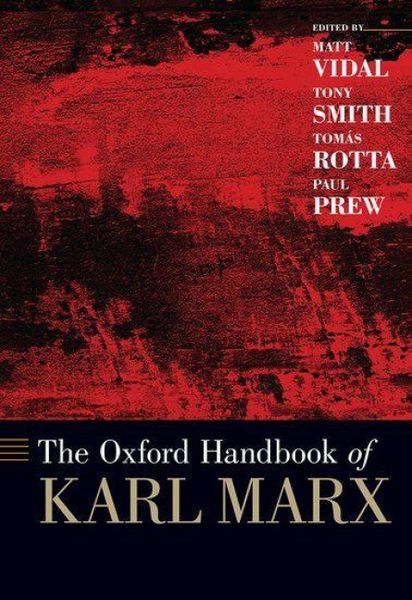
The Oxford Handbook of Karl Marx

Aus der Reihe Oxford Handbooks

164,99 €

inkl. gesetzl. MwSt., Versandkostenfrei


Beschreibung

Karl Marx is one of the most influential writers in history. Despite repeated obituaries proclaiming the death of Marxism, in the 21st century Marx's ideas and theories continue to guide vibrant research traditions in sociology, economics, political science, philosophy, history, anthropology, management,...

Beschreibung

Karl Marx is one of the most influential writers in history. Despite repeated obituaries proclaiming the death of Marxism, in the 21st century Marx's ideas and theories continue to guide vibrant research traditions in sociology, economics, political science, philosophy, history, anthropology, management, economic geography, ecology, literary criticism, and media studies.
Due to the exceptionally wide influence and reach of Marxist theory, including over 150 years of historical debates and traditions within Marxism, finding a point of entry can be daunting. The Oxford Handbook of Karl Marx provides an entry point for those new to Marxism. At the same time, its chapters, written by leading Marxist scholars, advance Marxist theory and research. Its coverage is more comprehensive than previous volumes on Marx in terms of both foundational concepts and state-of-the-art empirical research on contemporary social problems. It is also provides equal space to sociologists, economists, and political scientists, with substantial contributions from philosophers, historians, and geographers.
The Oxford Handbook of Karl Marx consists of six sections. The first section, Foundations, includes chapters that cover the foundational concepts and theories that constitute the core of Marx's theories of history, society, and political economy. This section demonstrates that the core elements of Marx's political economy of capitalism continue to be defended, elaborated, and applied to empirical social science and covers historical materialism, class, capital, labor, value, crisis, ideology, and alienation. Additional sections include Labor, Class, and Social Divisions; Capitalist States and Spaces; Accumulation, Crisis, and Class Struggle in the Core Countries; Accumulation, Crisis, and Class Struggle in the Peripheral and Semi-Peripheral Countries; and Alternatives to Capitalism.

Rezension

This Oxford handbook serves its stated purpose of providing an entry point into Marxist theory. While the book aims to be accessible to beginners, readers will benefit from prior understanding of economic theories. This collection of empirical research is divided into seven sections that can be read independently. Some of the sections include essay collections such as "Labor, Class, and Social Divisions," "Capitalist States and Spaces," and "Alternatives to Capitalism." The handbook has various points of entry beginning with the table of contents, which receives a detailed walk-through in the introductory chapter. The index is also detailed and thorough (as one would expect from Oxford's authoritative series). If the researching mind finds itself stimulated, each chapter contains extensive citations. This detailed volume provides enough information for readers to make their own decision on whether Marxism still lives. R. I. Saltz, Independent scholar, CHOICE
Produktdetails

Einband

Gebundene Ausgabe

Erscheinungsdatum

23.04.2019

Herausgeber Matt Vidal + weitere
Verlag Oxford University Press

Produktdetails

Einband

Gebundene Ausgabe

Erscheinungsdatum

23.04.2019

Herausgeber
Verlag Oxford University Press
Seitenzahl

862

Maße (L/B/H)

25,4/17,7/6 cm

Gewicht

1632 g

Sprache

Englisch

ISBN

978-0-19-069554-5

Herstelleradresse

Libri GmbH
Europaallee 1
36244 Bad Hersfeld
DE

Email: gpsr@libri.de

Noch keine Bewertungen vorhanden

Verfassen Sie die erste Bewertung zu diesem Artikel

Helfen Sie anderen Kundinnen und Kunden durch Ihre Meinung.

Kundinnen und Kunden meinen

Bewertungen (0)

Die Leseprobe wird geladen.
  • Produktbild: The Oxford Handbook of Karl Marx
    • Introduction
    • 1. The Enduring Relevance of Karl Marx
    • Paul Prew, Tomas Rotta, Tony Smith, and Matt Vidal
    • Part I. Foundations
    • 2. Historical Materialism
    • Paul Blackledge
    • 3. Class and Class Struggle
    • Henry Heller
    • 4. Forces of Production and Relations of Production
    • David Laibman
    • 5. The Eight Steps in Marx's Dialectical Method
    • Bertell Ollman
    • 6. Ideology as Alienated Socialization
    • Jan Rehmann
    • 7. Marx's Conceptualization of Value in Capital
    • Geert Reuten
    • 8. Value and Class
    • Alan Freeman
    • 9. Money
    • Leda Maria Paulani
    • 10. Capital
    • Andrew Kliman
    • 11. Capital: A Revolutionary Social Form
    • Patrick Murray
    • 12. The Grammar of Capital: Wealth in-against-and-beyond Value
    • John Holloway
    • 13. Work and Exploitation in Capitalism: The Labor Process and the Valorization Process
    • Matt Vidal
    • 14. Capital in General and Competition: The Production and Distribution of Surplus-Value
    • Fred Moseley
    • 15. Reproduction and Crisis in Capitalist Economies
    • Deepankar Basu
    • 16. The Capitalist State and State Power
    • Bob Jessop
    • 17. Capitalist Social Reproduction: The Contradiction between Production and Social Reproduction under Capitalism
    • Martha E. Gimenez
    • 18. Marx, Technology, and the Pathological Future of Capitalism
    • Tony Smith
    • 19. Alienation, or Why Capitalism Is Bad for Us
    • Dan Swain
    • 20. The Commodification of Knowledge and Information
    • Tomás Rotta and Rodrigo Teixeira
    • Part II. Labor, Class, and Social Divisions
    • 21. Labor Unions and Movements
    • Barry Eidlin
    • 22. Migration and the Mobility of Labor
    • Nicholas De Genova
    • 23. Race, Class, and Revolution in the Twenty-First Century: Lessons from the League of Revolutionary Black Workers
    • Walda Katz-Fishman and Jerome Scott
    • 24. Nationalism, Class, and Revolution
    • Kevin B. Anderson
    • 25. Hegemony: A Theory of National-Popular Class Politics
    • Mark McNally
    • Part III. Capitalist States and Spaces
    • 26. Capitalist Crises and the State
    • Leo Panitch and Sam Gindin
    • 27. European "Integration"
    • Magnus Ryner
    • 28. The Urbanization of Capital and the Production of Capitalist Natures
    • Erik Swyngedouw
    • Part IV. Accumulation, Crisis, and Class Struggle in the Core Countries
    • 29. Stages of Capitalism and Social Structures of Accumulation: A Long View
    • Terrence McDonough
    • 30. Geriatric Capitalism: Stagnation and Crisis in the Atlantic Postfordist Accumulation Regime
    • Matt Vidal
    • 31. Sociopoiesis: Understanding Crisis in the Capitalist World-System through Complexity Sciences
    • Paul Prew
    • 32. Towards a Marxist Theory of Financialized Capitalism
    • Jeff Powell
    • 33. Metabolic Rifts and the Ecological Crisis
    • Brett Clark, John Bellamy Foster, and Stefano B. Longo
    • Part V. Accumulation, Crisis, and Class Struggle in the Peripheral and Semi-Peripheral Countries
    • 34. Global Capital Accumulation and the Specificity of Latin America
    • Guido Starosta
    • 35. The Unresolved Agrarian Question in South Asia
    • Debarshi Das
    • 36. Asia and the Shift in Marx's Conception of Revolution and History
    • Chun Lin
    • 37. Analyzing the Middle East
    • Gilbert Achcar
    • 38. Primitive Accumulation in Post-Soviet Russia
    • David Mandel
    • Part VI. Alternatives to Capitalism
    • 39. Marx's Concept of Socialism
    • Peter Hudis
    • 40. Democratic Socialist Planning
    • Pat Devine
    • 41. The Continuing Relevance of the Marxist Tradition for Transcending Capitalism
    • Erik Olin Wright