Gutscheinbedingungen

**Gültig nur für Bestellungen an die Wunsch-Poststation bis 10.06.2026 auf Spielzeug, Schreibwaren, Filme, Geschenke & Trends, Musik, tolino eReader & Zubehör, Hörbücher und Hörbuch-Downloads (außer Abo), nicht preisgebundene Bücher und Kalender online auf thalia.at und in der Thalia App. Einzelne Artikel können ausgeschlossen sein. Aufgrund der Buchpreisbindung sind deutschsprachige Bücher und eBooks ausgenommen. Zusätzlich ausgenommen sind preisgebundene Artikel, Abos & Flatrates, eBooks, Games, Geschenkkarten/-boxen, Shelfies, Software, Zeitschriften sowie einzelne Artikel von tonies®. Pro Einkauf einmal einlösbar. Kein Click & Collect möglich. Keine Barauszahlung. Nicht kombinierbar mit anderen Aktionen und Gutscheinen. Gutschein wird auf max. 500€ Bestellwert angerechnet. Nicht gültig für Versandkosten und Services.

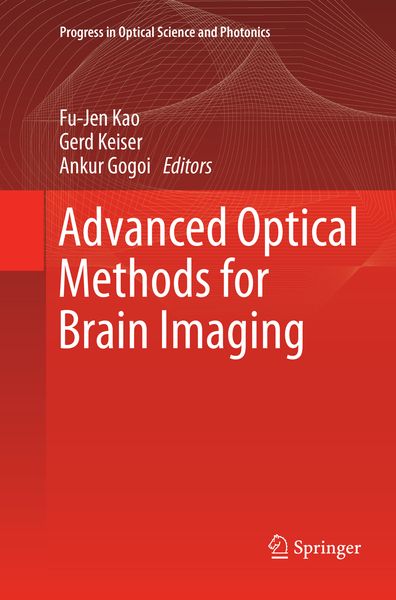
  • Produktbild: Advanced Optical Methods for Brain Imaging
  • Produktbild: Advanced Optical Methods for Brain Imaging
Band 5 - 12%

Advanced Optical Methods for Brain Imaging

12% sparen

95,99 € UVP 109,99 €

inkl. gesetzl. MwSt., Versandkostenfrei


Beschreibung

Produktdetails

Einband

Taschenbuch

Erscheinungsdatum

10.01.2019

Abbildungen

XX, 113 illus., 101 illus. in color., farbige Illustrationen, schwarz-weiss Illustrationen

Herausgeber

Fu-Jen Kao + weitere

Verlag

Springer Singapore

Seitenzahl

334

Maße (L/B/H)

23,5/15,5/2 cm

Gewicht

540 g

Auflage

Softcover reprint of the original 1st ed. 2019

Sprache

Englisch

ISBN

978-981-13-4301-8

Beschreibung

Portrait

Fu-Jen Kao is a Professor at Institute of Biophotonics, National Yang-Ming University, Taiwan. At present, he is the Vice President of the Association of Asia Pacific Physical Societies. He was also the former Director, Institute of Biophotonics, National Yang-Ming University and former President of the Physics Society of ROC, Taiwan. In addition, he has served as the Chief of Research and Planning, Office of Research Affair, Professor of Institute of Electro-Optical Engineering and Professor of the Department of Physics at National Sun Yat-sen University. He is a fellow of Royal Microscopy Society and SPIE, associate editor of IEEE TBME and reviewer of a number of international research journals. The research laboratory led by him has successfully developed many advanced techniques based on multiphoton microscopy with a wide variety of imaging modalities, including two-photon, OBIC, SHG, THG, CARS, stimulated emission, FLIM/FRET, etc. In addition to championing these developments, hehas transferred many of the above techniques to a large number of interested research groups both domestically and internationally. He has authored over 90 SCI Journal Papers, edited two books, and presented his research at over 100 international conferences. He received his Bachelor of Science (BA) in Physics from the National Taiwan University (June, 1983), Master of Science (MA) in Physics from Cornell University (August, 1988) and Doctor of Philosophy (PhD) in Physics from Cornell University (August, 1993).

Gerd Keiser is Research Professor at Boston University and Professor and consultant at PhotonicsComm Solutions, a firm specializing in education and consulting for the optical communications and biophotonics industries. Previously he was involved with telecom technologies at Honeywell, GTE, and General Dynamics. His technical achievements at GTE earned him the prestigious Leslie Warner Award. In addition, he has served as Adjunct Professor of Electrical Engineering at Northeastern University, Boston University, and Tufts University, and was an industrial advisor to the Wentworth Institute of Technology. Formerly he was a chair professor in the Electronics Engineering Department at the National Taiwan University of Science and Technology. He also was a visiting researcher at the Agency for Science, Technology, and Research (A*STAR) in Singapore and at the University of Melbourne, Australia. He is a life fellow of the IEEE, a fellow of OSA and SPIE, an associate editor and reviewer of several technical journals, and the author of five books. He received his B.A. and M.S. degrees in Mathematics and Physics from the University of Wisconsin and a Ph.D. in Physics from Northeastern University. His professional experience and research interests are in the general areas of optical networking and biophotonics.

Ankur Gogoi is an Assistant Professor in the Department of Physics at Jagannath Barooah College, Assam, India and a post doctoral Research Associate at the Institute of Biophotonics, National Yang Ming University, Taiwan. Formerly, he also served as an Assistant  Professor in Physics in The Assam Kaziranga University, Assam, India and Girijananda Chowdhury Institute of Management and Technology – Tezpur, Assam, India. He is a reviewer of several international journals, author of more than a dozen international research publications, editor of one book and member of SPIE, OSA and the Optical Society of India (OSI). During the last 10 years he has been actively involved in optoelectronics, photonics and nanotechnology research, especially in the design and fabrication of laser based light scattering instruments for the characterization of small particulate matter. He completed B.Sc. in Physics from Dibrugarh University, India in 2004 and received M.Sc. and Ph.D. from Tezpur University, India in 2006 and 2012, respectively.

Produktdetails

Einband

Taschenbuch

Erscheinungsdatum

10.01.2019

Abbildungen

XX, 113 illus., 101 illus. in color., farbige Illustrationen, schwarz-weiss Illustrationen

Herausgeber

Verlag

Springer Singapore

Seitenzahl

334

Maße (L/B/H)

23,5/15,5/2 cm

Gewicht

540 g

Auflage

Softcover reprint of the original 1st ed. 2019

Sprache

Englisch

ISBN

978-981-13-4301-8

Herstelleradresse

Springer-Verlag GmbH
Tiergartenstr. 17
69121 Heidelberg
DE

Email: ProductSafety@springernature.com

Kundinnen und Kunden meinen

0 Bewertungen

Informationen zu Bewertungen

Zur Abgabe einer Bewertung ist eine Anmeldung im Konto notwendig. Die Authentizität der Bewertungen wird von uns nicht überprüft. Wir behalten uns vor, Bewertungstexte, die unseren Richtlinien widersprechen, entsprechend zu kürzen oder zu löschen.

Die Bewertungen sind nach Format, Anzahl Sterne und Datum sortiert.

Verfassen Sie die erste Bewertung zu diesem Artikel

Helfen Sie anderen Kund*innen durch Ihre Meinung

Kundinnen und Kunden meinen

0 Bewertungen filtern

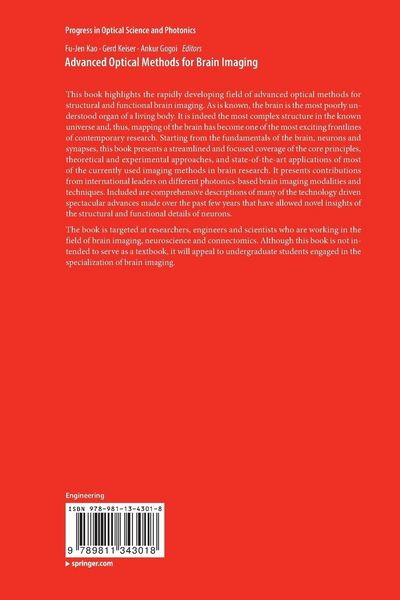
  • Produktbild: Advanced Optical Methods for Brain Imaging
  • Produktbild: Advanced Optical Methods for Brain Imaging


  • Part I    Introduction   

        Chapter 1    The brain, neurons and synapses

        Chapter 2    Brain Imaging: an overview

        Chapter 3    Historical development of superresolution microscopy


    Part II    Advanced Optical Microscopy for Brain Imaging   

        Chapter 4    STED microscopy

        Chapter 5    STORM microscopy

        Chapter 6    Light Sheet microscopy

        Chapter 8    FLIM/FRET microscopy

        Chapter 9    Multiphoton microscopy

        Chapter 10    SRS microscopy


    Part III    Supporting Technologies for Optical Microscopy   

        Chapter 11    Adaptive Optics

        Chapter 12    CLARITY

        Chapter 13    Image Processing

        Chapter 14    Artificial Neural Network


    Part IV    Neuroimaging or related Researches   

        Chapter 15    Ultrasensitive fluorescent proteins

        Chapter 16    Optically Controllable Proteins

        Chapter 17    Whole-brain functional imaging in drosophila