Gutscheinbedingungen

**Gültig bis 06.07.2026 auf fremdsprachige Bücher online auf thalia.at, in der Thalia App ab einem Mindestbestellwert von 30€ und in allen Thalia Buchhandlungen in Österreich. In den Buchhandlungen nur gültig auf lagernde Ware. Einzelne Artikel können ausgeschlossen sein. Ausgenommen sind preisgebundene Artikel & eBooks. Pro Einkauf einmal einlösbar. Nur gültig gegen Vorlage oder im Onlineshop hinterlegter Bonuscard. Infos zur Einlösung in der Buchhandlung sind auf der Bonuscard-Vorteilspreisseite zu finden. Click & Collect nur bei Onlinevorabzahlung möglich. Keine Einlösung bei Scan & Go-Bezahlung. Keine Barauszahlung. Nicht kombinierbar mit anderen Aktionen und Gutscheinen. Gutschein wird auf max. 500€ Bestellwert angerechnet. Nicht gültig für Versandkosten und Services.

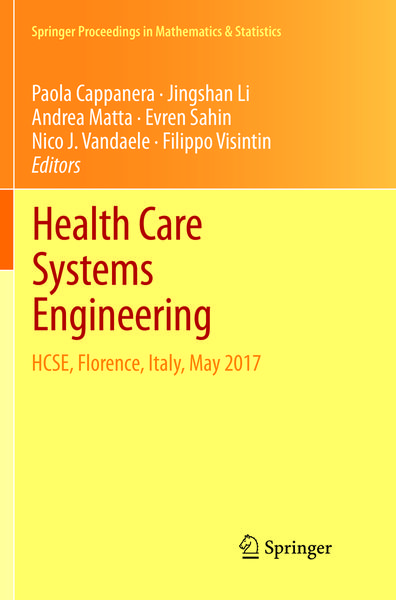
Produktbild: Health Care Systems Engineering
Band 210

Health Care Systems Engineering HCSE, Florence, Italy, May 2017

148,99 €

inkl. gesetzl. MwSt., Versandkostenfrei


Beschreibung

Produktdetails

Einband

Taschenbuch

Erscheinungsdatum

04.06.2019

Abbildungen

XVII, 63 illus., schwarz-weiss Illustrationen

Herausgeber

Paola Cappanera + weitere

Verlag

Springer

Seitenzahl

300

Maße (L/B/H)

23,5/15,5/1,8 cm

Gewicht

496 g

Auflage

Softcover reprint of the original 1st ed. 2017

Sprache

Englisch

ISBN

978-3-319-88188-1

Beschreibung

Produktdetails

Einband

Taschenbuch

Erscheinungsdatum

04.06.2019

Abbildungen

XVII, 63 illus., schwarz-weiss Illustrationen

Herausgeber

Verlag

Springer

Seitenzahl

300

Maße (L/B/H)

23,5/15,5/1,8 cm

Gewicht

496 g

Auflage

Softcover reprint of the original 1st ed. 2017

Sprache

Englisch

ISBN

978-3-319-88188-1

Herstelleradresse

Springer-Verlag KG
Sachsenplatz 4-6
1201 Wien
AT

Email: GPSR Kontakt

Noch keine Bewertungen vorhanden

Verfassen Sie die erste Bewertung zu diesem Artikel

Helfen Sie anderen Kundinnen und Kunden durch Ihre Meinung.

Kundinnen und Kunden meinen

Bewertungen (0)

  • Produktbild: Health Care Systems Engineering
  • 1 V. Nicoletta et al., A Cardinality-Constrained Robust Approach for the Ambulance Location and Dispatching Problem.- 2 K. Hwang et al., A choice model for estimating realized accessibility: case study for obstetrics care in Korea.- 3 M. Di Mascolo et al., A decision-making tool for the calculation of a robust planning for Home Service employees.- 4 S. Yalçındağ and A. Matta, A Decomposition Approach for the Home Health Care Problem with Time Windows.- 5 P. Landa et al., A Hybrid Simulation Approach to face/analyze patient boarding in Emergency Departments.- 6 H. Jang et al., A Location Problem for Medically Under-served Areas in Korea.- 7 N. Lahrichi et al., A New Decomposition Approach for the Home Health Care Problem.- 8 D. Miller et al., A practical approach to machine learning for clinical decision support.- 9 M. Koyuncu et al., A Simulation Model for Optimizing Staffing in the Emergency Department.- 10 K. Karubeet al., Analysis of Facility Layout in Elderly Day Care Facility.- 11 D. Scheinker and M. Brandeau, Analytical Approaches to Operating Room Management: Projects at Lucile Packard Children's Hospital Stanford.- 12 Y. Chen et al., Appointment Overbooking and Scheduling: Tradeoffs between Schedule Efficiency and Timely Access to Service.- 13 C. Caprara et al., Crowding in Paediatric Emergency Department, a Review of the Literature and a Simulation-Based Case Study.- 14 M. Cildoz et al., Dealing with stress and workload in emergency departments.- 15 M. Painchaud et al., Discrete-Event Simulation of an Hospital Transportation Service.- 16 P. Cappanera et al., Empirical Data Driven Intensive Care Unit Drugs Inventory Policies.- 17 P. Mic and M. Koyuncu, Estimation of Case Numbers at Pandemics and Testing of Hospital Resource’s Sufficiency with Simulation Modeling.- 18 G. Carello et al., Handling Time-Related Demands in the Home Care Nurse-to-Patient Assignment Problem with the Implementor-Adversarial Approach.- 19 A. Guinet, How to protect a hospital against cyber attacks.- 20 A. Roshanghalb et al., Identifying ‘Hospital Effect’ on Performances for their Improvements: The Case of The HF Administrative Data.- 21 J-Y. Yu and K-L. Huang, Improving Emergency Medical Services with Time-Region-Specific Cruising Ambulances.- 22 Mining the patient flow through an Emergency Department to deal with overcrowding.- 23 G. Ielpa el al., Outpatient Day Service Operations: a Case Study within Rheumatology Diseases Management.- 24 W. Abo-Hamad, Patient pathways discovery and analysis using process mining techniques: An Emergency Department case study.- 25 F. Schäfer et al., Patient-Bed Allocation in Large Hospitals.- 26 P. Cappanera and M.G. Scutellà, Pattern generation policies to cope with robustness in Home Care.- 27 A. Stefanini et al., Service Reconfiguration in Healthcare Systems: the Case of a New Focused Hospital Unit.- 28 B Resta et al., Strategic Operations Management in Healthcare: a reference model for Cardiac Rehabilitation.- 29 J. Coton et al., User-centered development of an information system in patient’s motor capacity evaluation.