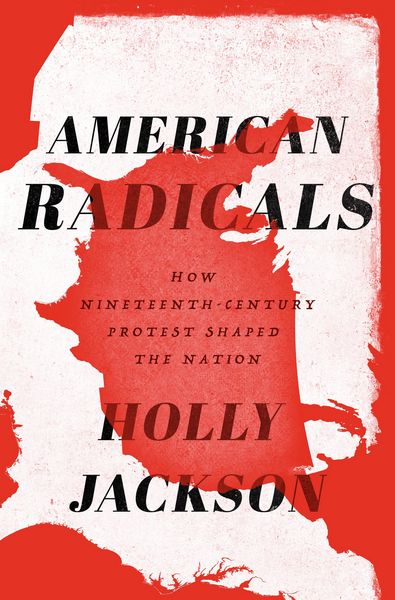
American Radicals: How Nineteenth-Century Protest Shaped the Nation How Nineteenth-Century Protest Shaped the Nation
25,99 €
inkl. gesetzl. MwSt.,
- Kostenlose Lieferung ab 30 € Einkaufswert
- Versandkostenfrei für Bonuscard-Kund*innen
Beschreibung
Produktdetails
Einband
Gebundene Ausgabe
Erscheinungsdatum
08.10.2019
Verlag
Random House N.Y.Seitenzahl
400
Maße (L/B/H)
23,6/15,2/3,8 cm
Gewicht
680 g
Sprache
Englisch
ISBN
978-0-525-57309-8
"In the tradition of Howard Zinn's people's histories, American Radicals reveals a forgotten yet inspiring past."-Megan Marshall, Pulitzer Prize-winning author of Margaret Fuller: A New American Life and Elizabeth Bishop: A Miracle for Breakfast
NAMED ONE OF THE TEN BEST HISTORY BOOKS OF THE YEAR BY SMITHSONIAN
On July 4, 1826, as Americans lit firecrackers to celebrate the country's fiftieth birthday, both John Adams and Thomas Jefferson were on their deathbeds. They would leave behind a groundbreaking political system and a growing economy-as well as the glaring inequalities that had undermined the American experiment from its beginning. The young nation had outlived the men who made it, but could it survive intensifying divisions over the very meaning of the land of the free?
A new network of dissent-connecting firebrands and agitators on pastoral communes, in urban mobs, and in genteel parlors across the nation-vowed to finish the revolution they claimed the founding fathers had only begun. They were men and women, black and white, fiercely devoted to causes that pitted them against mainstream America even while they fought to preserve the nation's founding ideals: the brilliant heiress Frances Wright, whose shocking critiques of religion and the institution of marriage led to calls for her arrest; the radical Bostonian William Lloyd Garrison, whose commitment to nonviolence would be tested as the conflict over slavery pushed the nation to its breaking point; the Philadelphia businessman James Forten, who presided over the first mass political protest of free African Americans; Marx Lazarus, a vegan from Alabama whose calls for sexual liberation masked a dark secret; black nationalist Martin Delany, the would-be founding father of a West African colony who secretly supported John Brown's treasonous raid on Harpers Ferry-only to ally himself with Southern Confederates after the Civil War.
Though largely forgotten today, these figures were enormously influential in the pivotal period flanking the war, their lives and work entwined with reformers like Frederick Douglass, Elizabeth Cady Stanton, and Henry David Thoreau, as well as iconic leaders like Abraham Lincoln. Jackson writes them back into the story of the nation's most formative and perilous era in all their heroism, outlandishness, and tragic shortcomings. The result is a surprising, panoramic work of narrative history, one that offers important lessons for our own time.
Kundinnen und Kunden meinen
Verfassen Sie die erste Bewertung zu diesem Artikel
Helfen Sie anderen Kund*innen durch Ihre Meinung
Kurze Frage zu unserer Seite
Vielen Dank für Ihr Feedback
Wir nutzen Ihr Feedback, um unsere Produktseiten zu verbessern. Bitte haben Sie Verständnis, dass wir Ihnen keine Rückmeldung geben können. Falls Sie Kontakt mit uns aufnehmen möchten, können Sie sich aber gerne an unseren Kund*innenservice wenden.
zum Kundenservice