
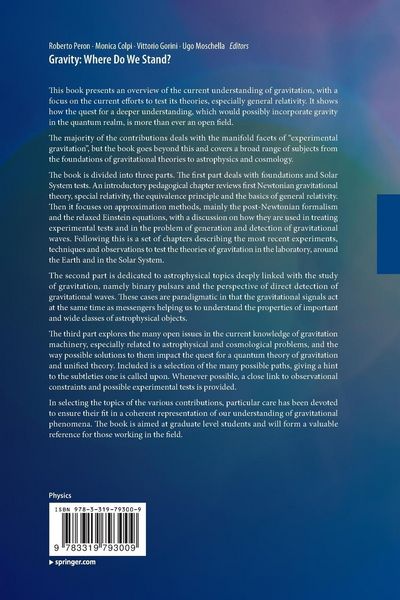
• Produktbild: Gravity: Where Do We Stand?
  • Produktbild: Gravity: Where Do We Stand?

Gravity: Where Do We Stand?

52,99 €

inkl. gesetzl. MwSt., Versandkostenfrei


Beschreibung

Produktdetails

Einband

Taschenbuch

Erscheinungsdatum

27.03.2019

Abbildungen

XIV, 130 illus., 103 illus. in color., farbige Illustrationen, schwarz-weiss Illustrationen

Herausgeber

Roberto Peron + weitere

Verlag

Springer

Seitenzahl

484

Maße (L/B/H)

23,5/15,5/2,7 cm

Gewicht

759 g

Auflage

Softcover reprint of the original 1st edition 2016

Sprache

Englisch

ISBN

978-3-319-79300-9

Beschreibung

Portrait

Roberto Peron

Istituto di Fisica dello Spazio Interplanetario – Istituto Nazionale di Astrofisica

Vittorio Gorini

Dipartimento di Fisica e Matematica, Università dell’Insubria, Como, Italy

Ugo Moschella

Dipartimento di Fisica e Matematica, Università dell’Insubria, Como, Italy

Produktdetails

Einband

Taschenbuch

Erscheinungsdatum

27.03.2019

Abbildungen

XIV, 130 illus., 103 illus. in color., farbige Illustrationen, schwarz-weiss Illustrationen

Herausgeber

Verlag

Springer

Seitenzahl

484

Maße (L/B/H)

23,5/15,5/2,7 cm

Gewicht

759 g

Auflage

Softcover reprint of the original 1st edition 2016

Sprache

Englisch

ISBN

978-3-319-79300-9

Herstelleradresse

Springer-Verlag KG
Sachsenplatz 4-6
1201 Wien
AT

Email: GPSR Kontakt

Noch keine Bewertungen vorhanden

Verfassen Sie die erste Bewertung zu diesem Artikel

Helfen Sie anderen Kundinnen und Kunden durch Ihre Meinung.

Kundinnen und Kunden meinen

Bewertungen (0)

  • Produktbild: Gravity: Where Do We Stand?
  • Produktbild: Gravity: Where Do We Stand?
  • Introduction.- Gravity: Newtonian, post-Newtonian and General Relativistic.- Newtonian Gravity and its classical tests (Equivalence Principle, Measure of G, 1/r2 dependence).- Gravitational Tests with Interplanetary Probes.- Probing gravity with second generation lunar laser ranging.- Fundamental physics with the LAGEOS satellites.- The role of binary pulsars in testing Gravity Theories.- Gravitational waves: theory, sources, detectors.- Possible low energy manifestations of strings and gravity.- Effective Field Theories with Lorentz Violations and their observational constraints.- Search for generic violations of Lorentz invariance in the Standard Model Extension formalism.- The MOND-TeVeS theory and the lensing results from the Bullet Cluster.