KI-Beratung Beta

Gutscheinbedingungen

**Gültig am 20.11.2026 ab einem Mindestbestellwert von 30€ auf Spielzeug, Schreibwaren, Filme, Geschenke & Trends, Musik, tolino eReader & Zubehör, Hörbücher und Hörbuch-Downloads, nicht preisgebundene Bücher und Kalender online auf thalia.at und in der Thalia App. Einzelne Artikel können ausgeschlossen sein. Aufgrund der Buchpreisbindung sind deutschsprachige Bücher und eBooks ausgenommen. Zusätzlich ausgenommen sind Abos & Flatrates, Games, Geschenkkarten/-boxen, Shelfies, Software, Zeitschriften sowie einzelne Artikel von tonies®. Pro Einkauf einmal einlösbar. Click & Collect nur bei Onlinevorabzahlung möglich. Keine Barauszahlung. Nicht kombinierbar mit anderen Aktionen und Gutscheinen. Gutschein wird auf max. 500€ Bestellwert angerechnet. Nicht gültig für Versandkosten und Services. Preisgebundene Artikel sind vom Mindestbestellwert ausgeschlossen.

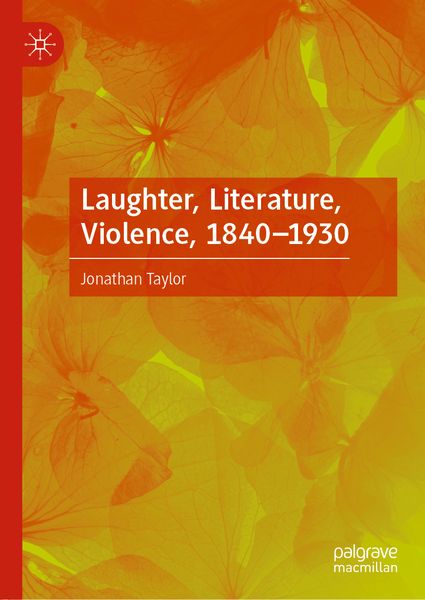
  • Produktbild: Laughter, Literature, Violence, 1840–1930
  • Produktbild: Laughter, Literature, Violence, 1840–1930

Laughter, Literature, Violence, 1840–1930

79,99 €

inkl. gesetzl. MwSt., Versandkostenfrei


Beschreibung

Laughter, Literature, Violence, 1840-1930  investigates the strange, complex, even paradoxical relationship between laughter, on the one hand, and violence, war, horror, death, on the other. It does so in relation to philosophy, politics, and key nineteenth- and twentieth-century literary texts, by Edgar...

Beschreibung

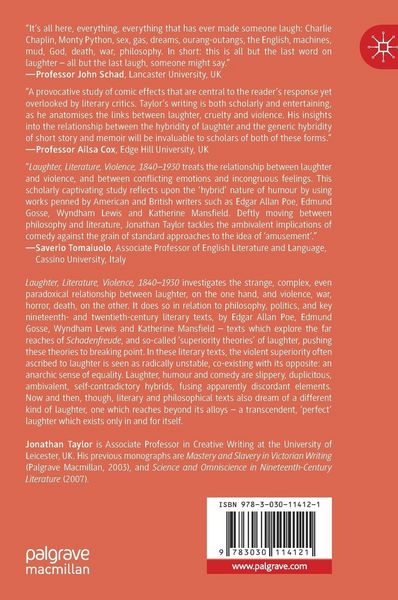
Laughter, Literature, Violence, 1840-1930  investigates the strange, complex, even paradoxical relationship between laughter, on the one hand, and violence, war, horror, death, on the other. It does so in relation to philosophy, politics, and key nineteenth- and twentieth-century literary texts, by Edgar Allan Poe, Edmund Gosse, Wyndham Lewis and Katherine Mansfield – texts which explore the far reaches of  Schadenfreude , and so-called ‘superiority theories’ of laughter, pushing these theories to breaking point. In these literary texts, the violent superiority often ascribed to laughter is seen as radically unstable, co-existing with its opposite: an anarchic sense of equality. Laughter, humour and comedy are slippery, duplicitous, ambivalent, self-contradictory hybrids, fusing apparently discordant elements. Now and then, though, literary and philosophical texts also dream of a different kind of laughter, one which reaches beyond its alloys –a transcendent, ‘perfect’ laughter which exists only in and for itself.  

Rezension

“In Laughter, Literature, Violence, 1840-1930 we see the convoluted relationship between laughter, violence, war, horror and death. … This is a text for the academic to help him or her to interrogate and to investigate and a book for the interested party, who enjoys the subject. Both are well served.

Produktdetails

Einband

Gebundene Ausgabe

Erscheinungsdatum

22.02.2019

Abbildungen

X, 258 p. 1 illus.

Verlag Springer

Produktdetails

Einband

Gebundene Ausgabe

Erscheinungsdatum

22.02.2019

Abbildungen

X, 258 p. 1 illus.

Verlag Springer
Seitenzahl

258

Maße (L/B/H)

21,6/15,3/2 cm

Gewicht

424 g

Sprache

Englisch

ISBN

978-3-030-11412-1

Herstelleradresse

Springer-Verlag GmbH
Europaplatz 3
69115 Heidelberg
DE

Email: ProductSafety@springernature.com

Noch keine Bewertungen vorhanden

Verfassen Sie die erste Bewertung zu diesem Artikel

Helfen Sie anderen Kundinnen und Kunden durch Ihre Meinung.

Kundinnen und Kunden meinen

Bewertungen (0)

  • Produktbild: Laughter, Literature, Violence, 1840–1930
  • Produktbild: Laughter, Literature, Violence, 1840–1930
  • 1. Preface: Allegories of Laughter. I. Comedy and Hybridity. II. Laughter and Annihilation.- 2. His ‘Last Jest’: On Laughter, Edgar Allan Poe and ‘Hop-Frog’. I. Comedy and Horror. II. Laughter and Democracy. III. Laughter and Leap-Frog.- 3. ‘Unseemly Levity’: On Memoirs, Humour and Edmund Gosse. I. Humour and Genre. II. Humour and Emotion. III. Humour and Text. IV. Humour and Beyond.- 4. ‘Perfect Laughter’: On War, Wyndham Lewis and The Wild Body. I. Laughter and Dualism. II. Laughter, Dualism and Bodies. III.  Laughter, Dualism, Bodies and Anarchism.- 5. Epilogue: ‘Derisive Laughter’: On Superiority, Katherine Mansfield and ‘Miss Brill’.