Gutscheinbedingungen

**Gültig bis 06.07.2026 auf fremdsprachige Bücher online auf thalia.at, in der Thalia App ab einem Mindestbestellwert von 30€ und in allen Thalia Buchhandlungen in Österreich. In den Buchhandlungen nur gültig auf lagernde Ware. Einzelne Artikel können ausgeschlossen sein. Ausgenommen sind preisgebundene Artikel & eBooks. Pro Einkauf einmal einlösbar. Nur gültig gegen Vorlage oder im Onlineshop hinterlegter Bonuscard. Infos zur Einlösung in der Buchhandlung sind auf der Bonuscard-Vorteilspreisseite zu finden. Click & Collect nur bei Onlinevorabzahlung möglich. Keine Einlösung bei Scan & Go-Bezahlung. Keine Barauszahlung. Nicht kombinierbar mit anderen Aktionen und Gutscheinen. Gutschein wird auf max. 500€ Bestellwert angerechnet. Nicht gültig für Versandkosten und Services.

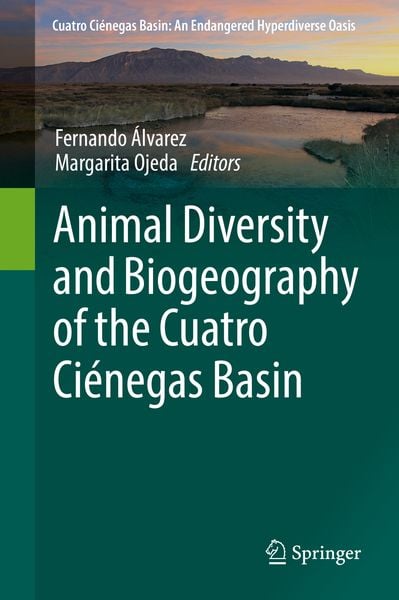
Produktbild: Animal Diversity and Biogeography of the Cuatro Ciénegas Basin

Animal Diversity and Biogeography of the Cuatro Ciénegas Basin

99,99 €

inkl. gesetzl. MwSt., Versandkostenfrei


Beschreibung

Produktdetails

Einband

Gebundene Ausgabe

Erscheinungsdatum

20.05.2019

Abbildungen

XV, 58 illus., 45 illus. in color., farbige Illustrationen, schwarz-weiss Illustrationen

Herausgeber

Fernando Álvarez + weitere

Verlag

Springer

Seitenzahl

231

Maße (L/B/H)

24,1/16/2 cm

Gewicht

541 g

Auflage

1st ed. 2019

Sprache

Englisch

ISBN

978-3-030-11261-5

Beschreibung

Portrait

Fernando Alvarez obtained his B.Sc. degree in Biology from the School of Sciences at the National Autonomous University of Mexico (UNAM) in Mexico City. He subsequently completed his MSc degree at Tulane University in New Orleans, Louisiana and his PhD at the University of Maryland at College Park, Maryland, USA. In 1993 he was hired by the Institute of Biology, UNAM, where he is now a full Professor and became Curator of Crustacea. He has published 121 papers on the biology of Crustacea, mainly in systematics, ecology and evolution; he has written 29 book chapters and 8 books. He is currently Editor in Chief of Revista Mexicana de Biodiversidad, has been awarded level III in the National Researchers System of Mexico (SNI) and is a regular member of the Mexican Academy of Sciences.

Margarita Ojeda received her BSc degree in Biology from the School of Sciences at the National Autonomous University of Mexico (UNAM) in Mexico City in 1983, and then her MSc degree and PhD from the same university in 1990. She has published papers describing species of oribatid mites from Mexico, and on different topics such as the ecology and the role of the soil fauna. Since 2013, she has been an associated researcher at the National Acarology Collection of the Biology Institute at UNAM, and collaborates in different activities and projects concerning several groups of mites.

Produktdetails

Einband

Gebundene Ausgabe

Erscheinungsdatum

20.05.2019

Abbildungen

XV, 58 illus., 45 illus. in color., farbige Illustrationen, schwarz-weiss Illustrationen

Herausgeber

Verlag

Springer

Seitenzahl

231

Maße (L/B/H)

24,1/16/2 cm

Gewicht

541 g

Auflage

1st ed. 2019

Sprache

Englisch

ISBN

978-3-030-11261-5

Herstelleradresse

Springer-Verlag KG
Sachsenplatz 4-6
1201 Wien
AT

Email: GPSR Kontakt

Noch keine Bewertungen vorhanden

Verfassen Sie die erste Bewertung zu diesem Artikel

Helfen Sie anderen Kundinnen und Kunden durch Ihre Meinung.

Kundinnen und Kunden meinen

Bewertungen (0)

Weitere Artikel finden Sie in

  • Produktbild: Animal Diversity and Biogeography of the Cuatro Ciénegas Basin
  • Chapter 1 - An overview of the fauna of the Cuatro Ciénegas Valley Fernando Alvarez  & Margarita Ojeda (UNAM, MX)

    Chapter 2 - Helminth community structure of some freshwater fishes in Cuatro Ciénegas: Patterns and Processes

    Gerardo Pérez-Ponce de Léon & Rogelio Aguilar-Aguilar (UNAM, MX)

    Chapter 3 - Soil microarthropods

    Margarita Ojeda (UNAM, MX)

    Chapter 4 - Scorpions (Arachnida: Scorpiones) from the Cuatro Ciénegas Basin

    Oscar Francké (UNAM, MX) 

    Chapter 5 - Spiders

    Pablo Corcuera (UAM, MX), María Luisa Jiménez (CIBNOR, MX) & Marco Antonio Desales (UAEM, MX)

    Chapter 6 - Water mites (Acari: Hydrachnidiae)

    Gerardo Rivas & María Marcia Ramírez-Sánchez (UNAM, MX)

    Chapter 7 - Crustaceans

    Fernando Alvarez & José Luis Villalobos (UNAM, MX)

    Chapter 8 - Molluscs

    Evan Carson (US Fish and Wildlife Service, USA)

    Chapter 9 - The diversity of Lepidoptera (Papilionoidea sensu stricto) in the Cuatro Ciénegas Valley: spatial and temporal patterns

    Marysol Trujano-Ortega, Jessica Hernández-Jerónimo, Moisés Armando Luis-Martínez, Uri Omar García-Vázquez & Omar Ávalos-Hernández (UNAM, MX)

    Chapter 10 - Diversity and resource use patterns of bees and flies that visit flowers in the Cuatro Ciénegas Valley

    Omar Ávalos-Hernández, Marysol Trujano-Ortega, Uri Omar García-Vázquez & Olivia Yánez-Ordóñez (UNAM, MX)

    Chapter 11 - Dragonflies and damselflies (Insecta: Odonata)

    Enrique Gónzalez-Soriano (UNAM, MX)

    Chapter 12 - Diversity and ecology of ants in Cuatro Ciénegas, Coahuila

    Milan Janda, Pablo Corcuera-Del Rio, Madai Rosas-Mejia, Mario Aguilar-Mendez & Miguel Vásquez-Bolaños (UNAM, UAdeG, UAG, MX)

    Chapter 13 -Systematics of the fishes of Cuatro Ciénegas

    Héctor Espinosa, Christian Lambarri (UNAM, MX), Mauricio de la Maza (Pronatura Noreste, UNAM, MX)  & Evan Carson (US Fish and Wildlife Service, USA)

    Chapter 14 - Diversity and biogeophaphical affinity of amphibians and reptiles of Cuatro Ciénegas ValleyUri Omar García-Vázquez, Marysol Trujano-Ortega (UNAM, MX), Arturo Contreras-Arquieta (Acuario y Herpetario W. L. Minckley, MX) & Omar Ávalos-Hernández (UNAM, MX)

    Chapter 15 - Birds

    Pablo Corcuera (UAM, MX), Adolfo Navarro (UNAM, MX), Luis Antonio Sánchez-González (UNAM, MX) & Omar Suárez-García (UNAM, MX)

    Chapter 16 - Patters of distribution and endemism in the mammals of the Cuatro Ciénegas Valley, CoahuilaNiza Gámez & Gabriela Castellanos-Morales (UNAM, MX)