
Gutscheinbedingungen

**Gültig bis 06.07.2026 auf fremdsprachige Bücher online auf thalia.at, in der Thalia App ab einem Mindestbestellwert von 30€ und in allen Thalia Buchhandlungen in Österreich. In den Buchhandlungen nur gültig auf lagernde Ware. Einzelne Artikel können ausgeschlossen sein. Ausgenommen sind preisgebundene Artikel & eBooks. Pro Einkauf einmal einlösbar. Nur gültig gegen Vorlage oder im Onlineshop hinterlegter Bonuscard. Infos zur Einlösung in der Buchhandlung sind auf der Bonuscard-Vorteilspreisseite zu finden. Click & Collect nur bei Onlinevorabzahlung möglich. Keine Einlösung bei Scan & Go-Bezahlung. Keine Barauszahlung. Nicht kombinierbar mit anderen Aktionen und Gutscheinen. Gutschein wird auf max. 500€ Bestellwert angerechnet. Nicht gültig für Versandkosten und Services.

  • Produktbild: Psychoanalysis Meets Psychosis
  • Produktbild: Psychoanalysis Meets Psychosis

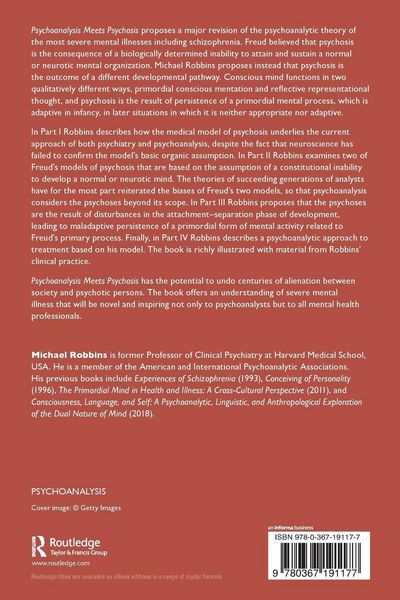
Psychoanalysis Meets Psychosis Attachment, Separation, and the Undifferentiated Unintegrated Mind

44,99 €

inkl. gesetzl. MwSt., Versandkostenfrei


Beschreibung

Produktdetails

Einband

Taschenbuch

Erscheinungsdatum

15.04.2019

Verlag

Taylor & Francis

Seitenzahl

206

Maße (L/B/H)

23,4/15,6/1,2 cm

Gewicht

330 g

Sprache

Englisch

ISBN

978-0-367-19117-7

Beschreibung

Rezension

"Robbins' goal is to introduce psychoanalysis to psychosis in a way that is internal to psychoanalysis and at the same time independent of the neurosis model and the biases that attend it. He does so successfully in this carefully reasoned and clinically illustrated book, as he returns us to a theory of primitive mind and primary process that Freud himself intimated but never further developed. In so doing, Robbins joins the increasingly interesting minority of analysts who are trying to extend psychoanalytic theory to include the understanding and treatment of psychoses.

For Robbins, psychosis is the consequence of a developmental pathway separate and independent from that of neurosis. It begins with problems of attachment and separation that produce early failures to separate self from object and integrate a cohesive sense of self. These failures leave one incapable of experiencing, sustaining and resolving intrapsychic conflict and lead "to inappropriate and maladaptive persistence of primordial conscious mentation in contexts where reflective representational thought would be appropriate and adaptive."-Howard B. Levine, MD, Editor-in-Chief, The Routledge Wilfred R. Bion Studies Book Series

Produktdetails

Einband

Taschenbuch

Erscheinungsdatum

15.04.2019

Verlag

Taylor & Francis

Seitenzahl

206

Maße (L/B/H)

23,4/15,6/1,2 cm

Gewicht

330 g

Sprache

Englisch

ISBN

978-0-367-19117-7

Herstelleradresse

Libri GmbH
Europaallee 1
36244 Bad Hersfeld
DE

Email: gpsr@libri.de

Noch keine Bewertungen vorhanden

Verfassen Sie die erste Bewertung zu diesem Artikel

Helfen Sie anderen Kundinnen und Kunden durch Ihre Meinung.

Kundinnen und Kunden meinen

Bewertungen (0)

Die Leseprobe wird geladen.
  • Produktbild: Psychoanalysis Meets Psychosis
  • Produktbild: Psychoanalysis Meets Psychosis
  • Theorists of psychosis whose contributions are discussed in chapters 4, 5, 6, and 7

    Introduction

    PART I: NOT FULLY HUMAN: THE UNWITTING COLLUSION BETWEEN MEDICINE AND PSYCHOANALYSIS

    1: Not fully human: Psychiatric and psychoanalytic understandings of psychosis

    2: The medicalization of madness: Evolution of the equation of psychosis with degeneracy

    PART II: PSYCHOANALYTIC MODELS OF PSYCHOSIS

    3: Freud's attempt to treat psychosis as though it were neurosis
    Obsessive-compulsive thoughts or delusional/hallucinatory enactments?
    Freud's interpretive enactment of his theory of repressed unconscious and its results

    4: Freud's three models and their offspring i: The inability to relate

    5: Freud's three models and their offspring iia: The inability to integrate mind and become neurotic: The European Kleinian iteration

    6: Freud's three models and their offspring iib: The inability to be neurotic: the American ego psychology iteration of the integration model and Kernberg's transatlantic rapprochement

    7: Freud's three models and their offspring iii: Thought disorder: the primary process

    PART III: A NEW BEGINNING: DISTINGUISHING PSYCHOSIS FROM NEUROSISClinical preface to chapters 8, 10, & 13
    Jane
    Jacob
    Lisabeth
    Charles

    8: Two conscious mental processes: The role of primordial consciousness in psychosis and other human phenomena
    Misconceptions of psychosis as an adult onset disorder of genetic origin
    Characteristics of reflective representational thought
    Characteristics of primordial consciousness or first mind
    Clinical illustrations of primordial consciousness
    Dreaming and primordial consciousness
    Attachment and the commencement of psychic life

    9: Return to the Rat Man: Psychosis as a manifestation of primordial consciousness

    10: Psychosis as a disorder of attachment and separation-individuation
    Psychosis and pathology of separation: The stages of separation
    Relationship between schizophrenia and psychotic personality disorder: The false self
    Clinical illustrations of false self
    Good enough attachment and development of the two mental processes: Rank and Bowlby
    Pathology of attachment, maladaptive persistence of primordial consciousness, failure to separate, and development of psychosis Clinical illustrations of pathological attachment and failure to separate

    PART IV: TREATMENT OF PSYCHOSIS

    11: The medical treatment of psychosis: Transforming psychosis from a socially disruptive to a socially adaptive disease

    12: Studies of the efficacy of psychological and psychoanalytic therapies of psychosis

    13: Psychoanalytic therapy of psychosis: Transforming primordial conscious mentation to reflective representational thought
    The therapeutic process
    The remembered and reconstructed past
    The process of therapy
    Stages of therapy with schizophrenic persons and psychotic personalities
    Criteria of successful treatment and outcome

    14: Qualities of a psychoanalytic therapist of psychosis

    15: Patients write about their therapy

    16: The 11 year therapy of a chronic paranoid schizophrenic woman
    Background
    Year one
    Year two
    Year three
    Year four
    Year five
    Year six
    Year seven
    Year eight
    Year nine
    Epilogue
    Discussion

    17: Conclusion

    References

    Index