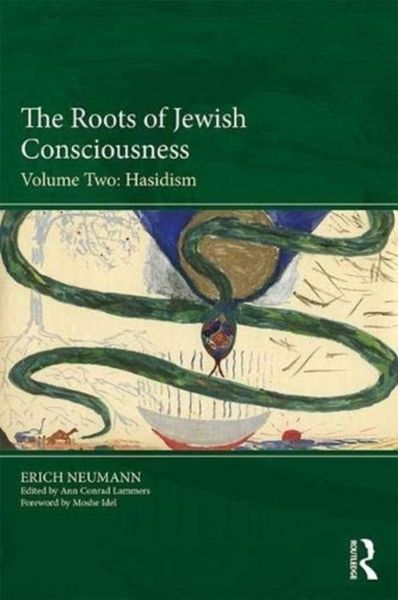
The Roots of Jewish Consciousness, Volume Two Hasidism
-
- Hardcover
- Taschenbuch ausgewählt
- eBook
-
Sprache:Englisch
48,99 €
inkl. gesetzl. MwSt.,
Beschreibung
Produktdetails
Einband
Taschenbuch
Erscheinungsdatum
07.05.2019
Abbildungen
2 SW-Abb., 3 SW-Zeichn.
Herausgeber
Ann Conrad LammersVerlag
Taylor & FrancisSeitenzahl
334
Maße (L/B/H)
23,4/15/1,8 cm
Gewicht
658 g
Übersetzt von
Ann Conrad Lammers + weitere
Sprache
Englisch
ISBN
978-1-138-55622-5
The Roots of Jewish Consciousness, Volume Two: Hasidism is the second volume, fullyannotated, of a major, previously unpublished, two-part work by Erich Neumann (1905-1960). It was written between 1940 and 1945, after Neumann, then a young philosopher and physician and freshly trained as a disciple of Jung, fled Berlin to settle in Tel Aviv. He finished this work at the end of World War II. Although he never published it, he kept it the rest of his life.
Volume Two, Hasidism, is devoted to the psychological and spiritual wisdom embodied in Jewish spiritual tradition. Relying on Jung's concepts and Buber's Hasidic interpretations, Neumann seeks alternatives to the legalism and anti-feminine bias that he says have dominated collective Judaism since the Second Temple. He argues that modern Jews can develop psychological wholeness through an appropriation of Hasidic legends, Talmudic texts, and Kabbalistic mysteries, including especially the Zohar. Exclusively, this volume includes a foreword by Moshe Idel. An appendix, Neumann's four-lecture series from the 1940s, gives a glimpse of his intended, unpublished Part Three.
These volumes anticipate Neumann's later works, including Depth Psychology and a New Ethic, The Origins and History of Consciousness, and The Great Mother. In Volume Two, Hasidism, his concept of the ego-Self axis is developed in clearly psychological terms. Four previously unpublished essays, appended to Volume Two, illustrate Neumann's developmental psychology, including his theme of primary and secondary personalization. This unique work will appeal to Jungian analysts and psychotherapists in training and in practice, historians of psychology, Jewish scholars, biblical historians, teachers of comparative religion, as well as academics and students.
Noch keine Bewertungen vorhanden
Verfassen Sie die erste Bewertung zu diesem Artikel
Helfen Sie anderen Kundinnen und Kunden durch Ihre Meinung.
Kurze Frage zu unserer Seite
Vielen Dank für Ihr Feedback
Wir nutzen Ihr Feedback, um unsere Produktseiten zu verbessern. Bitte haben Sie Verständnis, dass wir Ihnen keine Rückmeldung geben können. Falls Sie Kontakt mit uns aufnehmen möchten, können Sie sich aber gerne an unseren Kund*innenservice wenden.
zum Kundenservice