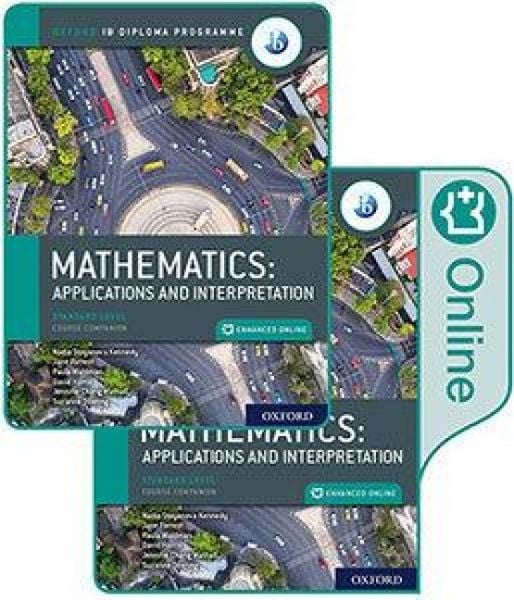
Produktbild: Oxford IB Diploma Programme: IB Mathematics: applications and interpretation

Oxford IB Diploma Programme: IB Mathematics: applications and interpretation Print and Enhanced Online Course Book Pack

88,99 €

inkl. gesetzl. MwSt., Versandkostenfrei


Beschreibung

Produktdetails

ISBN

978-0-19-842698-1

Erscheinungsdatum

21.02.2019

Einband

Taschenbuch

Verlag

Oxford Children's Books

Seitenzahl

672

Maße (L/B/H)

25,2/19,3/2,8 cm

Gewicht

1410 g

Sprache

Englisch

Beschreibung

Produktdetails

ISBN

978-0-19-842698-1

Erscheinungsdatum

21.02.2019

Einband

Taschenbuch

Verlag

Oxford Children's Books

Seitenzahl

672

Maße (L/B/H)

25,2/19,3/2,8 cm

Gewicht

1410 g

Sprache

Englisch

Herstelleradresse

Libri GmbH
Europaallee 1
36244 Bad Hersfeld
DE

Email: gpsr@libri.de

Noch keine Bewertungen vorhanden

Verfassen Sie die erste Bewertung zu diesem Artikel

Helfen Sie anderen Kundinnen und Kunden durch Ihre Meinung.

Kundinnen und Kunden meinen

Bewertungen (0)

Weitere Artikel finden Sie in

  • Produktbild: Oxford IB Diploma Programme: IB Mathematics: applications and interpretation
    • Measuring space: accuracy and 2D geometry
    • 1.1: Measurements and estimates
    • 1.2: Recording measurements, significant digits and rounding
    • 1.3: Measurements: exact or approximate?
    • 1.4: Speaking scientifically
    • 1.5: Trigonometry of right-angled triangles and indirect measurements
    • 1.6: Angles of elevation and depression
    • Representing space: non-right angled trigonometry and volumes
    • 2.1: Trigonometry of non-right triangles
    • 2.2: Area of triangle formula. Applications of right and non-right angled trigonometry
    • 2.3: Geometry: solids, surface area and volume
    • Representing and describing data: descriptive statistics
    • 3.1: Collecting and organising univariate data
    • 3.2: Sampling techniques
    • 3.3: Presentation of data
    • 3.4: Bivariate data
    • Dividing up space: coordinate geometry, lines, Voronoi diagrams
    • 4.1: Coordinates, distance and midpoint formula in 2D and 3D
    • 4.2: Gradient of lines and its applications
    • 4.3: Equations of straight lines; different forms of equations
    • 4.4: Parallel and perpendicular lines
    • 4.5: Voronoi diagrams and toxic waste problem
    • Modelling constant rates of change: linear functions
    • 5.1: Functions
    • 5.2: Linear Models
    • 5.3: Arithmetic Sequences
    • 5.4: Modelling
    • Modelling relationships: linear correlation of bivariate data
    • 6.1: Measuring correlation
    • 6.2: The line of best fit
    • 6.3: Interpreting the regression line
    • Quantifying uncertainty: probability, binomial and normal distributions
    • 7.1: Theoretical and experimental probability
    • 7.2: Representing combined probabilities with diagrams
    • 7.3: Representing combined probabilities with diagrams and formulae
    • 7.4: Complete, concise and consistent representations
    • 7.5: Modelling random behaviour: random variables and probability distributions
    • 7.6: Modelling the number of successes in a fixed number of trials
    • 7.7: Modelling measurements that are distributed randomly
    • Testing for validity: Spearman's, hypothesis testing and x^2 test for independence
    • 8.1: Spearman's rank correlation coefficient
    • 8.2: chi^2 test for independence
    • 8.3: chi^2 goodness of fit test
    • 8.4: The t-test
    • Modelling relationships with functions: power functions
    • 9.1: Quadratic models
    • 9.2: Problems involving quadratics
    • 9.3: Cubic models, power functions and direct and inverse variation
    • 9.4: Optimisation
    • Modelling rates of change: exponential and logarithmic functions
    • 10.1: Geometric sequences and series
    • 10.2: Compound interest, annuities, amortization
    • 10.3: Exponential models
    • 10.4: Exponential equations and logarithms
    • Modelling periodic phenomena: trigonometric functions
    • 11.1: An introduction to periodic functions
    • 11.2: An infinity of sinusoidal functions
    • 11.3: A world of sinusoidal models
    • Analyzing rates of change: differential calculus
    • 12.1: Limits and derivatives
    • 12.2: Equation of tangent and normal and increasing and decreasing functions
    • 12.3: Maximum and minimum points and optimisation
    • Approximating irregular spaces: integration
    • 13.1: Finding areas
    • 13.2: Integration: the reverse processes of differentiation
    • Exploration