Gutscheinbedingungen

**Gültig von 22.06.2026 ab 19 Uhr bis 23.06.2026 24 Uhr auf Spielzeug, Schreibwaren, Filme, Geschenke & Trends, Musik, tolino eReader & Zubehör, Hörbücher und Hörbuch-Downloads (außer Abo), nicht preisgebundene Bücher und Kalender online auf thalia.at und in der Thalia App. Einzelne Artikel können ausgeschlossen sein. Aufgrund der Buchpreisbindung sind deutschsprachige Bücher und eBooks ausgenommen. Zusätzlich ausgenommen sind preisgebundene Artikel, Abos & Flatrates, eBooks, Games, Geschenkkarten/-boxen, Shelfies, Software, Zeitschriften sowie einzelne Artikel von tonies®. Pro Einkauf einmal einlösbar. Click & Collect nur bei Onlinevorabzahlung möglich. Keine Barauszahlung. Nicht kombinierbar mit anderen Aktionen und Gutscheinen. Gutschein wird auf max. 500€ Bestellwert angerechnet. Nicht gültig für Versandkosten und Services.

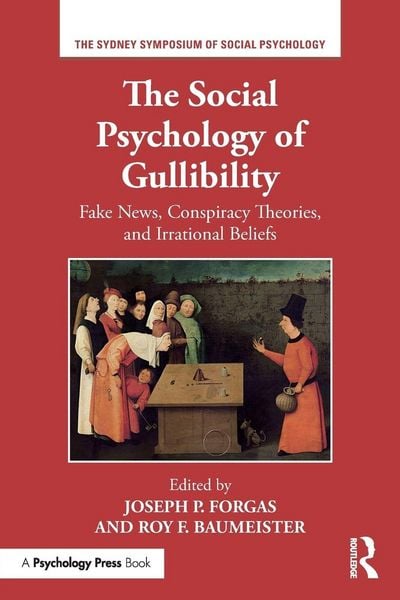
  • Produktbild: The Social Psychology of Gullibility
  • Produktbild: The Social Psychology of Gullibility

The Social Psychology of Gullibility Conspiracy Theories, Fake News and Irrational Beliefs

72,99 €

inkl. gesetzl. MwSt., Versandkostenfrei


Beschreibung

Produktdetails

Einband

Taschenbuch

Erscheinungsdatum

17.04.2019

Abbildungen

1 schwarzweisse Fotos, 25 schwarzweisse Zeichnungen, 4 Tabellen

Herausgeber

Joseph P. Forgas + weitere

Verlag

Taylor & Francis

Seitenzahl

352

Maße (L/B/H)

22,9/15,2/1,9 cm

Gewicht

513 g

Sprache

Englisch

ISBN

978-0-367-18793-4

Beschreibung

Rezension

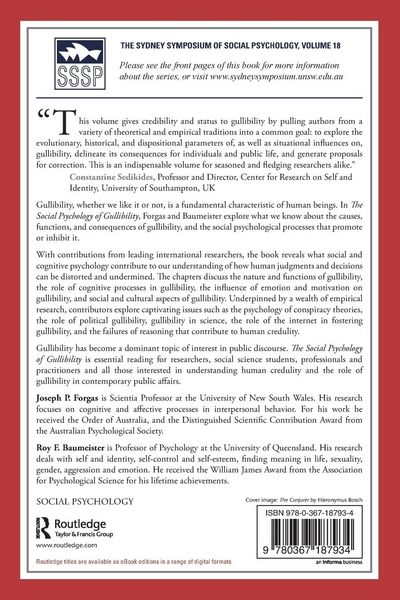
"This volume gives credibility and status to gullibility by pulling authors from a variety of theoretical and empirical traditions into a common goal: to explore the evolutionary, historical, and dispositional parameters of, as well as situational influences on, gullibility, delineate its consequences for individuals and public life, and generate proposals for correction. This is an indispensable volume for seasoned and fledging researchers alike."

Constantine Sedikides, Professor and Director, Center for Research on Self and Identity, University of Southampton, UK

Produktdetails

Einband

Taschenbuch

Erscheinungsdatum

17.04.2019

Abbildungen

1 schwarzweisse Fotos, 25 schwarzweisse Zeichnungen, 4 Tabellen

Herausgeber

Verlag

Taylor & Francis

Seitenzahl

352

Maße (L/B/H)

22,9/15,2/1,9 cm

Gewicht

513 g

Sprache

Englisch

ISBN

978-0-367-18793-4

Herstelleradresse

Produktsicherheitsverantwortliche/r
Europaallee 1
36244 Bad Hersfeld
DE

Email: gpsr@libri.de

Kundinnen und Kunden meinen

0 Bewertungen

Informationen zu Bewertungen

Zur Abgabe einer Bewertung ist eine Anmeldung im Konto notwendig. Die Authentizität der Bewertungen wird von uns nicht überprüft. Wir behalten uns vor, Bewertungstexte, die unseren Richtlinien widersprechen, entsprechend zu kürzen oder zu löschen.

Die Bewertungen sind nach Format, Anzahl Sterne und Datum sortiert.

Verfassen Sie die erste Bewertung zu diesem Artikel

Helfen Sie anderen Kund*innen durch Ihre Meinung

Kundinnen und Kunden meinen

0 Bewertungen filtern

Die Leseprobe wird geladen.
  • Produktbild: The Social Psychology of Gullibility
  • Produktbild: The Social Psychology of Gullibility
  • Contents

    Chapter 1. Homo Credulus: On the social psychology of gullibility. Joseph P. Forgas, University of New South Wales, and Roy F. Baumeister, University of Queensland.

    Part I. The Nature and Functions of Credulity

    Chapter 2. The mask of love and sexual gullibility. Roy F. Baumeister (University of Queensland), Jessica A Maxwell, Geoffrey P Thomas (Florida state University), and Kathleen D. Vohs (University of Minnesota).

    Chapter 3. Gullible but Functional? Information repetition and the formation of beliefs. Christian Unkelbach and Alex Koch, (University of Cologne, Germany).

    Chapter 4. Belief in Conspiracy Theories: Looking beyond gullibility. Karen Douglas, Sutton, R. M. and Chicoka, A. (University of Kent, UK).

    Chapter 5. Psychological Science Meets a Gullible Post-Truth World. David Myers (Hope College).

    Part II. Cognitive processes and gullibility

    Chapter 6. Towards a Credible Theory of Gullibility. Joachim I. Krueger (Brown University), Claudia Vogrincic-Haselbacher (University of Graz, Austria), Anthony M. Evans (Tilburg University, The Netherlands).

    Chapter 7. Metacognitive Myopia - Gullibility as a Major Obstacle in the Way of Rational Behavior. Klaus Fiedler (University of Heidelberg, Germany).

    Chapter 8. The skeptical (ungullible) mindset. Ruth Mayo (The Hebrew University of Jerusalem)

    Chapter 9. Comparing is believing: Ease of comparison as a means to induce gullibility. Fritz Strack (University of Würzburg).

    Part III. Affective and Motivational Processes and Gullibility

    Chapter 10. On The Role of Affect in Gullibility: Can Positive Mood Increase, and Negative Mood Reduce Credulity? Joseph P. Forgas (University of New South Wales).

    Chapter 11. Gullible or Streetwise: How Does the Self Bias Information Processing? C. Neil Macrae, Juliana L. Olivier, Johanna K. Falbén, Marius Golubickis (University of Aberdeen)

    Chapter 12. Gullible to Ourselves. David Dunning (University of Michigan).

    Chapter 13. The smell of suspicion: How the nose curbs gullibility. Norbert Schwarz (University of Southern California) and Spike W. S. Lee (University of Toronto).

    Part IV. Social and Cultural Aspects of Gullibility

    Chapter 14. Cultural fluency, mindlessness and gullibility. Daphna Oyserman (University of Southern California).

    Chapter 15. Scientific Gullibility. Lee Jussim (Rutgers University), Sean T. Stevens (NYU, Stern School of Business), Nathan Honeycutt (Rutgers University), Stephanie M. Anglin (Carnegie Mellon University), and Nicholas Fox (Rutgers University).

    Chapter 16. Gullibility and the envelope of Legitimacy. Joel Cooper and Joseph J. Avery (Princeton University).

    Chapter 17. Belief in Conspiracy Theories: Gullibility or Rational Skepticism? Jan-Willem van Prooijen (VU Amsterdam).