KI-Beratung Beta

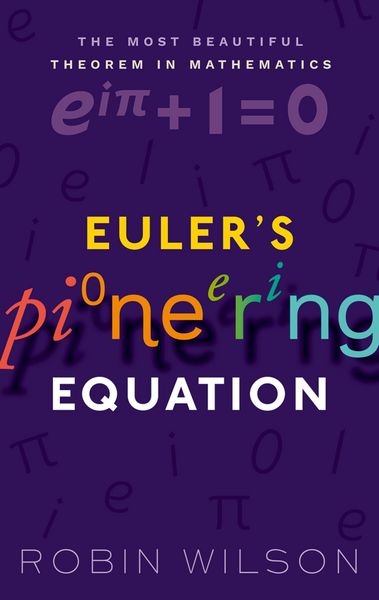
Produktbild: Euler's Pioneering Equation

Euler's Pioneering Equation The most beautiful theorem in mathematics

10,80 €

inkl. gesetzl. MwSt.

Beschreibung

In 1988 The Mathematical Intelligencer, a quarterly mathematics journal, carried out a poll to find the most beautiful theorem in mathematics. Twenty-four theorems were listed and readers were invited to award each a 'score for beauty'. While there were many worthy competitors, the winner was 'Euler's...

Beschreibung

In 1988 The Mathematical Intelligencer, a quarterly mathematics journal, carried out a poll to find the most beautiful theorem in mathematics. Twenty-four theorems were listed and readers were invited to award each a 'score for beauty'. While there were many worthy competitors, the winner was 'Euler's equation'. In 2004 Physics World carried out a similar poll of 'greatest equations', and found that among physicists Euler's mathematical result came second only to Maxwell's equations. The Stanford mathematician Keith Devlin reflected the feelings of many in describing it as "like a Shakespearian sonnet that captures the very essence of love, or a painting which brings out the beauty of the human form that is far more than just skin deep, Euler's equation reaches down into the very depths of existence". What is it that makes Euler's identity, e i ¿ + 1 = 0, so special? In Euler's Pioneering Equation Robin Wilson shows how this simple, elegant, and profound formula links together perhaps the five most important numbers in mathematics, each associated with a story in themselves: the number 1, the basis of our counting system; the concept of zero, which was a major development in mathematics, and opened up the idea of negative numbers; ¿ an irrational number, the basis for the measurement of circles; the exponential e, associated with exponential growth and logarithms; and the imaginary number i, the square root of -1, the basis of complex numbers. Following a chapter on each of the elements, Robin Wilson discusses how the startling relationship between them was established, including the several near misses to the discovery of the formula.

Produktdetails

Format

PDF

Kopierschutz

Ja

Family Sharing

Nein

Text-to-Speech

Nein

Produktdetails

Format

PDF

Format

eBooks im PDF-Format haben eine festgelegte Seitengröße und eignen sich daher nur bedingt zum Lesen auf einem tolino eReader oder Smartphone. Für den vollen Lesegenuss empfehlen wir Ihnen bei PDF-eBooks die Verwendung eines Tablets oder Computers.

Kopierschutz

Ja

Kopierschutz

Zum Lesen dieses eBooks auf Geräten der tolino Familie sowie auf sonstigen eReadern und am PC benötigen Sie eine ByteBook-ID. Weitere Hinweise zum Lesen von kopiergeschützten eBooks finden Sie unter Hilfe/Downloads.

Family Sharing

Nein

Family Sharing

Mit Family Sharing können Sie eBooks innerhalb Ihrer Familie (max. sechs Mitglieder im gleichen Haushalt) teilen. Sie entscheiden selbst, welches Buch Sie mit welchem Familienmitglied teilen möchten. Auch das parallele Lesen durch verschiedene Familienmitglieder ist durch Family Sharing möglich. Um eBooks zu teilen oder geteilt zu bekommen, muss jedes Familienmitglied ein Konto bei Thalia oder einem anderen tolino-Buchhändler haben. Weitere Informationen finden Sie unter Hilfe/Family-Sharing.

Text-to-Speech

Nein

Text-to-Speech

Bedeutet Ihnen Stimme mehr als Text? Mit der Funktion Text-to-Speech können Sie sich im tolino webReader und in der aktuellen Thalia – Lesen & Hören App das eBook vorlesen lassen. Weitere Informationen finden Sie unter Hilfe/Text-to-Speech.

Erscheinungsdatum

23.02.2018

Verlag Oxford University Press
Seitenzahl

200 (Printausgabe)

Dateigröße

39670 KB

Sprache

Englisch

EAN

9780192514059

Barrierefreiheit
  • keine Information zur Barrierefreiheit bekannt

Noch keine Bewertungen vorhanden

Verfassen Sie die erste Bewertung zu diesem Artikel

Helfen Sie anderen Kundinnen und Kunden durch Ihre Meinung.

Kundinnen und Kunden meinen

Bewertungen (0)

Weitere Artikel finden Sie in

Die Leseprobe wird geladen.
  • Produktbild: Euler's Pioneering Equation