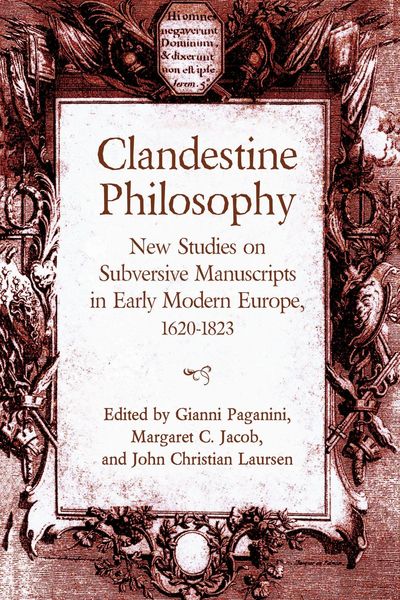
Clandestine Philosophy New Studies on Subversive Manuscripts in Early Modern Europe, 1620-1823
-
- Englisch ausgewählt
68,99 €
UVP
79,20 €
inkl. gesetzl. MwSt.,
Beschreibung
Produktdetails
Einband
Gebundene Ausgabe
Erscheinungsdatum
11.02.2020
Abbildungen
20 b&w illustrations
Herausgeber
Gianni Paganini + weitereVerlag
University of Toronto PressSeitenzahl
448
Maße (L/B/H)
23,1/15,5/3,8 cm
Gewicht
748 g
Sprache
Englisch
ISBN
978-1-4875-0461-8
Clandestine philosophical manuscripts, made up of forbidden works including erotic texts, political pamphlets, satires of court life, forbidden religious texts, and books about the occult, had an avid readership in the seventeenth and eighteenth centuries, becoming objects of historical research by the twentieth century. The purveyors of the clandestine could be found in the Dutch Republic, Switzerland, Denmark, Spain, and not least in Paris or London. Despite the heavy risks, including prison, the circulation of these manuscripts was a prosperous venture.
After Ira Wade’s pioneering contribution (1938), Clandestine Philosophy is the first work in English entirely focused on the philosophical clandestine manuscripts that preceded and accompanied the birth of the Enlightenment. Topics from philosophy, political and religious thought, and moral and sexual behaviour are addressed by contemporary authors working in both America and Europe. These manuscripts shed light on the birth of pornography and provide an important avenue for investigating philosophical, religious, political, and social critique.
Noch keine Bewertungen vorhanden
Verfassen Sie die erste Bewertung zu diesem Artikel
Helfen Sie anderen Kundinnen und Kunden durch Ihre Meinung.
Kurze Frage zu unserer Seite
Vielen Dank für Ihr Feedback
Wir nutzen Ihr Feedback, um unsere Produktseiten zu verbessern. Bitte haben Sie Verständnis, dass wir Ihnen keine Rückmeldung geben können. Falls Sie Kontakt mit uns aufnehmen möchten, können Sie sich aber gerne an unseren Kund*innenservice wenden.
zum Kundenservice