KI-Beratung Beta

Gutscheinbedingungen

**Gültig bis 30.11.2026 auf Spielzeug, Schreibwaren, Filme, Geschenke & Trends, Musik, tolino eReader & Zubehör, Hörbücher und Hörbuch-Downloads, nicht preisgebundene Bücher und Kalender online auf thalia.at und in der Thalia App. Einzelne Artikel können ausgeschlossen sein. Aufgrund der Buchpreisbindung sind deutschsprachige Bücher und eBooks ausgenommen. Zusätzlich ausgenommen sind Abos & Flatrates, Games, Geschenkkarten/-boxen, Shelfies, Software, Zeitschriften sowie einzelne Artikel von tonies®. Pro Einkauf einmal einlösbar. Nur gültig mit im Onlineshop hinterlegter Bonuscard. Click & Collect nur bei Onlinevorabzahlung möglich. Keine Barauszahlung. Nicht kombinierbar mit anderen Aktionen und Gutscheinen. Gutschein wird auf max. 500€ Bestellwert angerechnet. Nicht gültig für Versandkosten und Services.

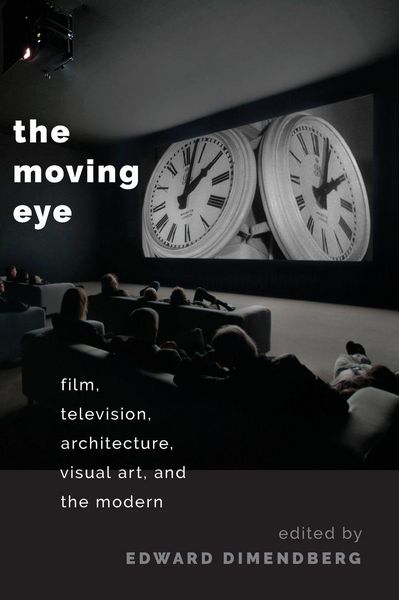
  • Produktbild: The Moving Eye
  • Produktbild: The Moving Eye

The Moving Eye

271,99 €

inkl. gesetzl. MwSt., Versandkostenfrei


Beschreibung

Once the province of film and media scholars, today the moving image is of broad concern to historians of art and architecture and designers of everything from websites to cities. As museums and galleries devote increasing space to video installations which no longer presuppose a fixed viewer, urban...

Beschreibung

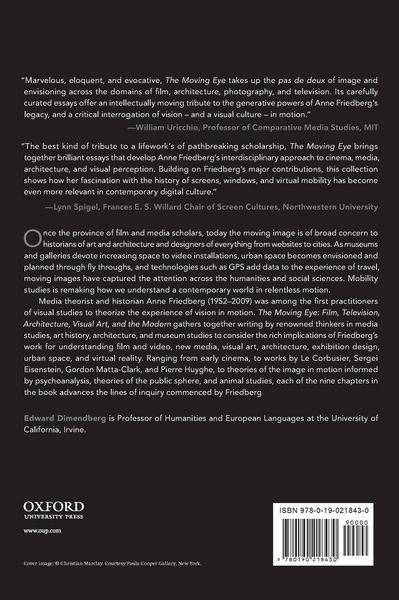
Once the province of film and media scholars, today the moving image is of broad concern to historians of art and architecture and designers of everything from websites to cities. As museums and galleries devote increasing space to video installations which no longer presuppose a fixed viewer, urban space becomes envisioned and planned through "fly throughs," and technologies such as GPS add data to the experience of travel, moving images have captured the attention of geographers and scholars across the humanities and social sciences. Their practice of "mobility studies" is remaking how we understand a contemporary world in relentless motion. Media theorist and historian Anne Friedberg (1952-2009) was among the first practitioners of visual studies to theorize the experience of vision in motion. Her books have become key points of reference in the discussion of the windows that frame images and the viewers in motion who perceive them. Although widely influential beyond her own discipline, Friedberg's work has never been the subject of an extended study. The Moving Eye: Film, Television, Architecture, Visual Art and the Modern gathers together essays by renowned thinkers in media studies, art history, architecture, and museum studies to consider the rich implications of her work for understanding film and video, new media, visual art, architecture, exhibition design, urban space, and virtual reality. Ranging from early cinema, to works by Le Corbusier, Sergei Eisenstein, Gordon Matta-Clark, and Pierre Huyghe, to theories of the image in motion informed by psychoanalysis, theories of the public sphere, and animal studies, each of the nine essays in the book advances the lines of inquiry commenced by Friedberg.

Produktdetails

Einband

Gebundene Ausgabe

Erscheinungsdatum

12.07.2012

Herausgeber Dimendberg Edward
Verlag Oxford Academic

Produktdetails

Einband

Gebundene Ausgabe

Erscheinungsdatum

12.07.2012

Herausgeber Dimendberg Edward
Verlag Oxford Academic
Seitenzahl

180

Maße (L/B/H)

26/18,3/1,4 cm

Gewicht

483 g

Sprache

Englisch

ISBN

978-0-19-021843-0

Herstelleradresse

Libri GmbH
Europaallee 1
36244 Bad Hersfeld
DE

Email: gpsr@libri.de

Noch keine Bewertungen vorhanden

Verfassen Sie die erste Bewertung zu diesem Artikel

Helfen Sie anderen Kundinnen und Kunden durch Ihre Meinung.

Kundinnen und Kunden meinen

Bewertungen (0)

Die Leseprobe wird geladen.
  • Produktbild: The Moving Eye
  • Produktbild: The Moving Eye
    • Introduction: Edward Dimendberg
    • Chapter 1. Moving Through Friedberg's Properly Adjusted Virtual Window: Tom Gunning
    • Chapter 2. Psychoanalysis Discovers Film Theory: Anne Friedberg and Close Up: Christa Blümlinger
    • Chapter 3. Nicholas Ray's We Can't Go Home Again: Multiple Windows in a Delirious Time Machine: Patricia Pisters
    • Chapter 4. The Eisenstein Effect: Architecture and Narrative Montage in Eisenstein and Le Corbusier: Anthony Vidler
    • Chapter 5. Max Ophuls and Instant Messaging: Reframing Cinema and Publicness: Miriam Hansen
    • Chapter 6. The Open Box: Umberto Eco, Achille Castiglioni and the Architecture of Television: Sylvia Lavin
    • Chapter 7. Windows on a Broken World: Gordon Matta-Clark's photographs of public housing in New York: Gwendolyn Owens (
    • Chapter 8. Sites of Screening: Cinema, Museum, and the Art of Projection: Giuliana Bruno
    • Chapter 9. Humans becoming Animals: On Sensorimotor Affection: Gertrud Koch
    • Bibliography of Writings by Anne Friedberg
    • Contributor Biographies
    • Index