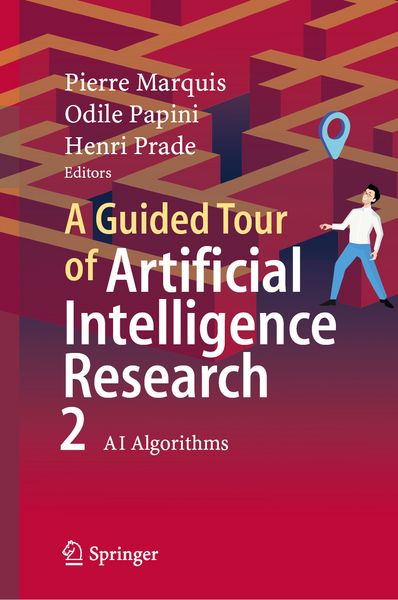
A Guided Tour of Artificial Intelligence Research Volume II: AI Algorithms
-
Sprache:Englisch
-
Auflage:1st ed. 2020
179,99 €
inkl. gesetzl. MwSt.,
Beschreibung
Produktdetails
Einband
Gebundene Ausgabe
Erscheinungsdatum
09.05.2020
Abbildungen
XV, 121 illus., 25 illus. in color., farbige Illustrationen, schwarz-weiss Illustrationen
Herausgeber
Pierre Marquis + weitereVerlag
SpringerSeitenzahl
523
Maße (L/B/H)
24,1/16/3,3 cm
Gewicht
1018 g
Auflage
1st ed. 2020
Sprache
Englisch
ISBN
978-3-030-06166-1
The purpose of this book is to provide an overview of AI research, ranging from basic work to interfaces and applications, with as much emphasis on results as on current issues. It is aimed at an audience of master students and Ph.D. students, and can be of interest as well for researchers and engineers who want to know more about AI. The book is split into three volumes:
- the first volume brings together twenty-three chapters dealing with the foundations of knowledge representation and the formalization of reasoning and learning (Volume 1. Knowledge representation, reasoning and learning)
- the second volume offers a view of AI, in fourteen chapters, from the side of the algorithms (Volume 2. AI Algorithms)
- the third volume, composed of sixteen chapters, describes the main interfaces and applications of AI (Volume 3. Interfaces and applications of AI).
This second volume presents the main families of algorithms developed or used in AI to learn, to infer, to decide. Generic approaches to problem solving are presented: ordered heuristic search, as well as metaheuristics are considered. Algorithms for processing logic-based representations of various types (first-order formulae, propositional formulae, logic programs, etc.) and graphical models of various types (standard constraint networks, valued ones, Bayes nets, Markov random fields, etc.) are presented. The volume also focuses on algorithms which have been developed to simulate specific ‘intelligent” processes such as planning, playing, learning, and extracting knowledge from data. Finally, an afterword draws a parallel between algorithmic problems in operation research and in AI.
Noch keine Bewertungen vorhanden
Verfassen Sie die erste Bewertung zu diesem Artikel
Helfen Sie anderen Kundinnen und Kunden durch Ihre Meinung.
Kurze Frage zu unserer Seite
Vielen Dank für Ihr Feedback
Wir nutzen Ihr Feedback, um unsere Produktseiten zu verbessern. Bitte haben Sie Verständnis, dass wir Ihnen keine Rückmeldung geben können. Falls Sie Kontakt mit uns aufnehmen möchten, können Sie sich aber gerne an unseren Kund*innenservice wenden.
zum Kundenservice