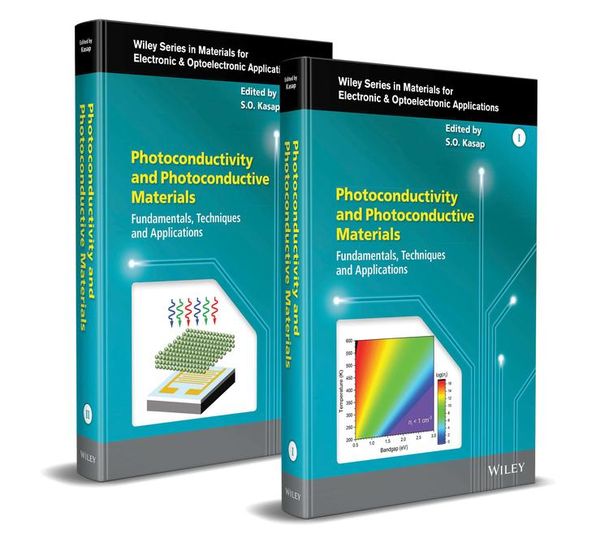
Photoconductivity and Photoconductive Materials, 2 Volume Set Fundamentals, Techniques and Applications
-
- Englisch ausgewählt
451,99 €
inkl. gesetzl. MwSt.,
Beschreibung
Produktdetails
Einband
Gebundene Ausgabe
Erscheinungsdatum
06.07.2022
Herausgeber
Safa O Kasap + weitereVerlag
John Wiley & Sons IncSeitenzahl
912
Maße (L/B/H)
24,4/17/5,4 cm
Gewicht
2013 g
Auflage
1. Auflage
Sprache
Englisch
ISBN
978-1-119-57911-3
Dieses wichtige Referenzwerk behandelt die grundlegenden Konzepte der Photoleitfähigkeit und der photoleitenden Materialien. Mit Photoconductivity and Photoconductive Materials präsentiert Professor Kasap eine maßgebliche Zusammenstellung der wesentlichen Grundsätze der Photoleitfähigkeit und stellt eine Auswahl aktueller photoleitfähiger Materialien vor. Der erste Band des zweibändigen Werks beginnt mit einer Darstellung der grundlegenden Konzepte und Definitionen. Es folgt eine Charakterisierung der verschiedenen Techniken auf Grundlage von stationärer, transienter und modulierter Photoleitfähigkeit, u.a. der neuen Methode der Ladungsextraktion durch linear steigende Spannung (CELIV). Auch die Physik der Terahertz-Photoleitfähigkeit sowie die Grundlagen der organischen Halbleiter LSoI werden behandelt. Der zweite Band beginnt mit einem umfassenden Überblick über eine Vielzahl unterschiedlicher photoleitfähiger Materialien, wobei der Schwerpunkt auf einige der wichtigsten Photoleiter gelegt wird, darunter hydriertes amorphes Silizium, Cadmium-Quecksilber-Tellurid, verschiedene Röntgenphotoleiter, Diamantfilme, Metallhalogenidperowskite, Nanodrähte und Quantenpunkte. Auch die Anwendungen der photoleitenden Antenne werden erörtert. Das Werk, das zahlreiche Beiträge führender Autoren auf diesem Fachgebiet enthält, bietet den Leserinnen und Lesern außerdem: * Eine gründliche Einführung in die Charakterisierung von Halbleitern mit Hilfe von Techniken der Photoleitfähigkeit, insbesondere gleichmäßiger Beleuchtung und Phototräger-Gittertechniken * Eine umfassende Darstellung organischer Photoleiter mitsamt Informationen zu Photoerzeugung, Transport und Anwendungen im Druckbereich * Praktische Erörterungen der transienten Lichtleitfähigkeit im Flugzeitverfahren inklusive Experimentiertechniken und Interpretationshinweisen * Eine eingehende Betrachtung der transienten Photoleitfähigkeit organischer Halbleiterschichten und neuartiger Techniken der transienten Photoleitfähigkeit Photoconductivity and Photoconductive Materials ist nicht nur ein wichtiges Referenzwerk für Physiker in der Forschung, Materialwissenschaftler und Elektroingenieure, sondern auch ein unverzichtbares Nachschlagewerk für Doktoranden und Studierende höherer Semester, die sich mit dem Bereich der optoelektronischen Materialien beschäftigen, sowie für Forschende in der Industrie. * Ein umfassendes zweibändiges Werk mit Beiträgen führender Fachautoren, herausgegeben von einem angesehenen Forscher auf dem Gebiet der Photoleitfähigkeit
Noch keine Bewertungen vorhanden
Verfassen Sie die erste Bewertung zu diesem Artikel
Helfen Sie anderen Kundinnen und Kunden durch Ihre Meinung.
Kurze Frage zu unserer Seite
Vielen Dank für Ihr Feedback
Wir nutzen Ihr Feedback, um unsere Produktseiten zu verbessern. Bitte haben Sie Verständnis, dass wir Ihnen keine Rückmeldung geben können. Falls Sie Kontakt mit uns aufnehmen möchten, können Sie sich aber gerne an unseren Kund*innenservice wenden.
zum Kundenservice