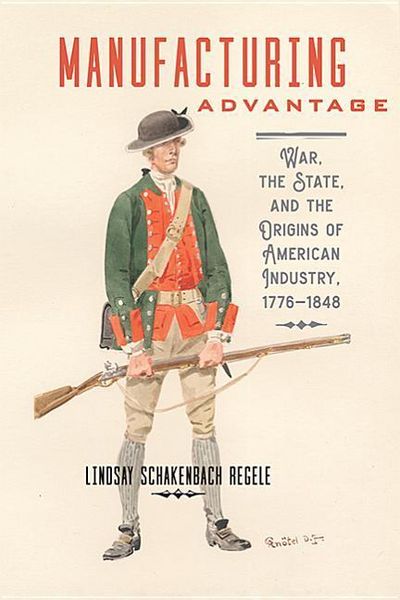
Manufacturing Advantage War, the State, and the Origins of American Industry, 1776-1848
69,99 €
inkl. gesetzl. MwSt.,
Beschreibung
Produktdetails
Einband
Gebundene Ausgabe
Erscheinungsdatum
19.02.2019
Abbildungen
schwarz-weiss Illustrationen
Verlag
Johns Hopkins University PressSeitenzahl
280
Maße (L/B/H)
23,1/15,7/2,5 cm
Gewicht
454 g
Sprache
Englisch
ISBN
978-1-4214-2525-2
How manufacturing textiles and guns transformed the United States from colonial dependent to military power.
In 1783, the Revolutionary War drew to a close, but America was still threatened by enemies at home and abroad. The emerging nation faced tax rebellions, Indian warfare, and hostilities with France and England. Its arsenal--a collection of hand-me-down and beat-up firearms--was woefully inadequate, and its manufacturing sector was weak. In an era when armies literally froze in the field, military preparedness depended on blankets and jackets, the importation of which the British Empire had coordinated for over 200 years. Without a ready supply of guns, the new nation could not defend itself; without its own textiles, it was at the economic mercy of the British. Domestic industry offered the best solution for true economic and military independence.
In Manufacturing Advantage, Lindsay Schakenbach Regele shows how the US government promoted the industrial development of textiles and weapons to defend the country from hostile armies--and hostile imports. Moving from the late 1700s through the Mexican-American War, Schakenbach Regele argues that both industries developed as a result of what she calls "national security capitalism" a mixed enterprise system in which government agents and private producers brokered solutions to the problems of war and international economic disparities. War and State Department officials played particularly key roles in the emergence of American industry, facilitating arms makers and power loom weavers in the quest to develop industrial resources. And this defensive strategy, Schakenbach Regele reveals, eventually evolved to promote westward expansion, as well as America's growing commercial and territorial empire.
Examining these issues through the lens of geopolitics, Manufacturing Advantage places the rise of industry in the United States in the context of territorial expansion, diplomacy, and warfare. Ultimately, the book reveals the complex link between government intervention and private initiative in a country struggling to create a political economy that balanced military competence with commercial needs.
Noch keine Bewertungen vorhanden
Verfassen Sie die erste Bewertung zu diesem Artikel
Helfen Sie anderen Kundinnen und Kunden durch Ihre Meinung.
Kurze Frage zu unserer Seite
Vielen Dank für Ihr Feedback
Wir nutzen Ihr Feedback, um unsere Produktseiten zu verbessern. Bitte haben Sie Verständnis, dass wir Ihnen keine Rückmeldung geben können. Falls Sie Kontakt mit uns aufnehmen möchten, können Sie sich aber gerne an unseren Kund*innenservice wenden.
zum Kundenservice