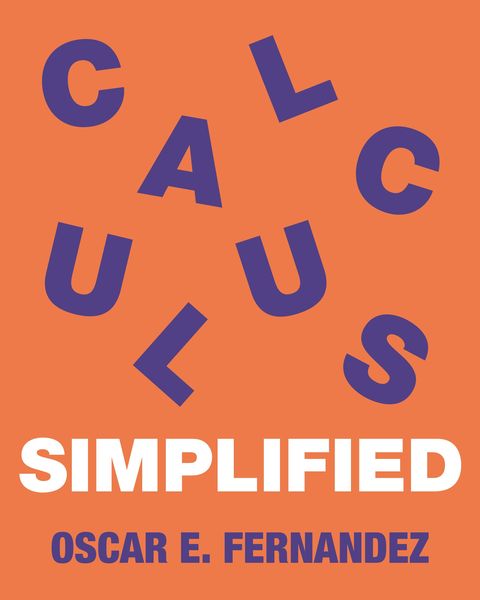
Calculus Simplified
-
- Taschenbuch ausgewählt
- eBook
-
Sprache:Englisch
24,99 €
inkl. gesetzl. MwSt.,
- Kostenlose Lieferung ab 30 € Einkaufswert
- Versandkostenfrei für Bonuscard-Kund*innen
Beschreibung
Produktdetails
Einband
Taschenbuch
Erscheinungsdatum
11.06.2019
Verlag
Princeton University PressSeitenzahl
272
Maße (L/B/H)
25,4/20,5/1,9 cm
Gewicht
647 g
Sprache
Englisch
ISBN
978-0-691-17539-3
An accessible, streamlined, and user-friendly approach to calculus
Calculus is a beautiful subject that most of us learn from professors, textbooks, or supplementary texts. Each of these resources has strengths but also weaknesses. In Calculus Simplified, Oscar Fernandez combines the strengths and omits the weaknesses, resulting in a "Goldilocks approach" to learning calculus: just the right level of detail, the right depth of insights, and the flexibility to customize your calculus adventure. Fernandez begins by offering an intuitive introduction to the three key ideas in calculus--limits, derivatives, and integrals. The mathematical details of each of these pillars of calculus are then covered in subsequent chapters, which are organized into mini-lessons on topics found in a college-level calculus course. Each mini-lesson focuses first on developing the intuition behind calculus and then on conceptual and computational mastery. Nearly 200 solved examples and more than 300 exercises allow for ample opportunities to practice calculus. And additional resources--including video tutorials and interactive graphs--are available on the book's website. Calculus Simplified also gives you the option of personalizing your calculus journey. For example, you can learn all of calculus with zero knowledge of exponential, logarithmic, and trigonometric functions--these are discussed at the end of each mini-lesson. You can also opt for a more in-depth understanding of topics--chapter appendices provide additional insights and detail. Finally, an additional appendix explores more in-depth real-world applications of calculus. Learning calculus should be an exciting voyage, not a daunting task. Calculus Simplified gives you the freedom to choose your calculus experience, and the right support to help you conquer the subject with confidence. - An accessible, intuitive introduction to first-semester calculus - Nearly 200 solved problems and more than 300 exercises (all with answers) - No prior knowledge of exponential, logarithmic, or trigonometric functions required - Additional online resources--video tutorials and supplementary exercises--providedNoch keine Bewertungen vorhanden
Verfassen Sie die erste Bewertung zu diesem Artikel
Helfen Sie anderen Kundinnen und Kunden durch Ihre Meinung.
Kurze Frage zu unserer Seite
Vielen Dank für Ihr Feedback
Wir nutzen Ihr Feedback, um unsere Produktseiten zu verbessern. Bitte haben Sie Verständnis, dass wir Ihnen keine Rückmeldung geben können. Falls Sie Kontakt mit uns aufnehmen möchten, können Sie sich aber gerne an unseren Kund*innenservice wenden.
zum Kundenservice