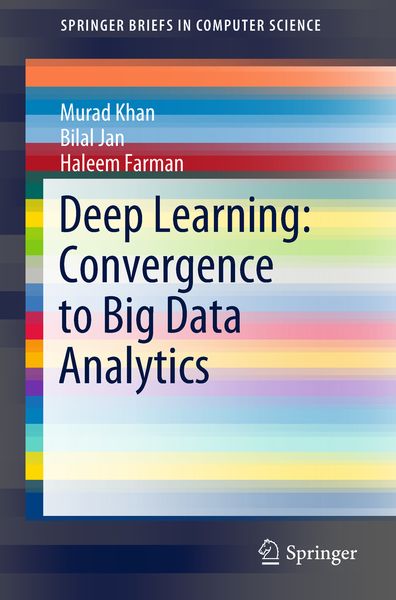
Deep Learning: Convergence to Big Data Analytics
-
- Taschenbuch ausgewählt
- eBook
-
Sprache:Englisch
66,99 €
UVP
76,99 €
inkl. gesetzl. MwSt.,
Beschreibung
Produktdetails
Einband
Taschenbuch
Erscheinungsdatum
10.01.2019
Abbildungen
XVI, 79 p. 27 illus., 18 illus. in color.
Verlag
Springer SingaporeSeitenzahl
79
Maße (L/B/H)
23,5/15,5/0,6 cm
Gewicht
180 g
Auflage
1st edition 2019
Sprache
Englisch
ISBN
978-981-13-3458-0
This book presents deep learning techniques, concepts, and algorithms to classify and analyze big data. Further, it offers an introductory level understanding of the new programming languages and tools used to analyze big data in real-time, such as Hadoop, SPARK, and GRAPHX. Big data analytics using traditional techniques face various challenges, such as fast, accurate and efficient processing of big data in real-time. In addition, the Internet of Things is progressively increasing in various fields, like smart cities, smart homes, and e-health. As the enormous number of connected devices generate huge amounts of data every day, we need sophisticated algorithms to deal, organize, and classify this data in less processing time and space. Similarly, existing techniques and algorithms for deep learning in big data field have several advantages thanks to the two main branches of the deep learning, i.e. convolution and deep belief networks. This book offers insights into these techniques and applications based on these two types of deep learning.
Further, it helps students, researchers, and newcomers understand big data analytics based on deep learning approaches. It also discusses various machine learning techniques in concatenation with the deep learning paradigm to support high-end data processing, data classifications, and real-time data processing issues.
The classification and presentation are kept quite simple to help the readers and students grasp the basics concepts of various deep learning paradigms and frameworks. It mainly focuses on theory rather than the mathematical background of the deep learning concepts. The book consists of 5 chapters, beginning with an introductory explanation of big data and deep learning techniques, followed by integration of big data and deep learning techniques and lastly the future directions.
Noch keine Bewertungen vorhanden
Verfassen Sie die erste Bewertung zu diesem Artikel
Helfen Sie anderen Kundinnen und Kunden durch Ihre Meinung.
Kurze Frage zu unserer Seite
Vielen Dank für Ihr Feedback
Wir nutzen Ihr Feedback, um unsere Produktseiten zu verbessern. Bitte haben Sie Verständnis, dass wir Ihnen keine Rückmeldung geben können. Falls Sie Kontakt mit uns aufnehmen möchten, können Sie sich aber gerne an unseren Kund*innenservice wenden.
zum Kundenservice