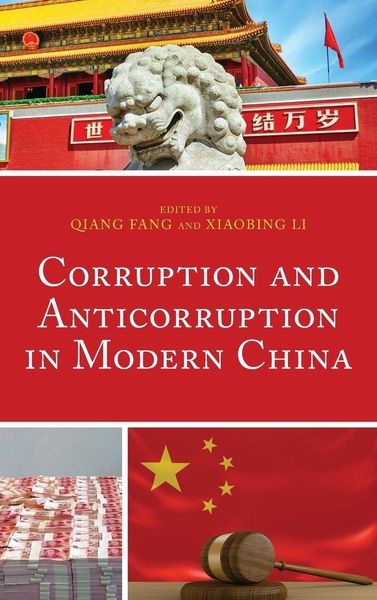
Corruption and Anticorruption in Modern China
176,99 €
inkl. gesetzl. MwSt.,
Beschreibung
Produktdetails
Einband
Gebundene Ausgabe
Erscheinungsdatum
20.12.2018
Herausgeber
Qiang Fang + weitereVerlag
Ingram Publishers ServicesSeitenzahl
398
Maße (L/B/H)
23,5/15,7/2,8 cm
Gewicht
667 g
Sprache
Englisch
ISBN
978-1-4985-7431-0
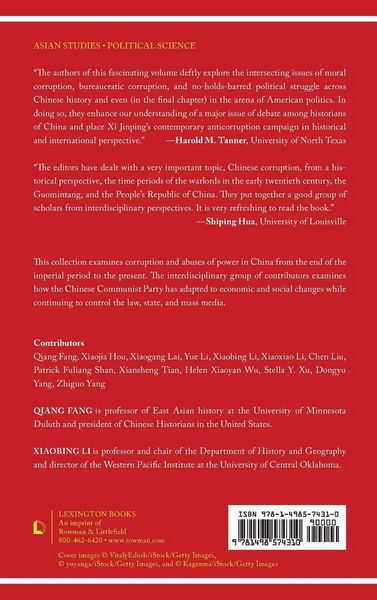
Corruption and Anti-Corruption in Modern China collects essays from the scholars in their fields and examines the ongoing corruption in China by addressing this important topic from a historical perspective through a cooperative interdisciplinary research effort among Chinese-American scholars interested in the subject. Their scholarship makes a significant contribution through multi-faceted components from different fields such as history, economics, political science, criminal justice, and popular culture. The authors introduce and explore the theory and practice of policy patterns, political systems, and social institutions by identifying key issues in Chinese government and society contained within the larger framework of the international sphere. This book describes a historical transition when the Chinese Communist Party (CCP) maintained its forceful control of cities while the middle class reluctantly sacrificed its rights in exchange for retaining their economic benefits. To survive market economy, the party leadership became more flexible and was able to adapt to economic and social change. The CCP governments in our research responded to the rising demands and expectations of the society. They were willing and able to cope with the middle class by making a few compromises and following certain legal procedures in exchange for continuing political support. These practical comprises characterized a new political culture in PRC history since 1949. The book voices the complaints and resentments in the cities, and interprets government policies and legal practices. It emphasizes the consequence for governance, human rights, and commercial rule of law, all of which threatens the legitimacy of the CCP. It also suggests an important evolution of the CCP. The reform movement since the 1980s has not yet contributed significantly to the country’s democratic transformation or to its social stability. The leaders in the 1990s focused on liberal economic reform while discouraging and even stifling political reform. As a result, economic interest groups successfully established an alliance with CCP officials to control economic policy-making and to share political governance. In the 2010s, Chinese leaders have paid special attention to political scandals, corruption, and mismanagement in the government and in the Party.
Noch keine Bewertungen vorhanden
Verfassen Sie die erste Bewertung zu diesem Artikel
Helfen Sie anderen Kundinnen und Kunden durch Ihre Meinung.
Kurze Frage zu unserer Seite
Vielen Dank für Ihr Feedback
Wir nutzen Ihr Feedback, um unsere Produktseiten zu verbessern. Bitte haben Sie Verständnis, dass wir Ihnen keine Rückmeldung geben können. Falls Sie Kontakt mit uns aufnehmen möchten, können Sie sich aber gerne an unseren Kund*innenservice wenden.
zum Kundenservice