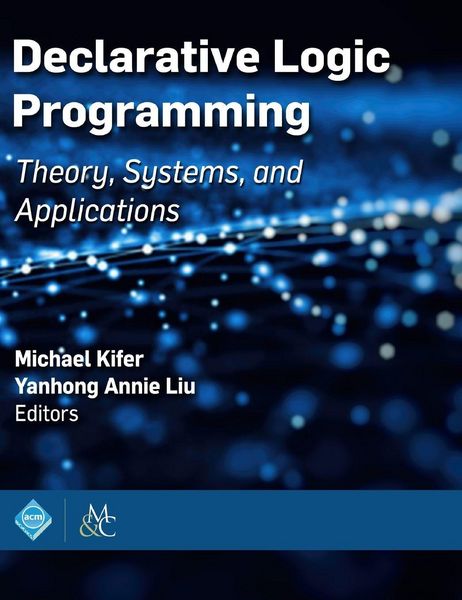
Declarative Logic Programming Theory, Systems, and Applications
-
- Hardcover ausgewählt
- Taschenbuch
- eBook
-
Sprache:Englisch
108,99 €
UVP
125,40 €
inkl. gesetzl. MwSt.,
Beschreibung
Produktdetails
Einband
Gebundene Ausgabe
Erscheinungsdatum
19.09.2018
Verlag
ACM BooksSeitenzahl
615
Maße (L/B/H)
24,1/19,6/3,7 cm
Gewicht
1327 g
Sprache
Englisch
ISBN
978-1-970001-99-0
Logic Programming (LP) is at the nexus of Knowledge Representation, Artificial Intelligence, Mathematical Logic, Databases, and Programming Languages. It is fascinating and intellectually stimulating due to the fundamental interplay among theory, systems, and applications brought about by logic. Logic programs are more declarative in the sense that they strive to be logical specifications of "what" to do rather than "how" to do it, and thus they are high-level and easier to understand and maintain. Yet, without being given an actual algorithm, LP systems implement the logical specifications automatically.
Several books cover the basics of LP but focus mostly on the Prolog language with its incomplete control strategy and non-logical features. At the same time, there is generally a lack of accessible yet comprehensive collections of articles covering the key aspects in declarative LP. These aspects include, among others, well-founded vs. stable model semantics for negation, constraints, object-oriented LP, updates, probabilistic LP, and evaluation methods, including top-down vs. bottom-up, and tabling.
For systems, the situation is even less satisfactory, lacking accessible literature that can help train the new crop of developers, practitioners, and researchers. There are a few guides onWarren's Abstract Machine (WAM), which underlies most implementations of Prolog, but very little exists on what is needed for constructing a state-of-the-art declarative LP inference engine. Contrast this with the literature on, say, Compilers, where one can first study a book on the general principles and algorithms and then dive in the particulars of a specific compiler. Such resources greatly facilitate the ability to start making meaningful contributions quickly. There is also a dearth of articles about systems that support truly declarative languages, especially those that tie into first-order logic, mathematical programming, and constraint solving.
LP helps solve challenging problems in a wide range of application areas, but in-depth analysis of their connection with LP language abstractions and LP implementation methods is lacking. Also, rare are surveys of challenging application areas of LP, such as Bioinformatics, Natural Language Processing, Verification, and Planning.
The goal of this book is to help fill in the previously mentioned void in the LP literature. It offers a number of overviews on key aspects of LP that are suitable for researchers and practitioners as well as graduate students. The following chapters in theory, systems, and applications of LP are included.
Kundinnen und Kunden meinen
Verfassen Sie die erste Bewertung zu diesem Artikel
Helfen Sie anderen Kund*innen durch Ihre Meinung
Kurze Frage zu unserer Seite
Vielen Dank für Ihr Feedback
Wir nutzen Ihr Feedback, um unsere Produktseiten zu verbessern. Bitte haben Sie Verständnis, dass wir Ihnen keine Rückmeldung geben können. Falls Sie Kontakt mit uns aufnehmen möchten, können Sie sich aber gerne an unseren Kund*innenservice wenden.
zum Kundenservice